A fast quote means nothing if your tech pack is vague. Price, lead time, and bulk quality all become fake precision. This guide covers how to source clothing from China as an operator, drawn from 42 factory screenings and 17 sample rounds, plus the inspection reports that followed.
Disclosure: LeelineGroup sells sourcing and inspection services. This guide reflects our own view as a vendor. No factory paid to appear here.
A first run is hard. Plan 80 to 110 days from kickoff to ship date: 2 to 3 weeks of supplier screening, 3 to 4 weeks of sample rounds, and 45 to 60 days of bulk production. Booking fabric during sampling can save about two weeks.
This guide gives you a repeatable process for custom apparel manufacturing in China: factory verification, fabric-roll intake, a locked POM tolerance, sampling gates, and AQL decisions. The scope is garment sourcing and production control, not generic proxy buying.
Key Takeaways
The short version of the eight-step process in this guide:
- Lock the tech pack first. A vague spec turns every quote into a guess, so build the POM chart, tolerances, and grade rules before you ask for a price.
- Name the sourcing model early. CMT, full-package, and ODM change who owns fabric, patterns, and trims, and that choice drives your MOQ.
- Shortlist by process, not prestige. Pick 3 to 5 factories that already run your garment category, then send every one the same locked brief.
- Verify the legal entity and the floor. Confirm the business license lists manufacturing, and watch the cutting room in use, not just the sample rack.
- Gate the fabric before you cut. Weigh and wash-test a swatch from every lot, and reject any roll that reads light or fails shrinkage, colorfastness, or GSM.
- Approve on evidence, not promises. Run three sample rounds and a three-point QC, then lock zero critical defects, majors at AQL 2.5, and minors at AQL 4.0.
Prerequisites

This is the pack I assemble before I request a single quote.
- Business case: Style list, color/size quantities, target market, price band, lead time, and Incoterm preference.
- Technical docs: Draft tech pack, BOM, grading logic, packaging spec, and an inspection plan under AQL 1.5/2.5.
- Access and budget: A signed NDA/NNN, one approved email channel, a sample budget, a testing budget, and a clear decision-maker sign-off path.
- Compliance: Never approve fabric or labels from a screenshot. Require physical swatches and cut only after shrinkage, colorfastness, and GSM pass. Childwear and skin-contact garments need tighter screening.
- Timeline: 2 to 3 weeks supplier screening, 3 to 4 weeks sample rounds, 45 to 60 days bulk production.
Your sourcing manager should own the NDA, and your QA lead should sign every inspection report. Nobody approves a cut from a screenshot.
Legal rules versus voluntary labels. OEKO-TEX is a voluntary label, not a law. For the US, all clothing must meet the 16 CFR 1610 flammability rule, and labels must show fiber content, country of origin, and care instructions under FTC rules. Kidswear for ages 12 and under needs CPSIA lab testing, a Children’s Product Certificate, tracking labels, and no neck drawstrings on tops.
For the EU, check REACH restrictions on azo dyes and nickel trims, plus the textile labelling rule, the GPSR, and EN 14682 for children’s cords.
The test most brands skip: a first-wash shrink test. Confirm shrinkage on a swatch from each lot before you cut. A run that shrinks after the first wash comes back as returns, and that cost lands on you, not the factory.
The Operator Playbook: How the 8 Steps Fit Together
Skip the traders and the fake factories. What follows is the eight-step sequence I run, with a three-point QC system and AQL 2.5 gates.
Step 1: Lock the Sourcing Model Before You Request a Quote

Once I name the sourcing model, the factory’s questions change. ODM factories ask about design. CMT factories ask about fabric and pattern. Stock suppliers ask about SKU and color. That reaction tells you what the factory actually does. Use this table as your commercial filter.
| Model | Fabric sourcing owner | Pattern/grading owner | Trims owner | Compliance risk | MOQ pressure |
|---|---|---|---|---|---|
| CMT | Buyer | Buyer or agent | Buyer | High | Medium |
| Full-package/FOB | Factory | Factory | Factory | Medium | High |
| ODM adaptation | Factory, buyer approves | Factory | Factory | Medium | Medium-high |
| Wholesale stock | Supplier | Supplier | Supplier | Low-medium | Low |
MOQ follows the model. Full custom carries the highest minimums, commonly a few hundred to around 1,000 units per style and color. Stock-style or light OEM adaptation can sometimes support smaller runs. Ask early, because MOQ is where most direct deals stall. For the full breakdown, see how MOQ works in China sourcing.
A China clothing manufacturer sourcing agent earns their fee on multi-factory search, translation, consolidation, and on-the-ground QC. The decision rule is simple: if you lack a locked spec and the bandwidth to manage a factory, use an agent or sourcing team as your primary method.
Direct factory management is the alternative for experienced teams. If you go the agent route, compare teams on a China sourcing agent comparison.
Done when: you know your target model, your acceptable MOQ range, and whether you need agent support.
A note on CMT: CMT can look cheaper per unit because you buy the fabric and trims yourself. The hidden cost is coordination. Chasing fabric and trim approvals can add weeks, and a few weeks of delay usually outruns the per-unit saving.
Step 2: Lock the Tech Pack Before You Ask for Price
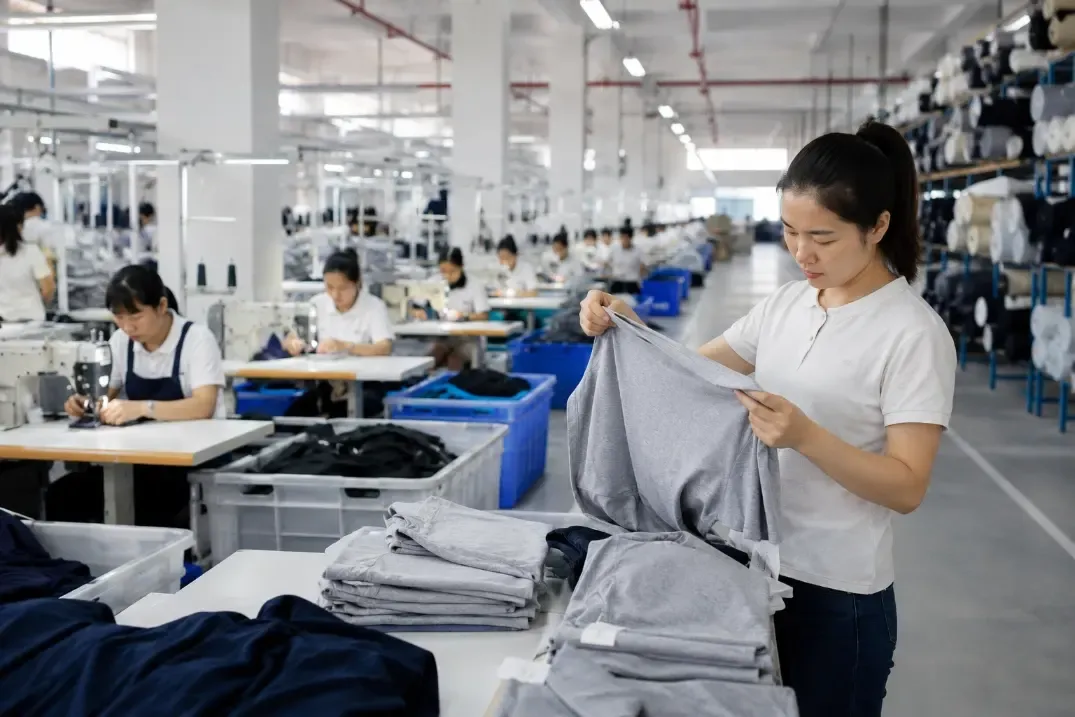
With a locked spec, the back-and-forth stops. Quotes come back faster, feedback points to one measurement instead of ten, and the line knows what to cut, sew, measure, and pack. Treat the tech pack as both your pricing brief and your production control document.
Include these minimum items: flat sketches, construction details, fabric composition, target GSM, wash and finish requirements, size range, point-of-measure chart, tolerance per POM, grade rules for each size jump, trim specs, label placement, artwork files, and packaging and folding instructions.
Use this grading checklist for China apparel:
- POM code.
- Measurement method.
- Base size.
- Tolerance.
- Grade increments.
- Unit system consistency.
Two pitfalls I see constantly: reference photos instead of a spec, and “cotton” named with no composition or GSM. As Apparel Manufacturer Molly Han explains, without grade rules a factory grades to its own base pattern and rounds tolerances to its default. That is the exact risk a locked pack removes.
For body-size ranges, start from a published ASTM body-size standard such as D5585 for women or D6240 for men, then apply each brand’s own grade rules.
Done when: every supplier quotes the same spec, and every POM has a method, a base size, a tolerance, and a grade rule.
Why grading fails in bulk: a factory that grades every size from a single base sample drifts further the farther it gets from that base. The largest sizes show it first. Catch it at the fit/PP sample, not in bulk.
Step 3: Cluster the Category and Shortlist 3 to 5 Factories
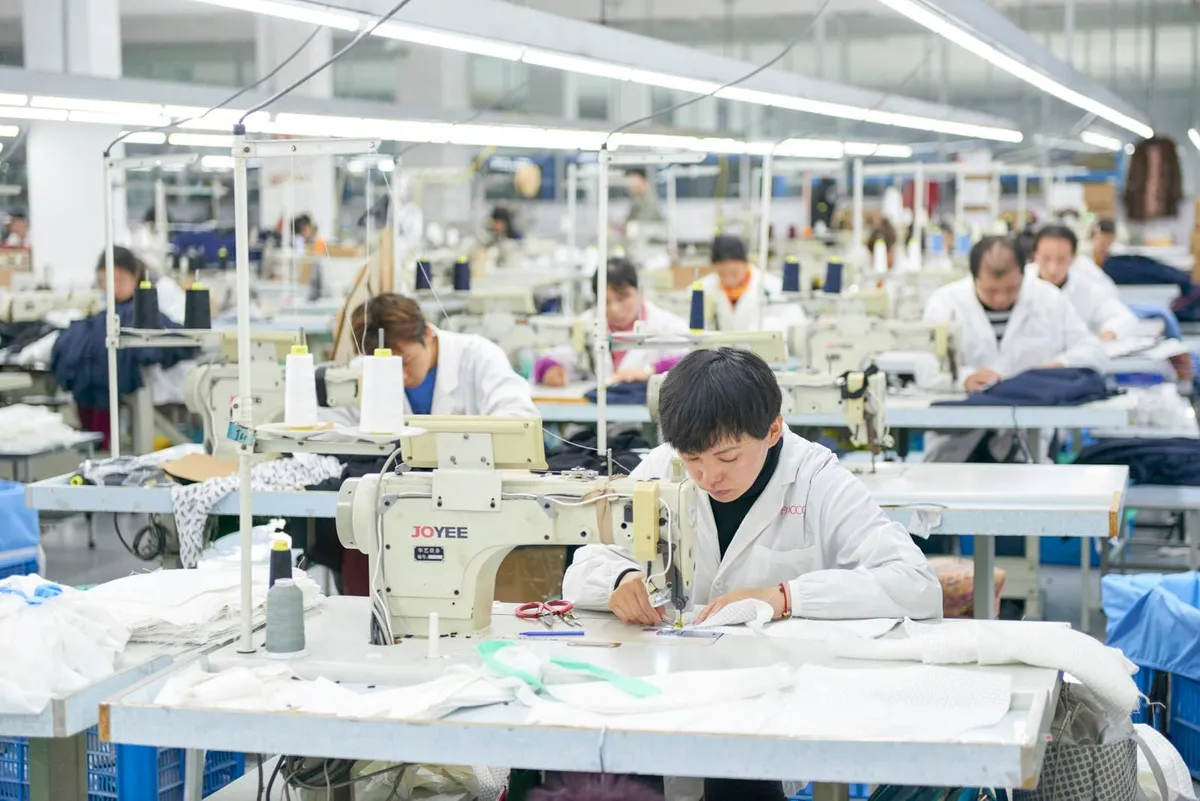
Start with a cluster map, then screen hard. Category fit beats city fame. Put the likely cluster for your garment on one line and the required process on the next.
| Garment category | Likely cluster | Typical strength |
|---|---|---|
| Fast women’s fashion | Guangzhou / Humen | Trend speed, woven tops, dresses |
| Sportswear | Fujian | Knit performance wear, activewear lines |
| Knitwear / sweaters | Zhejiang | Flat knit, sweater panels, yarn handling |
The city name alone doesn’t decide it. A factory in the right city but with the wrong process still quotes off and samples wrong. Match garment category, price band, and production process before you send the brief.
Ask every candidate for: legal company name, business license scope, main product category, export markets, MOQ by style, sample lead time, monthly capacity, machinery list, and in-house pattern making and grading.
Use a remote shortlist-and-screen first. If you are already in China, visit markets and fairs as a complement. Baima and Shisanhang in Guangzhou are good for trend discovery, but they are not proof of manufacturing capability. Use them to shortlist styles, then verify the actual line.
Keep outreach tight. Send the same locked brief to 5 to 7 factories and request comparable quotes from 3 to 5. Do not blast 40 suppliers. The reply tells you who is real, and it is the fastest way to find reliable suppliers in China. One supplier answers with precise line capability, down to needle types, seam types, and capacity by line. Another sends a catalog and generic promises. Shortlist the first.
Done when: you have 3 to 5 technically viable candidates, each quoting from the same brief and each naming a line, capacity, and sample lead time.
The right cluster is not the right line. A famous address tells you where a factory sits, not what it can sew. Before you treat city fame as proof, ask which line would run your style, what process it uses, and how many units it can hold per day. Match the process first, the postcode second.
Step 4: Audit the Factory Floor and Verify the Legal Entity

Start with the license, not the showroom. Search the company on China’s National Enterprise Credit Information Publicity System. The business scope must list manufacturing; trading-only means walk away. Then match the legal entity name across five documents: license, company chop, bank beneficiary, gate sign, and contract.
Ask three separating questions: who owns the cutting room, who employs the pattern makers, and which line would run your style.
Plan an on-site or live-video audit. A real garment floor is loud and busy: cutting tables, overlock machines, steam irons, thread dust on the floor, needle detectors at the end of each line, WIP carts moving between lines, and line boards showing output. If the floor is silent and empty, you are not looking at the factory that will make your order.
Your checklist: cutting room, spreading and cutting equipment, lockstitch, overlock, coverstitch, buttonhole and bar-tack machines, finishing and ironing, packing, warehouse segregation, and needle detection.
Require proof of process ownership: a sample room, grading and CAD, inline QC, defect logs, and a production board. A trader shows a catalog. A factory shows a line.
Compare types. A trading company has a polished office but no cutting room. A wholesale stall has samples but no pattern makers. A direct factory has both, plus a line board with your style number.
Watch for borrowed samples, off-site subcontracting, and mixed certificates. These are common supplier red flags. Check that the certificate name matches the legal entity.
Visit the floor if you can. If travel isn’t possible, book a live video walk and hire a third-party auditor to confirm what the camera showed. Our factory audit checklist lists what to bring and what to look for.
Done when: you can state whether this is a direct factory, a trader with subcontractors, or a hybrid, and whether that matches your strategy.
Watch the cutting room, not just the sample wall. One factory showed me a full sample rack but an empty cutting room; the work was subcontracted to a shed, and the PP sample missed tolerance. A sample rack proves they can sew a sample, not that they will run your line.
Step 5: Run the Three-Round Sample Approval

I never approve a sample from a photo. Photo-only approval misses fit problems a live fitting catches, especially at the shoulder and side seam. Book a live fit: a video call with the factory while a model wears the sample, or fit it on a body form in person. Both work. Photos do not.
Break the process into three rounds.
Proto sample: validates style and build. Check the pattern, the silhouette, and basic construction.
Fit/PP sample: validates sizing and construction. Lock it to your tech pack. Check POM measurements, tolerance pass or fail, fabric hand, print and embroidery placement, seam construction, trim function, label placement, and packaging details.
Golden sample: becomes the production reference. It must carry a version number and be attached to the PO or contract as the bulk benchmark.
Run a physical review. Look for twisting side seams, collar stretch, stitch bite, zipper drag, and shoulder imbalance. Feel the fabric hand. Do not skip this.
Why soft approvals cost the most: the single most expensive mistake in apparel sourcing is approving a PP sample that is slightly out of tolerance. Once bulk starts, you carry that miss across the whole run and usually end up replacing the supplier. Reject any PP sample outside tolerance, and hold the golden sample to the same standard.
Done when: the approved sample, the tolerance table, and the comments log all match, and no bulk launch happens until they do.
Step 6: Gate the Fabric: No Cutting Until Bulk Rolls Pass Incoming Checks
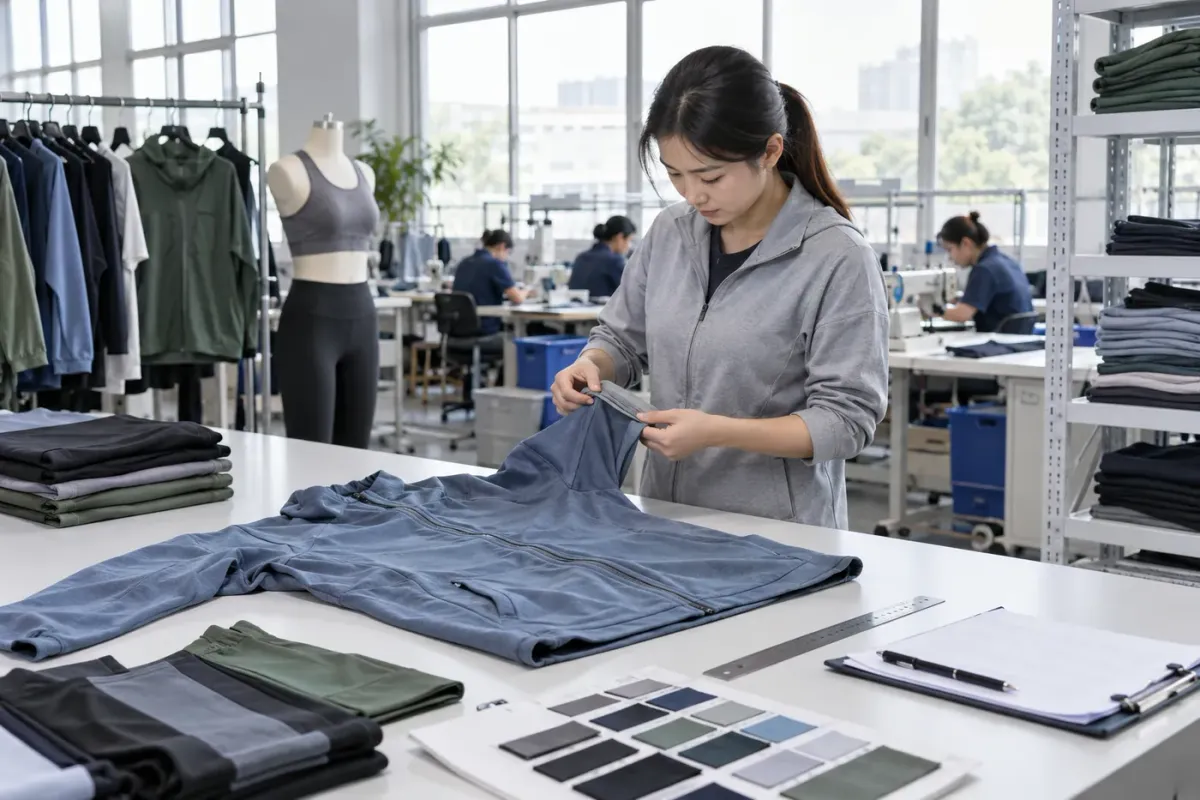
The cutting room is where substitution hides. A roll can look right in a photo and still feel lighter on the table, drape thinner, and shift shade against the next roll. Those are warning signs. The rule is plain: no cutting until bulk fabric passes incoming checks.
Run this fabric-roll intake SOP before releasing to cutting:
- Verify roll count against the packing list.
- Check the lot numbers; every roll must match.
- Inspect color consistency across rolls and look for shade shift.
- Measure width and weigh a swatch against the spec on an accurate scale. A roll that measures light is a swapped lot.
- Confirm composition documentation matches the signed sample.
- Run shrinkage and colorfastness tests on a swatch from each lot.
- Inspect for visible defects: holes, stains, and weaving errors.
Test methods matter. Run shrinkage under AATCC 135 or ISO 6330, wash colorfastness under AATCC 61 or ISO 105-C06, and check GSM with a round cutter and scale under ISO 3801. Ask your lab to name the standard it used.
Use this pass or fail table:
| Result | Action |
|---|---|
| Pass all checks | Approved to cut |
| Fail GSM or shrinkage | Hold for retest |
| Fail colorfastness or composition | Reject and replace |
Certificates are a second blind spot. Do not trust a fabric PDF alone; verify the certificate against the actual article through the OEKO-TEX label check. For EU-bound or skin-contact products, also screen for REACH compliance. For the wider certificate and test-report process, see product certification. If you are still choosing fabrics, see our textile materials sourcing guide.
Cotton traceability. If you ship to the US, trace your cotton. US Customs can detain goods made with Xinjiang cotton under the UFLPA, on a presumption of forced labor, unless you document the fiber and yarn origin. Ask the mill for origin papers before you cut. The EU forced-labour rule is on a similar path, so EU buyers should plan for the same documentation.
Done when: the approved bulk fabric is materially consistent with the signed sample. You can feel the same hand, see the same shade, and measure the same GSM.
Weigh every lot. I have seen a factory present a light lot as a 240 GSM fabric and hope nobody checked. We now weigh a swatch from every lot before releasing the cut. A fabric that measures light is a different fabric from the one you approved.
Step 7: Run Quality Control as a Three-Point System
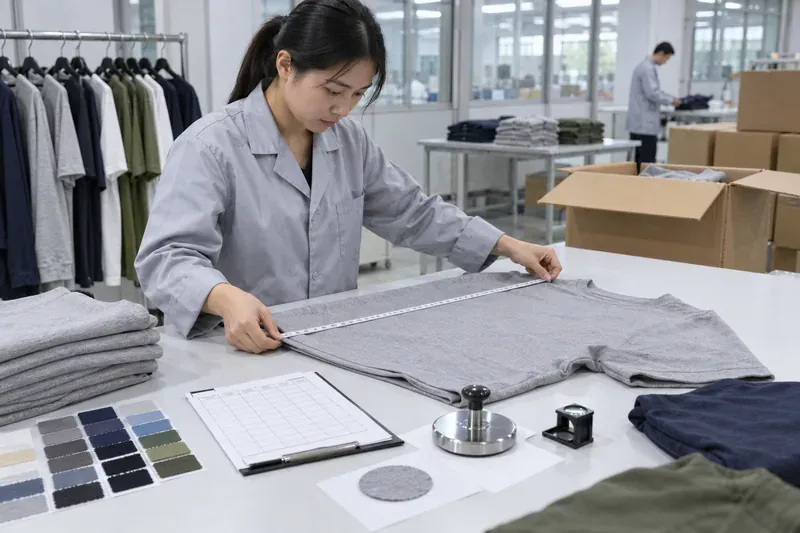
QC is not a final photo shoot. It is a three-point system. Inline checks during sewing — the during-production inspection layer — catch defects early: operators trim loose threads and flag seam slippage under tension.
End-of-line review before packing catches assembly issues: inspectors test zipper drag and check label placement. Final random inspection before balance payment or shipment release catches batch problems: inspectors reopen cartons and recheck measurements.
Lock the acceptance framework: zero critical defects, majors at AQL 2.5, and minors at AQL 4.0 under ISO 2859-1, General Inspection Level II. For a 1,000-unit lot, that means an 80-piece sample. Majors pass at 5 or fewer and fail at 6; minors pass at 7 or fewer and fail at 8.
Defect examples. Critical: needle holes, sharp metal, mold. Major: seam slippage, measurement out of tolerance, wrong color. Minor: loose thread, untrimmed thread, minor color deviation.
Require dimensional audits. Use a tape against the approved tech pack POM points and tolerance chart, and check every measurement on every sample.
Include needle detection and metal control as an explicit gate. Every garment passes through a needle detector at the line end. If the detector alarms, quarantine the piece.
What good looks like: a weak supplier usually shows a defect rate that climbs through the run. Moving to a vetted supplier and enforcing inline checks plus an AQL 2.5 final check is what pulls a drifting run back under control. The gain shows up as less rework and fewer air-freight recoveries, not just a lower defect number.
If you want a third party to run the final check, our pre-shipment inspection service covers the full AQL report and a needle-detector log. To see how the AQL numbers convert to accept and reject counts, read AQL inspection standard.
Official sampling reference: ISO 2859-1.
The primary method is an independent third-party or in-house inspector on site. Remote photo and video reporting is a backup, not a substitute.
Done when: you have a signed inspection report with pass or fail results for all three control points.
The check that pays for itself: brands skip the final random inspection to save a modest inspection fee, then absorb far more in returns. The three-point system is not optional.
Step 8: Approve the Packing Spec and Landed Cost Before Shipment
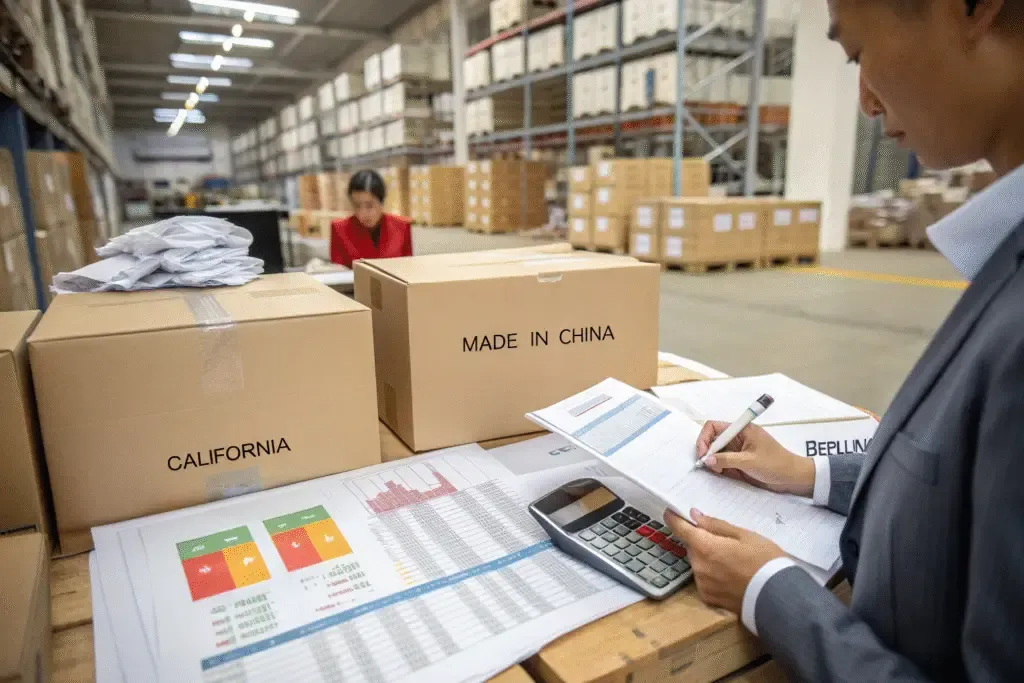
A ready carton passes three checks: the unit folds match, the polybag carries a suffocation warning, and every barcode scans on the first try. Before I approve freight, I pull one carton from each size and color ratio and check unit packing, fold method, polybag spec, carton assortment, carton marks, barcode placement, and carton dimensions and weight against the freight quote.
On polybags: Amazon FBA requires a suffocation warning on any bag with an opening of 5 inches or more, printed on the bag or added as a label, and bags at least 1.5 mil thick. Many retailers ask for the same warning, so we print it on every bag.
Confirm ratio-pack accuracy against the PO, and confirm carton marks match the packing list. For apparel, volumetric freight matters; a small carton-height change can move your landed cost more than you expect.
Run this compact landed-cost checklist: unit price, fabric and trims, sample-cost amortization, inspection fees, inland China trucking, export charges, freight, insurance, duties and tariffs, customs broker, and destination delivery. For the costs that fall between these lines, see hidden sourcing costs.
A general retail shipment follows the factory pack. Amazon FBA or 3PL routing guides can override factory defaults, so check the Amazon FBA packaging requirements before release.
Done when: the packing spec, the inspection result, and the landed-cost model all align.
Barcode position is part of the spec. A label that scans on your desk can fail at the 3PL if it sits too close to a carton edge. Set a barcode position in the packing spec, not a guess.
Cheap cartons are expensive. Pay for correct dimensions and print quality up front.
Troubleshooting
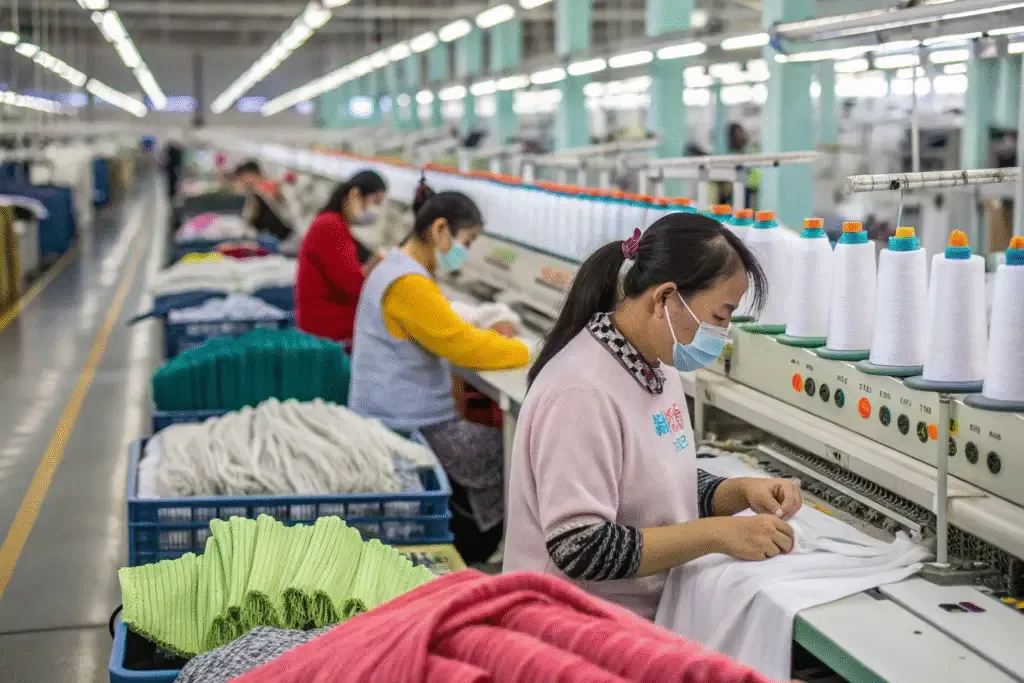
Bulk drifts from the approved sample when fabric, sizing, or capability was never locked. Four failures recur.
Bulk fabric feels lighter or tests below target GSM
Problem: Rolls measure below the approved GSM, and the hand feels thin.
Why: The supplier swapped lots or used a cheaper mill, and nobody weighed the rolls.
Fix: Hold cutting. Re-weigh every roll and verify lot numbers. Force a replacement or a price adjustment, and release nothing until GSM and shrinkage pass.
Sizes grade incorrectly from XS to XXL
Problem: The largest sizes come in off, and sleeve lengths jump unevenly.
Why: They graded from one base size without your rules.
Fix: Pull a size-set audit and measure every POM against your grade rules. Block shipment until it is corrected or re-sorted.
Certificates do not match the actual fabric or article
Problem: Their OEKO-TEX certificate lists a different article number.
Why: They reused a certificate from another buyer.
Fix: Verify through the official OEKO-TEX database or the issuer, and quarantine compliance claims until they are proven.
Mid-run stitching or workmanship drift appears
Problem: The defect rate climbs after the first week.
Why: Operator fatigue, a new line, or a subcontractor takeover.
Fix: Increase inline checks. Isolate the operator or line. Then choose rework, re-cut, or a factory switch based on the defect trend.
The guardrails that save the most: never pay the balance on a promise. Never approve from photos only. Never accept “same as sample” without a POM sheet.
A failure I have seen: a PP sample signed off just outside tolerance, then bulk drifted further and the line had to be replaced mid-run. The root cause was the soft approval, not the sewing. See Step 5.
The root cause is almost always a soft sample approval. Lock the golden sample, enforce the tolerance table, and never cut until the fabric checks pass.
Frequently Asked Questions
1. How long does custom apparel manufacturing in China really take?
Plan 80 to 110 days on a first run, from kickoff to ship date: 2 to 3 weeks of factory screening, 3 to 4 weeks of sample rounds, and 45 to 60 days of bulk production. Booking fabric during sampling saves roughly two weeks. Avoid launching into Chinese New Year, when many lines stop for three to four weeks.
2. What is the minimum order quantity for custom clothing from China?
It depends on the model. Full custom typically needs a few hundred to around 1,000 units per style and color, while stock-style or light OEM can go lower. Ask about off-season capacity, because many factories flex MOQ during the January to March lull. Step 1 shows how the model drives the number.
3. How do I verify a Chinese clothing factory is real?
Check the legal entity, then the floor. Search the company on China's National Enterprise Credit system at gsxt.gov.cn and confirm the business scope includes manufacturing. Then get eyes on the cutting room in use. A trader shows a catalog; a real factory shows a line board with your style number. The audit checklist in Step 4 covers what to look for.
4. Should I use a sourcing agent or manage the factory directly?
Go direct only if you have a locked tech pack and a China-side QC contact. Otherwise, hire support. Sourcing fees typically run 3% to 7%. My rule is simple: if your spec isn't locked, don't manage the factory yourself. See Step 1.
5. What defect rate should I accept before shipment?
Lock zero critical defects, majors at AQL 2.5, and minors at AQL 4.0 under ISO 2859-1. For a 1,000-unit lot that means an 80-piece sample, and six or more major defects fail the lot. No inspection report, no balance payment.
Conclusion: Lock the System, Not the Price
You now have a sourcing process that opens with a locked tech pack and closes only when the evidence supports shipment. Don’t hunt for a cheaper factory first. Build the tech pack, shortlist 3 to 5 factories, and send them all the same brief. The next win is not a lower price quote; it is a production system you can control.
Have a tech pack or a reference sample? Send it to our team and we will match it to vetted factories and flag inspection risks before you commit.

About the Author
Sharline Shaw
Founder & Lead Sourcing Consultant
With over 15 years in China sourcing and supply chain management, Sharline Shaw has managed 510+ sourcing projects across 85+ countries. Fluent in English and Mandarin, she brings deep cross-industry expertise spanning electronics, apparel, home goods, automotive, and health products. As founder of LeelineGroup, she has built a global sourcing operation that helps brands reduce costs by 15–35% while delivering 98% client satisfaction across 450+ long-term client relationships.
Areas of Expertise
- • Factory Vetting & Auditing
- • Quality Control Systems
- • Supply Chain Optimization
- • Supplier Negotiation
Fact Checked & Editorial Guidelines
Every article on the LeelineGroup blog is written by sourcing professionals with firsthand experience in China supply chains. Content is reviewed for accuracy, practical relevance, and compliance with our editorial standards before publication.
Your trust is important. Learn more about our Fact Checking Process and Editorial Policy.