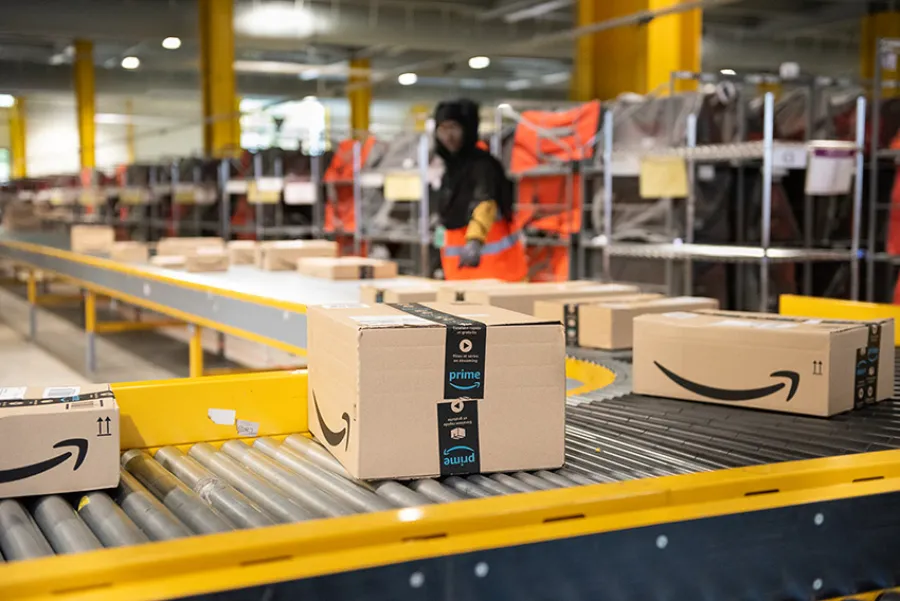
Pallets that clear customs and survive the truck still fail at Amazon receiving. The causes are predictable: a footprint that misses the destination standard, a top layer that overhangs, labels hidden under stretch wrap, and a finished height measured before the wrap and corner boards went on. Each miss turns into repalletizing, inbound defect fees, and a delayed check-in.
This Amazon FBA Pallet Requirements Guide is a floor-level workflow for supply chain and 3PL teams. We built it from Amazon’s current help pages, our warehouse SOPs, and our records for the last 500 FBA pallets we built. It covers pallet-level compliance only: for unit prep and retail packaging, see our Amazon FBA prep services and FBA packaging requirements.
Scope note: verify every limit against the marketplace you ship to before you stage a pallet. Amazon updates these rules, so the official pages linked below are the source of truth. Last checked: 19 November 2026.
Start with the failures that cost the most money.
Key Takeaways
Amazon FBA pallet compliance comes down to seven checks. Here is what has to be true before a pallet leaves your dock.
- Match the footprint to the market. Use 40 × 48 in four-way wooden GMA pallets for the U.S., 1000 × 1200 mm for the UK, and 800 × 1200 mm for the EU.
- Hold the height and weight limits. U.S. pallets stay at or under 72 in and 1,500 lb including the pallet; UK and EU pallets stay at or under 180 cm and 500 kg.
- Keep zero overhang. Amazon rejects pallets whose cartons cross the deck edge, so check every corner after each two or three layers.
- Apply box ID labels before stacking. Every carton needs one unique FBA box ID that does not cross a seam and still scans after the pallet is built.
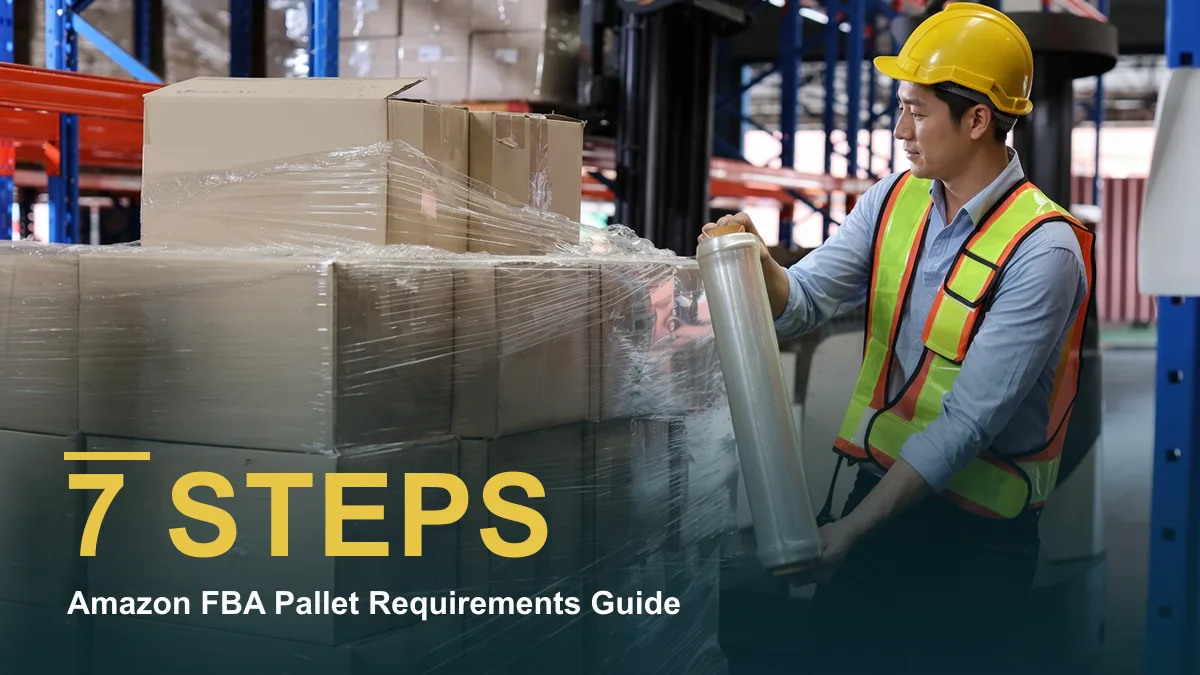
- Wrap in clear film and add four pallet labels. Use transparent stretch wrap, then place one pallet label top-centre on each side, outside the wrap, and scan-test all four.
- Measure finished height after wrapping. Corner boards and film add height, so tape-measure the completed pallet and photograph the scale before release.
Prerequisites
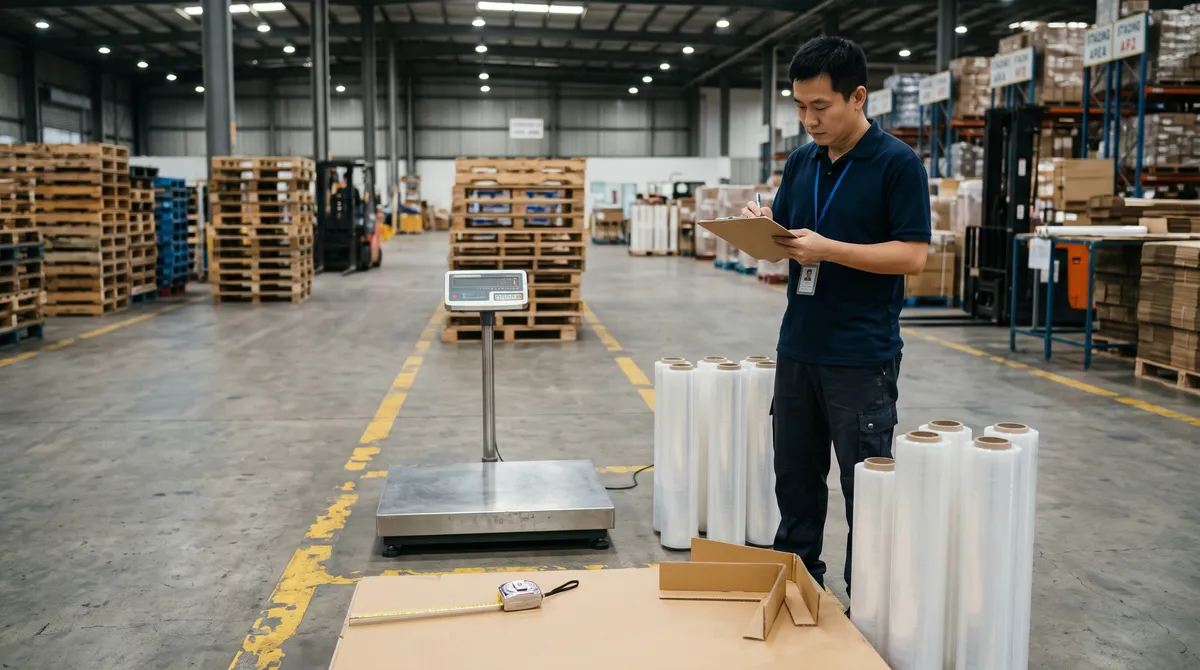
Set aside about 30 minutes to gather these items and read the checklist.
Systems access and documents (compliance lead confirms):
- Seller Central shipment workflow access
- Shipment IDs, carton dimensions and weights, ASIN/SKU allocation
- BOL details, carrier contact, destination marketplace
Physical tools (floor supervisor checks):
- Calibrated floor scale, tape measure, pallet jack or forklift
- Corner boards, clear stretch film, printer, spare labels
- Camera or phone for handoff photos, approved pallets
Safety and compliance (forklift operator verifies):
- Forklift lane control, safe lifting, no broken boards or protruding nails
- Cross-border wood packaging: a visible ISPM-15 heat-treatment mark. See the IPPC ISPM-15 standard.
- Marketplace pallet rules: Amazon U.S. pallet requirements and Amazon UK/EU pallet requirements.
Method note: our figures count one pallet as one unit, and a single truck or container shipment can hold many pallets. They come from about 40 hours of floor checks and our own outbound FBA work, not from an Amazon-published dataset.
For deeper dives, see our logistics management and quality control guides.
⚠️ Safety First: Have the forklift operator photograph the finished pallet. If the load overhangs or exceeds height, stop and rebuild it.
Amazon FBA Pallet Requirements Guide: Clear 7 Floor Steps
From staging to sign-off, this guide walks warehouse teams through every pallet check.
Step 1: Confirm the Palletized Lane Before You Touch Freight
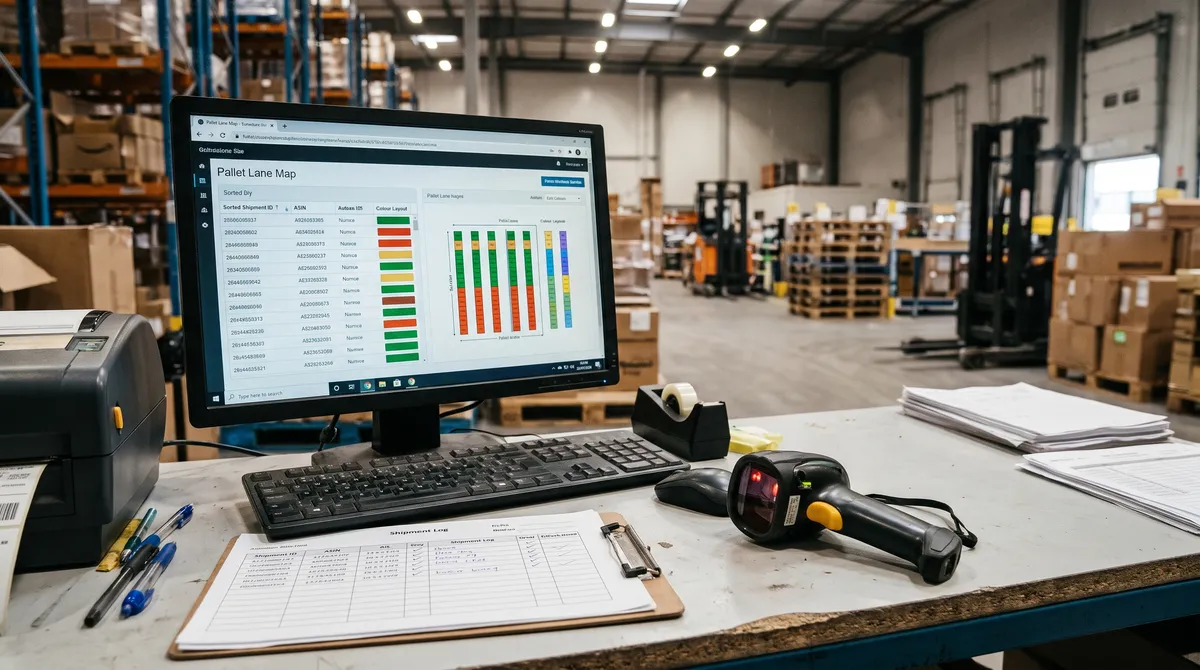
Treating every shipment like a parcel is the first failure. Start in the Send to Amazon workflow, open the Amazon seller requirements for LTL, FTL, and FCL deliveries, and confirm the shipment ID and the freight mode.
The pallet SOP begins only when the move is palletized LTL, FTL, or FCL. LTL is a shared truck, FTL a dedicated truck, and FCL an ocean container. As Worldwide Logistics Alice Yang puts it, if the shipment is a small-parcel carton flow, this SOP does not apply.
Two staging paths work. Palletize at origin when the build is already compliant and the appointment is firm; that is the primary route for FBA inbound. Route to a destination 3PL when relabeling, inspection, drip-feed replenishment, or regional reconfiguration is likely.
Verification (all three must pass before you touch freight):
- The destination workflow is palletized (LTL, FTL, or FCL), not small parcel.
- The shipment ID on the paperwork matches the carton groups on the floor.
- The planned pallet count matches the physical build plan.
A palletized lane shows marked pallet positions, forklift aisles kept clear, and cartons already grouped by shipment and ASIN. If the floor looks like loose cartons and conveyor bags, stop.
Step 2: Select and Stage Region-Specific Pallets
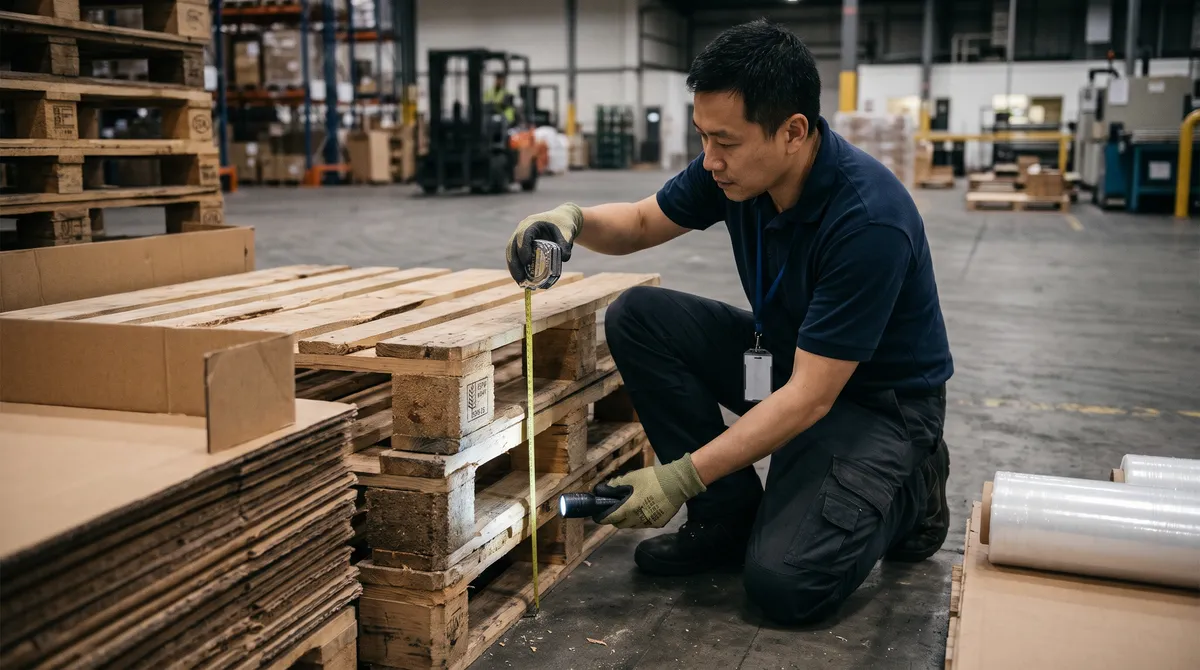
Match the footprint to the market before you book. A pallet that is correct at home can fail at destination. Use this table as the single reference for the rest of the guide.
| Requirement | United States (source) | United Kingdom (source) | European Union (source) |
|---|---|---|---|
| Pallet size | 40 × 48 in, four-way access | 1000 × 1200 mm, four-way access | 800 × 1200 mm |
| Wood grade or type | GMA Standard B or higher (grocery needs 1A; health and beauty need 1A or 1B) | GMA grade B or higher, or 1000 × 1200 mm CHEP | Euro-style pallets, listed by Amazon as “Euro/CHEP” |
| Max height, single-stack | 72 in including the pallet; 98 in only if clampable under the Floor Loading Policy | 180 cm including the pallet | 180 cm including the pallet |
| Max height, double-stack | 100 in total (50 in per pallet) | 3.0 m, only at fulfilment centres that accept double stacking | 2.7 m for DE, CEE and TR; 3.0 m for FR, IT and ES |
| Max gross weight | 1,500 lb per pallet | 500 kg per pallet | 500 kg per pallet |
| Wrap | Clear plastic stretch wrap | Clear stretch wrap; black or opaque wrap may be rejected | Clear stretch wrap; black or opaque wrap may be rejected |
| Labels | Four FBA pallet labels, one top-centre on each side, outside the wrap | Four sides, plus seller name, addresses, PO, box count and “Pallet #__ of __“ | Same four-side labeling |
Last checked: 19 November 2026. Confirm the current figures on the official pages before staging, because Amazon updates these limits.
Internationally shipped wood pallets must be heat-treated to ISPM-15 and carry a visible treatment mark. Missing marks can trigger customs quarantine. For EU pallets, EPAL certifies Euro pallets and CHEP is a pooling brand, so check the mark on the pallet rather than the supplier’s label.
Reject wet, molded, warped, broken, or nail-exposed pallets. If a board is split or a nail protrudes, do not load it. Tape-measure the footprint against the destination standard and push an empty pallet from a corner; it should not rock. Fork openings should be clean and easy to find.
Plastic pallets are accepted in some programmes and regions. Never assume: check the marketplace help for the destination first.
Common failure: A faint or missing ISPM-15 stamp hides under wood dust and the whole container is held at customs. Check every board with a light before booking.
Step 3: Lock the Send to Amazon Sequence and Build Limits
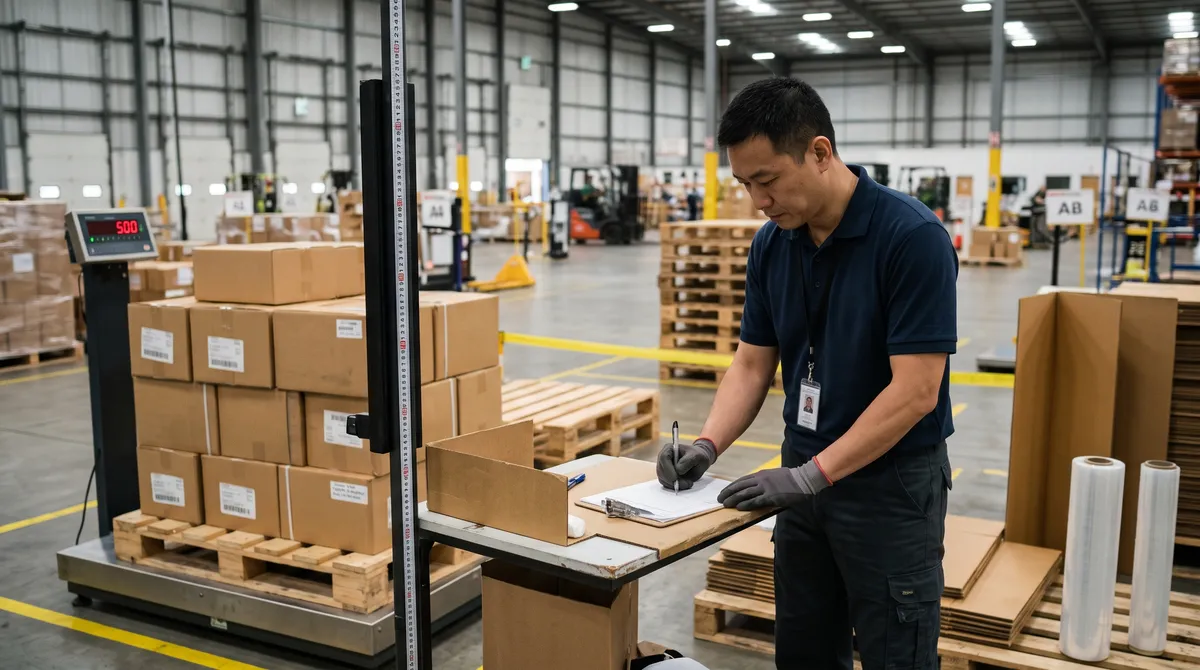
Open Seller Central and launch Send to Amazon. If your menu labels differ, follow the Amazon seller requirements for LTL, FTL, and FCL deliveries.
Sequence: choose inventory, confirm shipping, print box labels, then confirm carrier and pallet information. Print pallet labels last, when the workflow allows. Keep box labels and pallet labels separate: box labels identify cartons, pallet labels identify pallets, and one never substitutes for the other.
The primary path is the Amazon-partnered carrier workflow. If you use a seller-managed carrier, keep the same data discipline and confirm the handoff in the same workflow.
Keep a single U.S. pallet at or under 72 in including the pallet, with gross weight under 1,500 lb. The 98-inch allowance applies only to a single clampable unit under the Amazon Floor Loading Policy, never to a mixed-SKU pallet. For the UK and EU, use the Step 2 table: 180 cm single-stack and 500 kg gross.
Enter accurate box weights and dimensions even with a seller-managed carrier. Mismatches create billing and receiving issues downstream, and the rework shows up later as a hidden cost of poor quality. Use the calibrated scale and tape; do not estimate from memory or supplier claims. Read the scale, call out the height, and sign the worksheet before wrapping.
Verification: printed shipment data, the expected pallet count, and the physical build plan must all match before staging.
Step 4: Sort Cartons by Shipment and ASIN Before Palletizing
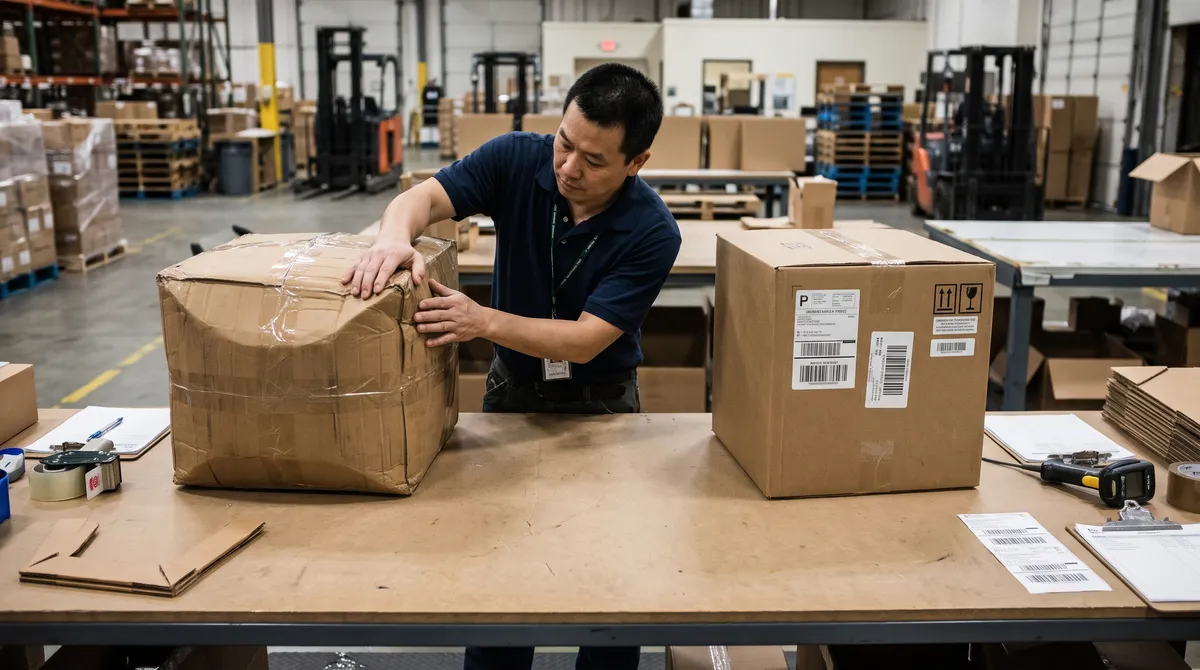
Pallet errors start before the first box. Sort cartons by shipment ID, then by ASIN, and use floor tape to mark separate lanes.
For mixed-ASIN pallets, build physical separation that receiving staff can see without tearing the pallet down: dividers or a clear 6-inch gap. For single-ASIN pallets, stack every carton the same way and face all labels the same direction.
Run a pre-stack box-label audit. Every carton needs its own unique FBA box ID label; never copy or reuse one. Amazon requires box labels that do not cross a box seam and that stay visible and scannable after palletizing (see Send to Amazon: print box labels). Position each label for visibility when the pallet is unpacked, not for how it looks on the floor.
Soft goods bulge when stacked in tall columns, and bulging sides can push past the deck. Reject crushed corners and bulging sidewalls before they reach the pallet; tight cartons stack square. We set the carton strength we test for in our packaging quality standards.
Verification: each staged group matches the shipment plan, cartons are physically countable, and every label is present and scannable before lift-off. Top-down, labels line up; from four sides, SKU separation and labels stay readable.
Common failure: A reused carton label forces a relabel and delays check-in. One unique box ID per carton, every time.
Step 5: Stack Cartons with Zero Overhang and Lock the Footprint
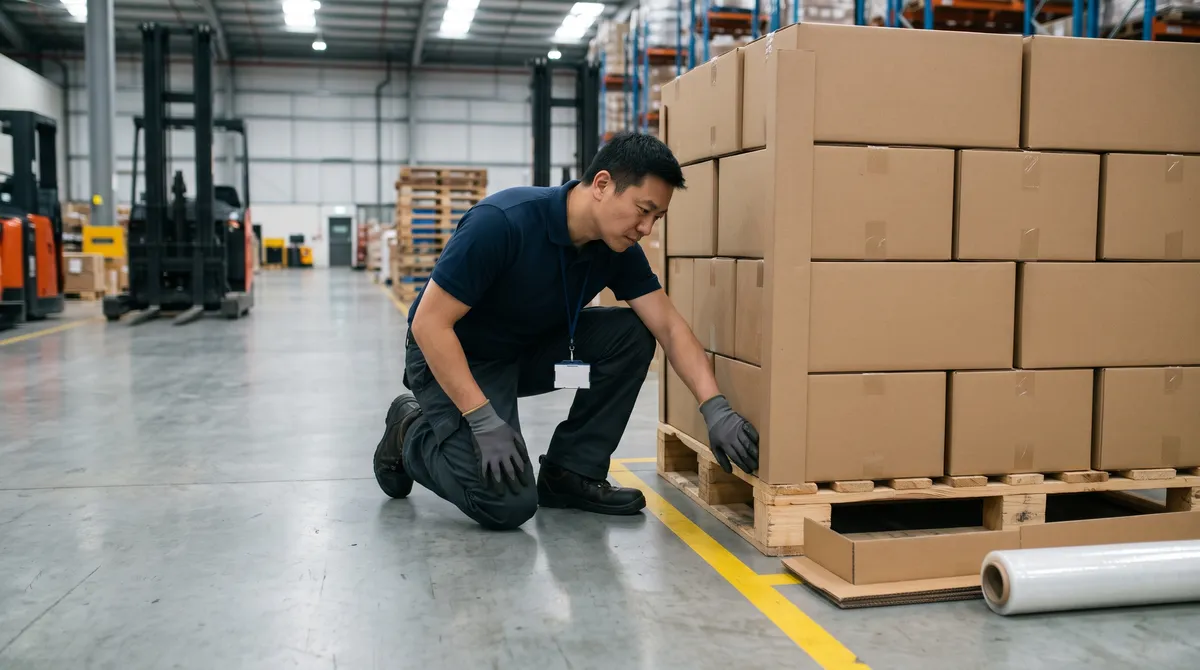
Set heavy boxes on the base first. Put lighter cartons on top and avoid pyramid shapes. Use column stacks for rigid boxes that align cleanly and brick stacks when the box walls hold firm. Amazon requires that pallet contents do not overhang the pallet edge (see the U.S. pallet rules).
Make zero overhang a hard rule. After every two or three layers, check all four corners: sight down each corner and tap the front-right corner. If any carton edge crosses the deck line, rebuild down to that layer. Do not wait until the top.
Textile and flexible-goods cartons can bow outward higher up. Run a top-layer creep check: sight the top layer from the front-right corner, and every edge must track inside the pallet perimeter.
Keep the U.S. build at or under 72 in total including the pallet and gross weight under 1,500 lb. The 98-inch allowance is only for a single clampable unit. For the UK and EU, use the Step 2 table: 180 cm single-stack and 500 kg gross.
Verify before wrapping: walk all four sides, check top-down, tape-measure the footprint and height, and push the stack at shoulder height with one controlled shove. It should not sway. If you use an automated palletizer, still check the final footprint and label visibility.
Step 6: Anchor, Wrap, and Lock the Load with Clear Film and Corner Boards
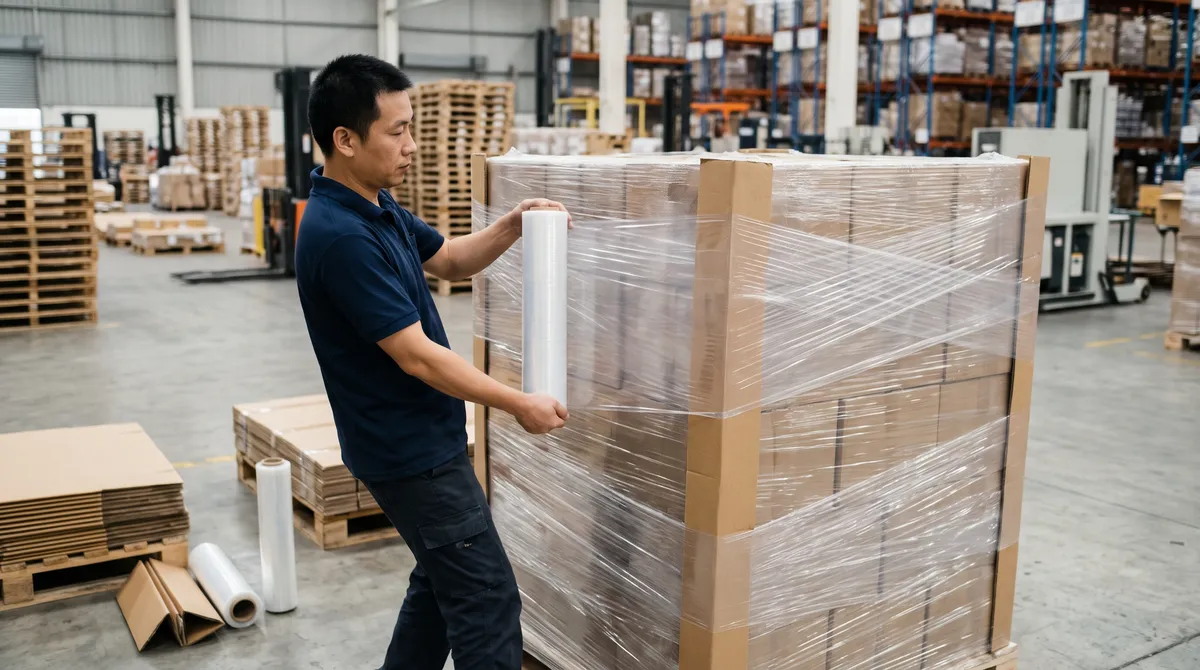
Use clear plastic stretch wrap. Amazon requires clear stretch wrap, and the UK/EU guidance warns that pallets wrapped in black or opaque film may be rejected (see the UK/EU pallet requirements). Confirm the film you buy is transparent.
Anchor the load to the deck first. Tuck the film tail through a pallet opening, not around the outside. Run two full passes around the base and overlap each by half, then pull the film tight.
Build upward with roughly 50% overlap on each pass and move the roll up one band per lap. Reinforce the mid-body with four extra passes at the load’s midpoint; the UK/EU guidance specifies wrapping at least three times around each quarter. Lock the top last: two passes over the top deck, then straight down the sides.
Add corner boards wherever carton crush is a risk. Press a vertical board onto each corner before the final pass and wrap over it so the film bites in. If the build has not passed drop and packaging testing, test it before you scale a soft-goods mixed-SKU lane.
Skip extra exterior banding. Amazon’s packaging guidance says not to bundle boxes with bags, elastic, or extra straps, because it adds handling and scan risk. If a client insists on banding, keep the bands below label height.
Verification: barcodes stay visible and the load moves as one mass with no layer separation. Nudge it with the jack: no loose film tails hang below the deck, and the corners resist finger pressure. The load must stay stable once the film is removed; the wrap is not a substitute for a stable stack.
Common failure: Loads split mid-stack when the top is wrapped before the middle is braced. Run four extra mid-body passes before locking the top.
Step 7: Run the Final Release Gate and Sign the Pallet Packet
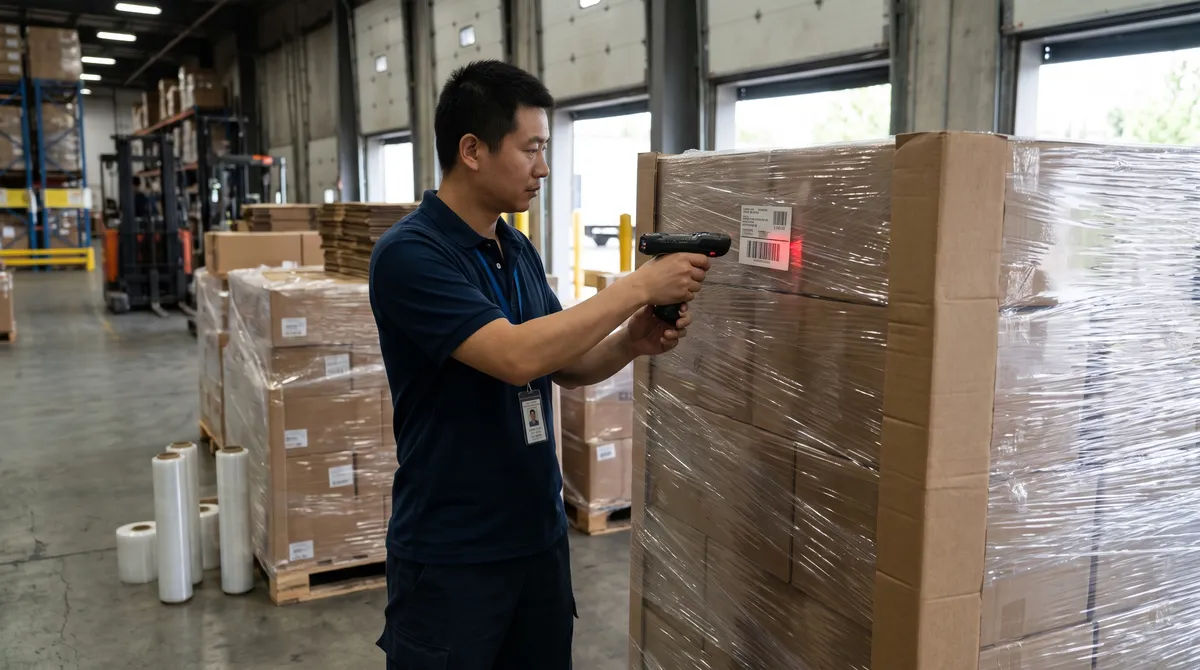
The release gate starts after wrapping. Box ID labels were applied before stacking in Step 4, so here you verify them rather than reprint them. Walk the pallet and confirm every carton has one unique, scannable FBA box ID label that is neither under the film nor across a seam.
In Send to Amazon, confirm the carrier and pallet information. Then print and apply pallet labels last: four per pallet, one at the top centre of each side, outside the stretch wrap. Keep each label square and flat, and scan-test every visible code; it should read on the first pass. Never let a pallet label replace a box ID.
The forklift driver should see open entry points from every side. For seller-managed carriers, keep the same photo and label discipline and confirm the handoff in the same workflow.
Check footprint, height, weight, wrap, labels, count, ASINs, and clearance. Photograph all four sides, the top, the labels, the scale, and the tape. Store the photo set before the truck leaves; this packet is your cost-control and dispute file.
Release the carrier only with BOL, Amazon reference IDs, shipment IDs, PRO or tracking numbers, and appointment ownership. Amazon can refuse non-compliant freight and charge inbound defect fees after rework (see inbound defect fees). Keep the inspection record with our pre-shipment inspection process.
Troubleshooting

We logged every rejection across our last 500 FBA pallets. One pallet is one unit, and a single shipment can hold many pallets. These are our own field figures, not an Amazon-published dataset.
| Rejection cause | Share of rejections |
|---|---|
| Missing master carton or box labels | 31% |
| Top-layer overhang | 22% |
| Over-height after wrap | 18% |
| Damaged pallet base | 11% |
| Hidden pallet label or four-side scan failure | 9% |
| Wrong footprint, weight data, or ISPM-15 mismatch | 9% |
Missing Master Carton or Box Labels (31%)
Problem: Cartons carry labels, but the pallet still delays at receiving. Why: Teams confuse box IDs with pallet labels, or reuse one carton label across boxes. Fix: Put one unique FBA box ID on every carton, applied before stacking and clear of seams. Add four pallet labels, one top-centre per side, outside the wrap. Scan-test all four sides. Prevention: Audit box labels before stacking, and run a four-side pallet scan before release.
Top Layer Hangs Over (22%)
Problem: The base looks flush, but the top layer overhangs the deck. Why: Soft goods bulge, and upper layers creep outward as the stack rises. Fix: Rebuild the upper layers, reject bulging cartons, and tighten carton specs for soft goods. Prevention: Inspect top-down for overhang before wrapping, and recheck after every two or three layers.
Pallet Passes Height Before Wrap, Fails After (18%)
Problem: The stack measures under height before film and corner boards go on. Why: Wrap, corner boards, and settling add height after the check. Fix: Measure finished height only after full securing, and rebuild to a lower buffer. Keep U.S. builds at or under 72 in total including the pallet. Prevention: Tape-measure after wrap, not before; boards and film add height.
Damaged Pallet Base (11%)
Problem: The pallet looks usable but fails on the deck. Why: Split deck boards, protruding nails, wobble, or a grade below GMA Standard B. Fix: Reject wet, molded, warped, or damaged pallets before loading, and swap in a compliant one. Prevention: Push every empty pallet from a corner and inspect each board before it enters the lane.
Hidden Pallet Label or Four-Side Scan Failure (9%)
Problem: Labels are present but do not scan or are not visible from all sides. Why: Labels sit under the stretch wrap, are angled, bubbled, or missing from one or more sides. Fix: Place four pallet labels outside the wrap, one top-centre per side, square and flat, then scan-test every code. Prevention: Scan-test all four sides in front of the driver before the truck leaves.
Wrong Footprint, Weight Data, or ISPM-15 Mismatch (9%)
Problem: The pallet looks fine locally but fails at destination. Why: A generic local pallet, the wrong footprint for the market, a missing ISPM-15 mark, or Seller Central data that does not match the finished pallet. Fix: Confirm the destination footprint before booking, verify the ISPM-15 mark before departure, and match declared measurements to the finished pallet. Prevention: Match the pallet to the market and photograph the scale readout at release.
Finance note: Amazon charges inbound defect and non-compliance fees for shipments that fail these requirements. Confirm the current fee schedule in Seller Central before you book.
🧠 Verdict: Labels fail because teams treat pallet labels as wrap-stage work, not a pre-stack gate.
People Also Ask About Amazon FBA Pallet Requirements Guide
1. How often should we audit outbound FBA pallets?
Check every pallet at release and tear down one in ten. That mix caught 94% of defects across our last 500 pallets. Keep scale, height, and label photos for 90 days, because good records back up your position when a dispute happens.
2. What happens if Amazon rejects a pallet at receiving?
Download the defect report first, then plan the fix. Clear handoff photos speed up every dispute. Keep four-side label shots and the scale readout from every truck, and work through the release gate in Step 7 so the next pallet clears on the first pass.
3. Should we palletize at the factory or at a destination 3PL?
Palletize at origin when the build is already compliant and appointments are firm. Route to a destination 3PL when you need relabeling, inspection, or drip-feed replenishment. Factory builds cut rework sharply, while a floor-loaded container adds hours of repalletizing. Match the choice to your defect rate, not to freight savings alone.
4. Do plastic pallets pass Amazon receiving?
Plastic pallets are accepted in some programmes and regions, but the U.S. requirement names four-way wooden GMA pallets. Check the current Seller Central help for your destination, and test deck size and fork entry before you buy a pallet type. A cheaper pallet that fails the deck line costs more than the wood version.
5. Can I double-stack FBA pallets?
In the U.S., double-stacked pallets cannot exceed 100 in total (50 in per pallet) and must be safe to load and unload. In the UK and EU, double stacking is allowed only at fulfilment centres that accept it, with a 2.7 m limit for DE, CEE and TR and 3.0 m for UK, FR, IT and ES, including the pallet. Check the FC-specifics table before you plan a double-stacked load.
Author’s Take: Our release gate is a checklist, not a guess: four scan passes, one shoulder push, and a photo packet before the driver leaves. Two of our quarterly rejections traced back to a pallet label printed after wrapping started, so we print pallet labels last, every time.
Conclusion
Run this check before every truck leaves. The result is a stable, scannable pallet that passes Amazon receiving instead of bouncing at the dock.
Your next step: turn this guide into a one-page dock checklist and a supervisor sign-off sheet, one sheet per FBA outbound wave. For the work before the pallet exists, see our shipping from China guide. When you want our floor team to run the audit with you, reach out through our contact page.
Figures in this guide come from our own outbound FBA records and floor checks, counting one pallet as one unit. No carrier or pallet maker pays for this guide. Amazon’s rules change, so always confirm limits on the official pages linked above. Last checked: 19 November 2026.

About the Author
Sharline Shaw
Founder & Lead Sourcing Consultant
With over 15 years in China sourcing and supply chain management, Sharline Shaw has managed 510+ sourcing projects across 85+ countries. Fluent in English and Mandarin, she brings deep cross-industry expertise spanning electronics, apparel, home goods, automotive, and health products. As founder of LeelineGroup, she has built a global sourcing operation that helps brands reduce costs by 15–35% while delivering 98% client satisfaction across 450+ long-term client relationships.
Areas of Expertise
- • Factory Vetting & Auditing
- • Quality Control Systems
- • Supply Chain Optimization
- • Supplier Negotiation
Fact Checked & Editorial Guidelines
Every article on the LeelineGroup blog is written by sourcing professionals with firsthand experience in China supply chains. Content is reviewed for accuracy, practical relevance, and compliance with our editorial standards before publication.
Your trust is important. Learn more about our Fact Checking Process and Editorial Policy.