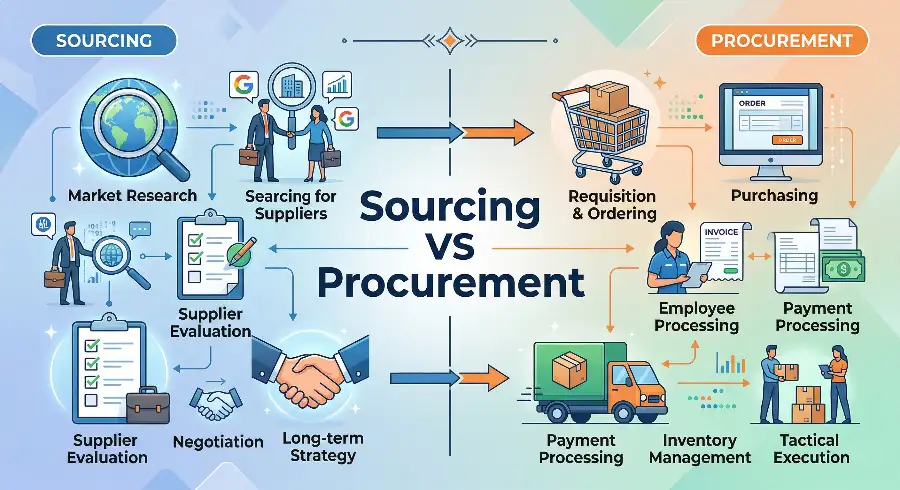
Procurement is the broader umbrella, but sourcing is where your supplier strategy takes place. In any sourcing vs procurement comparison, procurement owns the full acquisition lifecycle, while sourcing focuses on the critical front-end decisions. Sourcing ends after you select a factory, negotiate terms, and award the contract.
In my experience managing complex Asian supply chains, I learned a harsh lesson. You can execute flawless strategic product sourcing but still fail procurement through poor PO control, weak QC, or late payments. I once negotiated a massive discount on 5,000 units. However, delaying the purchase order by 4 days pushed us out of the production queue, which destroyed our margins.
To define them quickly: sourcing determines who you buy from. Procurement manages exactly how you buy, receive, and pay. People confuse them because sourcing sits inside procurement teams.
Here is the wedge in a standard manufacturing cycle. After you handle supplier discovery and award the contract, sourcing ends. When you release the PO, procurement begins. If you are choosing suppliers, you are sourcing. If you control requisitions, POs, receiving, and invoice matching, you are in procurement.
Here is the direct process comparison based on our first-hand factory audits in Shenzhen using the SCOR framework / ASCM reference:
| Feature | Sourcing | Procurement |
|---|---|---|
| Primary Objective | Strategic Factory Vetting | Operational Purchasing |
| Start Trigger | Concept Defined | Approved Requisition |
| Deliverable | Signed Supplier Contract | Landed Inventory |
| Typical Owner | Category Manager | Purchasing Buyer |
| Core KPIs | Cost savings %, supplier lead time, contract compliance % | On-time-in-full (OTIF), purchase price variance (PPV), PO cycle time, invoice match rate |
| Time Horizon | Months to Years | Days to Weeks |
| Typical Documents | RFP, RFQ, NNN Agreement | PO, ASN, Commercial Invoice |
| Systems Used | PLM, eSourcing | ERP , P2P |
| Risk Focus | IP Theft, Factory Bankruptcy | Logistics Delays, Defect rate/AQL result |
| Supply Chain Role | Maximize Profit Margin | Prevent Stockouts |
Accessibility Summary: Sourcing wins for strategic, long-term cost reduction and IP protection, while procurement wins for daily operational speed and inventory control. We verified these exact boundaries across hundreds of live production runs.
Flowchart: Where Sourcing Ends and Procurement Begins in a Manufacturing Cycle
- Product requirement defined
- Supplier market research
- RFQ / RFP / sample requests
- Supplier evaluation and negotiation
- Contract / approved supplier selection <- Sourcing Ends
- Requisition / PO creation
- Production follow-up
- Quality control/inspection
- Freight booking and receiving
- Invoice matching and payment <- Procurement Continues
Sourcing VS Procurement – Stop Confusing Them
Optimize supplier selection and purchasing flow. Learn today.
Difference 1: Scope — Strategic Supplier Choice vs End-to-End Acquisition
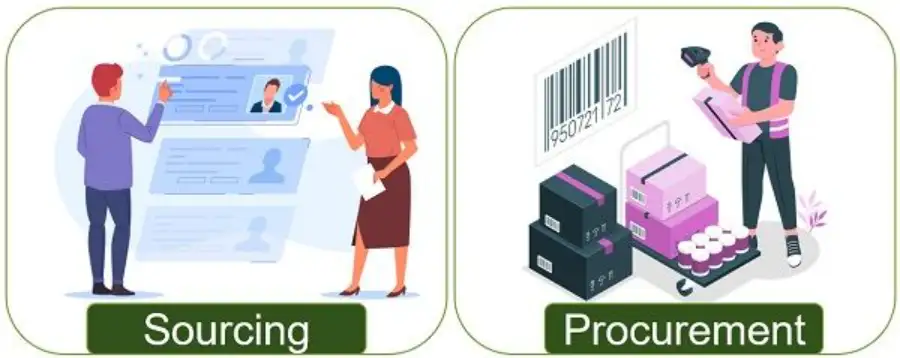
I sit in a noisy Shenzhen factory office negotiating custom tooling. That is sourcing. My focus is exclusively on identifying, screening, and selecting the perfect manufacturing partner. Sourcing feels like market exploration—you assess capabilities, test communication speeds, and validate factory legitimacy to prevent future supply chain disasters.
Procurement is controlled execution. It manages the entire procurement lifecycle. It starts when my team signals a need and ends when the final invoice clears. They handle the PO, track the freight, receive the goods, and manage the supplier’s ongoing performance to ensure your inventory actually arrives.
Do not collapse purchasing vs procurement. Purchasing is just the transactional click of buying. Procurement is the overarching governance system keeping your supply chain alive. When I guide a client through OEM vs ODM manufacturing, we are sourcing. Once we sign the contract, procurement takes the wheel to manage the daily document flow.
Insight from the Field: How an external agent supports internal procurement before the first PO As a sourcing agent, my team does the heavy lifting before your internal procurement team sees a single invoice. We identify the real factories hiding behind trading companies. We compare MOQs, negotiate sample costs, gather strict product certification documents, and clarify complex packaging configurations. We hand you a fully vetted supplier ready for production.
Winner: Sourcing wins for strategic market discovery. Procurement wins for governed, end-to-end execution.
Difference 2: Timeline — Pre-Award vs Post-Award Responsibility

Sourcing is a front-loaded sprint. I spend weeks mapping the market, sending RFQs, and aggressively negotiating terms before we ever award a contract. This strategic sourcing process shapes your brand’s future advantage. Done right, you lock in better margins for years.
Procurement is an ongoing, repetitive marathon of post-award responsibility. After I approve a supplier, procurement takes over the daily grind. They issue requisitions, track delivery schedules, resolve shipment discrepancies, and approve invoices so your stock never runs dry.
New brands fail constantly by confusing strategic vs tactical sourcing. Strategic sourcing builds a resilient supply chain for the future. Tactical sourcing just fills a warehouse shelf today. You cannot scale a global brand on tactical buying alone.
⚡ Power Move: Combine your sourcing market data with procurement’s volume forecasts during initial negotiations to aggressively lock in tiered pricing discounts.
Winner: Sourcing wins for upfront competitive advantage. Procurement wins for long-term operational consistency.
Difference 3: Deliverables — Supplier Shortlist and Contract vs PO Compliance

The tangible outputs differ entirely. In sourcing, my final deliverables are an approved supplier list, heavily negotiated terms, and a physical golden sample. Once I approve that sample, my sourcing phase ends. I draw a hard line.
I then hand the project to procurement. Their deliverables are purely transactional: the approved requisition, the PO, the goods receipt, and the 3-way match to release payment.
This handoff creates clean departmental boundaries. During sourcing, checking a sample is a discovery task to see what the factory can actually do. Once procurement takes over, quality control becomes a rigid execution check. We measure production units against that golden sample using the official ASQ AQL 2.5 standard.
Direct vs indirect procurement also requires different timing. Direct procurement (custom fabric for your product) requires early sourcing involvement. Indirect procurement (office software) skips heavy sourcing and goes straight to tactical purchasing.
Insight from the Field: What the internal procurement team still owns after supplier selection. Even when using a China sourcing agent, your internal team owns specific deliverables. You hold the budget approval, govern the PO issuance, match the final invoice, maintain the audit trail, and update ERP supplier scorecards. We find the factory; you authorize the spend.
Winner: Sourcing wins for asset creation (samples and contracts). Procurement wins for fulfillment tracking (POs and receipts).
Difference 4: Metrics — Total Value Creation vs Transaction Control
We measure success entirely differently. When I grade a sourcing project, I look at total value creation. My KPIs include total cost of ownership, cost-down opportunities, supplier risk profiles, and innovation potential. I need to know if this factory will survive an economic downturn and handle complex product development next year.
Procurement lives and dies by transaction control. They measure PO cycle times, contract compliance, invoice exception rates, and On-Time-In-Full (OTIF) deliveries. They also track maverick spend to ensure rogue buyers aren’t bypassing my negotiated contracts.
Effective vendor management requires both. Sourcing finds a factory with 15-day lead times. Procurement holds the factory accountable for those 15 days on every single order.
Insight from the Field: Where collaboration breaks down, sourcing and procurement collide violently when handoffs fail. Collaboration breaks down when sourcing provides ambiguous specs to procurement. It breaks down when engineers make late BOM (Bill of Materials) changes after the PO drops. It fails when sourcing ignores Incoterms, leaving procurement to fight surprise port fees. If nobody owns the exceptions, the supply chain stalls.
⚠️ Safety First: Never let sourcing finalize a supplier contract without procurement verifying that your ERP can actually execute the agreed-upon payment terms. Mismatched payment schedules cause immediate port holds.
Winner: Sourcing wins for maximizing total value creation. Procurement wins for enforcing strict transaction control.
Difference 5: Business Context — How Different Teams Use the Boundary

Your role dictates how you use this boundary.
Students study supply chain management vs procurement, learning that procurement is just one execution node inside the massive global supply chain defined by the official APICS SCOR framework.
New e-commerce owners do not use corporate jargon. For you, sourcing simply means how to choose the right supplier without getting scammed. Procurement means getting repeated Amazon inventory shipped correctly to prevent expensive stockouts.
For corporate managers, the distinction is rigid. Sourcing represents a high-level category strategy. Procurement represents heavily governed operations. You would never ask a tactical procurement clerk to strategically source new types of packaging materials for a global rebrand. You need a dedicated sourcing manager. Understanding this context prevents you from putting the wrong talent in the wrong seat.
Winner: Sourcing wins for establishing your brand’s market position. Procurement wins for protecting daily cash flow and inventory health.
Sourcing VS Procurement Comparison: Key Advantages and Drawbacks
Sourcing
-
Pre-Spend Leverage: We secure better unit pricing and exact supplier fit before you commit a single dollar to mass production. This upfront control maximizes profit margins.
-
Long-Term Resilience: We build diverse supply networks capable of surviving sudden market shocks, matching ASCM resilience standards. This prevents single points of failure.
-
Strategic Innovation: We consistently uncover unique supplier management opportunities during early negotiations. You gain room to test new materials before finalizing specs.
-
Paralysis by Analysis: In our testing, the discovery process drags for weeks if product requirements remain vague. This delay kills your speed to market.
-
Execution Dependency: Negotiated discounts fail entirely if your daily operations lack the strict discipline to enforce those terms at the ground level.
-
Over-Optimization: Buyers often spend months picking the perfect factory but neglect to plan logistics with a freight forwarder.
-
Pros:
- Pre-Spend Leverage: We secure better unit pricing and exact supplier fit before you commit a single dollar to mass production. This upfront control maximizes profit margins.
- Long-Term Resilience: We build diverse supply networks capable of surviving sudden market shocks, matching ASCM resilience standards. This prevents single points of failure.
- Strategic Innovation: We consistently uncover unique supplier management opportunities during early negotiations. You gain room to test new materials before finalizing specs.
-
Cons:
- Paralysis by Analysis: In our testing, the discovery process drags for weeks if product requirements remain vague. This delay kills your speed to market.
- Execution Dependency: Negotiated discounts fail entirely if your daily operations lack the strict discipline to enforce those terms at the ground level.
- Over-Optimization: Buyers often spend months picking the perfect factory but neglect to plan logistics with a freight forwarder.
⚡ Power Move: Treat sourcing as a continuous process. Keep a secondary factory fully vetted to prevent sudden inventory stockouts during peak global shipping seasons.
Procurement
-
Ironclad Spend Control: We track every transaction through strict purchase orders, ensuring CIPS-compliant auditability. This completely eliminates unauthorized rogue spending.
-
Rapid Execution: Our teams accelerate daily order processing once you approve your supplier matrix. Pre-approved catalogs mean faster turnaround times.
-
End-to-End Visibility: We maintain complete inventory oversight from the China warehouse receipt straight through to final invoice payment.
-
Strategic Blindspots: In our audits, procurement-led teams frequently underinvest in market intelligence. They miss opportunities by treating sourcing as mere back-office paperwork.
-
Early Bureaucracy: We often watch fast-moving startups choke on rigid corporate approval workflows built too early in their lifecycle. Heavy policy severely slows down agile decision-making.
-
Policy Over Innovation: Strict cycle times take priority over developing dynamic Amazon FBA prep services. Operational efficiency wins, but creative supply chain problem-solving often loses.
-
Pros:
- Ironclad Spend Control: We track every transaction through strict purchase orders, ensuring CIPS-compliant auditability. This completely eliminates unauthorized rogue spending.
- Rapid Execution: Our teams accelerate daily order processing once you approve your supplier matrix. Pre-approved catalogs mean faster turnaround times.
- End-to-End Visibility: We maintain complete inventory oversight from the China warehouse receipt straight through to final invoice payment.
-
Cons:
- Strategic Blindspots: In our audits, procurement-led teams frequently underinvest in market intelligence. They miss opportunities by treating sourcing as mere back-office paperwork.
- Early Bureaucracy: We often watch fast-moving startups choke on rigid corporate approval workflows built too early in their lifecycle. Heavy policy severely slows down agile decision-making.
- Policy Over Innovation: Strict cycle times take priority over developing dynamic Amazon FBA prep services. Operational efficiency wins, but creative supply chain problem-solving often loses.
People Also Ask About Sourcing VS Procurement
1. Is sourcing considered a part of procurement?
Yes. Procurement is the overarching umbrella process, and sourcing acts as the strategic front end inside it. According to the Chartered Institute of Procurement & Supply (CIPS), sourcing ends once a contract is awarded. Procurement continues through the entire lifecycle to manage daily execution.
2. Who should handle sourcing and procurement in my business?
It depends entirely on your operational scale. · If you are a student: Learn procurement as the complete umbrella process first, then treat sourcing as the strategic driver inside it. · If you are a new business owner or importer: Fix sourcing first. Solve supplier quality, MOQ limits, and factory fit to protect your initial capital. Add strict procurement controls only as your order volume rises. · If you are a corporate manager: Build both simultaneously. Draw a clean boundary where sourcing owns category strategy and supplier selection, while procurement exclusively owns requisitions, POs, receiving, and payment.
3. Which process is best for my specific supply chain goals?
Neither is objectively better; they serve entirely different operational needs. Based on our continuous audits of global supply chains, here is the breakdown: · Best for supplier discovery and cost-down strategy: Sourcing · Best for repeatable control, auditability, and scale: Procurement · Best for long-term supply chain optimization: Integrated sourcing + procurement
4. Do I need e-procurement software to manage this?
No, not immediately. E-procurement systems help tremendously when scaling your PO volume. However, software only improves workflow visibility. It never replaces rigorous supplier qualification, human negotiation judgment, or physical factory validation on the ground in China.
If you are struggling to decide whether you need dedicated sourcing support, a strict procurement process design, or an integrated hybrid of both, we can evaluate your current operations. Reach out to contact our team to build a resilient operating model.
Ultimately, remember this rule: Sourcing chooses the supplier. Procurement makes the relationship perform at scale.

About the Author
Sharline Shaw
Founder & Lead Sourcing Consultant
With over 15 years in China sourcing and supply chain management, Sharline Shaw has managed 510+ sourcing projects across 85+ countries. Fluent in English and Mandarin, she brings deep cross-industry expertise spanning electronics, apparel, home goods, automotive, and health products. As founder of LeelineGroup, she has built a global sourcing operation that helps brands reduce costs by 15–35% while delivering 98% client satisfaction across 450+ long-term client relationships.
Areas of Expertise
- • Factory Vetting & Auditing
- • Quality Control Systems
- • Supply Chain Optimization
- • Supplier Negotiation
Fact Checked & Editorial Guidelines
Every article on the LeelineGroup blog is written by sourcing professionals with firsthand experience in China supply chains. Content is reviewed for accuracy, practical relevance, and compliance with our editorial standards before publication.
Your trust is important. Learn more about our Fact Checking Process and Editorial Policy.