Key Takeaways
Eight release gates, not one final check, protect an apparel order from returns and chargebacks.
- Lock one sealed golden sample. Sign it with date, sign-off, and lot code, and keep a measurement-approved size set beside it. Every later gate compares against that piece.
- Baseline AQL is 1.5 major / 2.5 minor. Premium, kidswear, and high-return SKUs tighten major to 1.0; critical defects stay at zero tolerance.
- Sample size comes from Inspection Level II. A 3,200-piece lot draws 125 pieces: AQL 1.5 major allows 5 defects and fails at 6, AQL 2.5 minor allows 7 and fails at 8.
- Clear fabric before cutting. Grade rolls on the four-point system against the buyer’s threshold (commonly 40 points per 100 square yards), and weigh a 100 cm² swatch to verify GSM.
- Run DUPRO at 30–50% completion. It is the last point where you can retrain a line or stop one colorway without delaying delivery.
- Verify needle control inside DUPRO and PSI safety tests. Hold balance payment until the corrective path is written, agreed, and reinspected.
Returns, chargebacks, late launches, and supplier disputes usually start well before PSI day. Soft goods fail differently. Drape, stitch behavior, and fit tolerances hide defects until someone handles the garment, measures it, and compares it against the approved sample.
Garment quality control inspection in China is a staged system that tests approved samples at IQC, DUPRO, and PSI, not a one-time final check. The result is a floor-ready SOP, defect classification logic, and a release framework that protects your leverage before balance payment.
This guide is for apparel founders, sourcing leaders, and production managers. My team runs garment QC in factories across Zhejiang, Guangdong, Jiangsu, and Hubei, and I train the inspectors who work those floors. The article follows our actual floor procedure: lock the standard, clear IQC, inspect DUPRO, decide at PSI, then release or rework.
Prerequisites
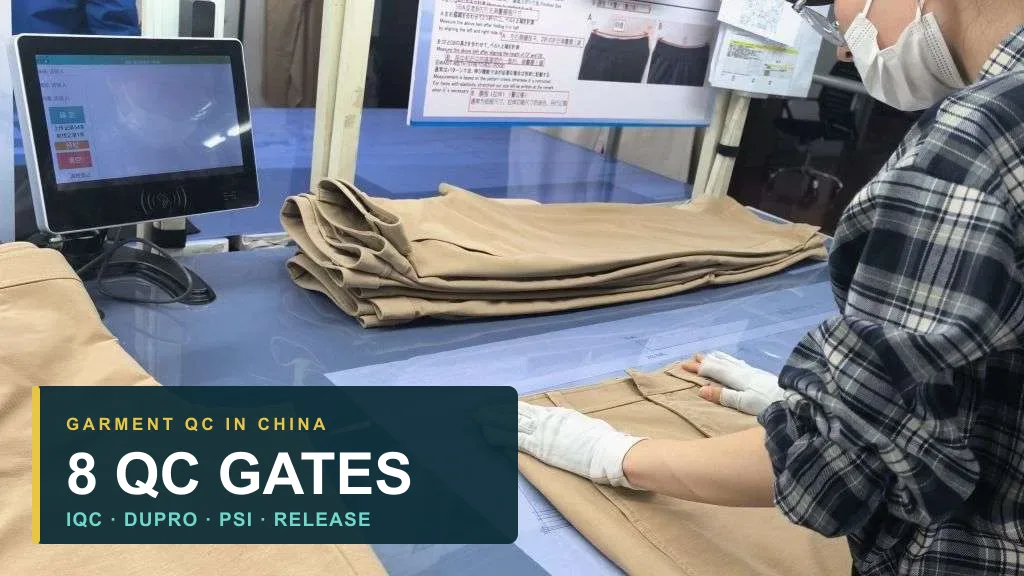
I built this list from repeated apparel inspection programs in those same four provinces, including audits that failed. Before an inspection, I need one approved standard file. A vague PO forces inspectors to rely on memory. A complete file lets me compare the sealed golden sample against the POM chart instead of guessing.
Documents: signed version-matched tech pack; POM chart with tolerances; approved color standard checked in a D65 lightbox; trims list; packing spec; carton marks; barcode file; PO quantity; defect classification table.
Access: factory approval; named QC contact; production schedule; lot breakdown by color and size; fabric roll list; permission to pull random samples independently, not samples a minder selects.
References: the ISO 2859-1 / ANSI-ASQ Z1.4 sampling standard, ISO 3801 for GSM, and ISO 105-A02 for colorfastness grading.
Method: on-site inspection is primary. Factory self-QC plus remote video is the fallback. Remote video misses shade drift and hand feel, so treat it as lower confidence. See our quality control China guide, factory audit checklist, and supplier management.
⚠️ Experience Warning: Never start without broken-needle logs. One factory had no needle-control record at all; we required a written log before allowing any cutting.
I take no fees from factories or inspection bodies. Tie decisions to written standards and evidence.
⚠️ Safety First: Escalate to lab testing when floor checks fail on chemical safety or colorfastness. Confirm destination labeling, children’s drawcord rules (US 16 CFR Part 1120, ASTM F1816; EU EN 14682), and needle control before lot approval.
Garment Quality Control Inspection China: Proven 8-Step SOP
Want fewer returns and fewer disputes? The eight steps below lock the golden sample, defect levels, and AQL counts before each gate.
Step 1: Seal the Golden Sample and Lock Defect Classification

This step locks commercial leverage. At one factory, two inspectors compared a bulk jacket to the sealed sample by touch: panel alignment at the shoulder, stitch feel at the cuff, finish at the hem. Photos missed the shade drift.
Before cutting, approve one sealed golden sample and one measurement-approved size set. Sign both with date, sign-off, and lot code.
Define defects now. Critical defects are zero tolerance. Major defects affect sales or function. Minor defects are cosmetic.
A broken needle or an open seam on kidswear is critical. Mislabeling and severe shade variation are major. Loose trims stay minor unless they create a choke hazard.
Under ISO 2859-1 / ANSI-ASQ Z1.4, classification sets the Ac/Re count, and Inspection Level II sets the sample size. Baseline garment AQL is 1.5 major / 2.5 minor. Premium, kidswear, and high-return SKUs usually tighten major to 1.0, with critical defects still at zero.
| Class | Definition | Examples | Acceptance |
|---|---|---|---|
| Critical | Unsafe to sell or use, or breaks a law or safety standard | Broken-needle fragment, choke hazard on kidswear, banned substances | Zero tolerance (Ac 0) |
| Major | Affects function or salability but not safety | Mislabeling, severe shade variation, open seam on adultwear | AQL 1.5 (tighten to 1.0 for premium and kidswear) |
| Minor | Cosmetic; will not stop a sale on its own | Loose thread, uneven stitch spacing, loose trim without a choke risk | AQL 2.5 |
Success check: factory, buyer, and inspector must all point to the same sealed sample and signed tolerance sheet. If they cannot, production is not ready. Use our pre-shipment inspection guide and quality control program at the next gate.
⚠️ Experience Warning: One factory approved a sample, then cut a different shade lot. Comparing the pilot piece under D65 light was the only thing that caught it. Seal the sample with date, sign-off, and lot code.
Step 2: Clear Raw Fabric and Trims at IQC Before Cutting

The rule is simple: do not cut bulk fabric until IQC clears the lot. I start with fabric hand feel and condition: even shade under light, even tension, no bowing pull, no gritty contamination, and no obvious skew when the roll is opened flat. For the material side, see our textile materials sourcing guide.
Run the intake in this order:
- Verify roll count, lot numbers, and supplier mill paperwork.
- Pull sample rolls across every dye lot.
- Check GSM against the fabric spec.
- Compare color shading lot to lot in a D65 lightbox.
- Inspect for bow, skew, yarn defects, stains, holes, barre, slubs, and knitting or weaving faults.
- Log defects by roll, lot, and severity.
Use the standard four-point system as the screening frame: each defect earns 1–4 points by size, points are counted per 100 square yards, and a roll that exceeds the buyer’s threshold (commonly 40 points per 100 square yards) is rejected. Hold a roll for paperwork or GSM failure. Downgrade a roll when minor defects are spread out but the fabric stays usable. Quarantine a roll for contamination, major shade drift, or critical skew.
For trims, confirm zipper model, button finish, elastic recovery, label stock, barcode file accuracy, and packaging-material match.
In one IQC lot, shade drift and skew showed up on three sample rolls before cutting. We quarantined those rolls and avoided a full-lot rework. The cutter receives only tagged released rolls. When logging visual defects, write location and size (for example, a 3 cm stain at the left chest), not color alone.
For compliance gaps, use our product certification file. For disputed safety checks, escalate to a lab. For repeated supplier misses, escalate through supplier risk management.
⚠️ Experience Warning: On one Jiangsu audit, a low-GSM roll passed the hand check. Weighing a die-cut 100 cm² swatch on a calibrated scale exposed it. We now weigh sampled rolls before release.
Step 3: Run the Pre-Production Meeting and First-Piece Approval

The pre-production meeting sets the tone. Confirm the pattern version, marker plan, construction method, stitch density, machine settings, pressing standards, and inline checkpoints.
Next, run first-piece approval. Inspect pilot pieces against the sealed golden sample before the line ramps up. Feel for panel mismatch, puckering at seam joins, SPI inconsistency, twisting, and trim stiffness. These defects are easier to feel than to see in a spreadsheet.
In the cutting room, verify grainline orientation, stripe/plaid matching risk, lay height, and size-bundle identification.
Production scales only after the pilot garments match the approved spec, workmanship standard, and visual appearance. Simple repeat styles may compress this stage, but document a sign-off either way. For custom programs, see our product development process guide.
At one Ningbo factory, the line supervisor stopped sewing to retension the overlock machine after showing me twisted fabric. Machine speed gets tested before bulk sewing, every run.
I do not skip first-piece approval. A missed panel mismatch at this stage becomes bulk rework later.
Step 4: Run the DUPRO Inspection Gate to Prevent Rework
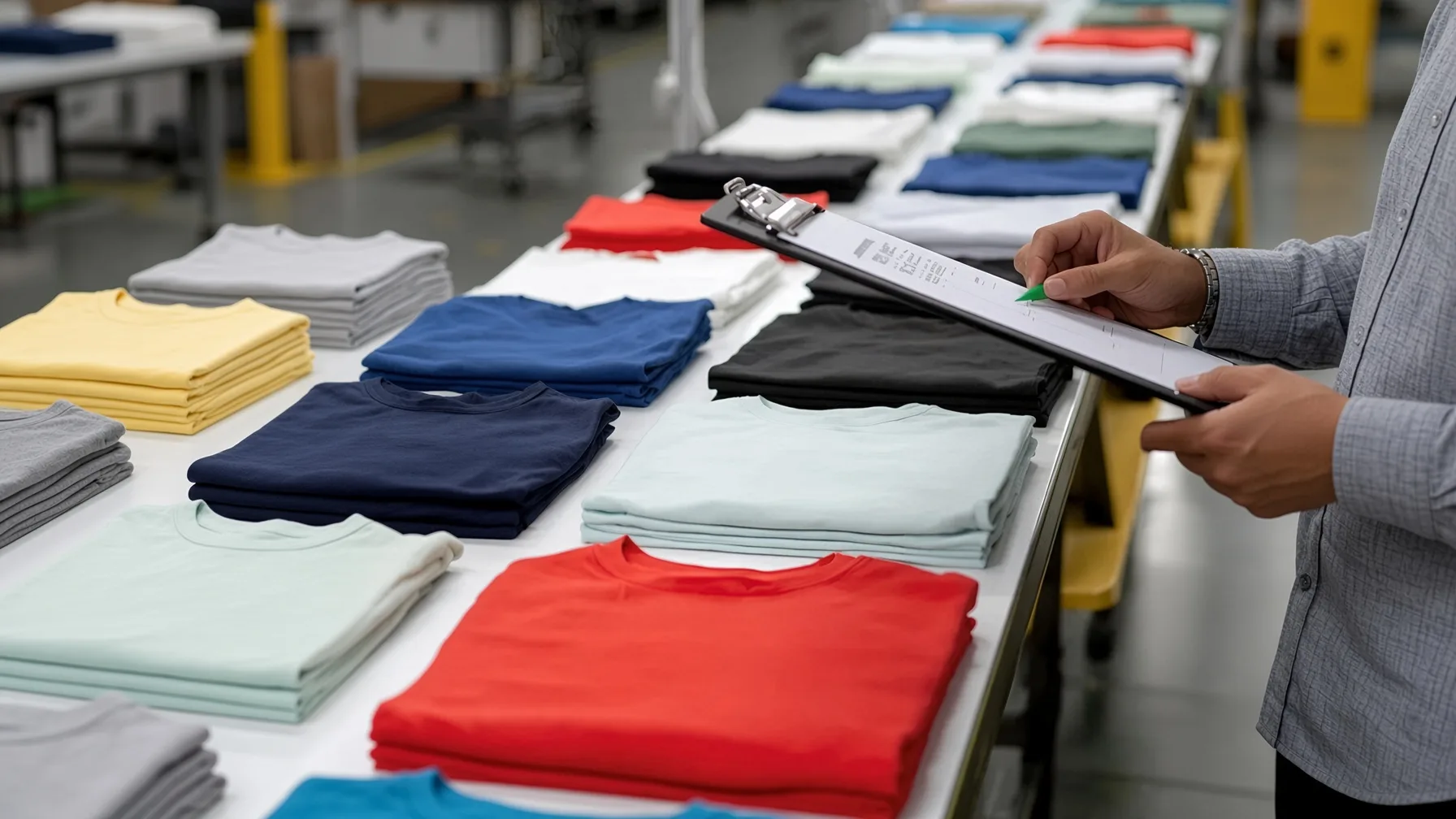
DUPRO happens when a meaningful share of goods is in production. Target 30–50% completion, never after the lot is finished. At that point you can still correct defects without delaying delivery.
Walk the floor in this order. Check bundle identification first. Then inspect sewing workmanship for open seams, skipped stitches, and raw edge exposure. Feel seam alignment for puckering.
Verify SPI consistency with a ruler. Look for loose threads and needle damage risk (broken needle logs must be current). Review print/embroidery quality for off-center placement.
Check symmetry: twisted leg, uneven collar, left/right asymmetry. Finish with pressing and stain control.
Name defects explicitly: open seam, skipped stitch, raw edge exposure, puckering, twisted leg, uneven collar, off-center print, and symmetry mismatch.
Anonymized audit note: in factories that moved from final-only spot checks to the three-tier gate, repeat defects dropped markedly, and DUPRO caught most issues before PSI. Skipping a gate pushes that risk downstream into your balance payment.
DUPRO is your last chance to retrain operators, isolate one line, or stop one colorway without freezing the whole order. Do not rely on factory self-reporting; walk the floor yourself. See our during-production inspection and sourcing from China guides.
Validation: you will see tagged bundles, a live defect log with photos, and a signed DUPRO report. If the line is clean, approve the next production block. If not, escalate through how to choose the right supplier.
⚠️ Experience Warning: A factory’s self-check reported zero defects. The first bundle I pulled had a cluster of skipped stitches. Inspect independently.
Step 5: Validate Measurements, Fit, and Labels at PSI
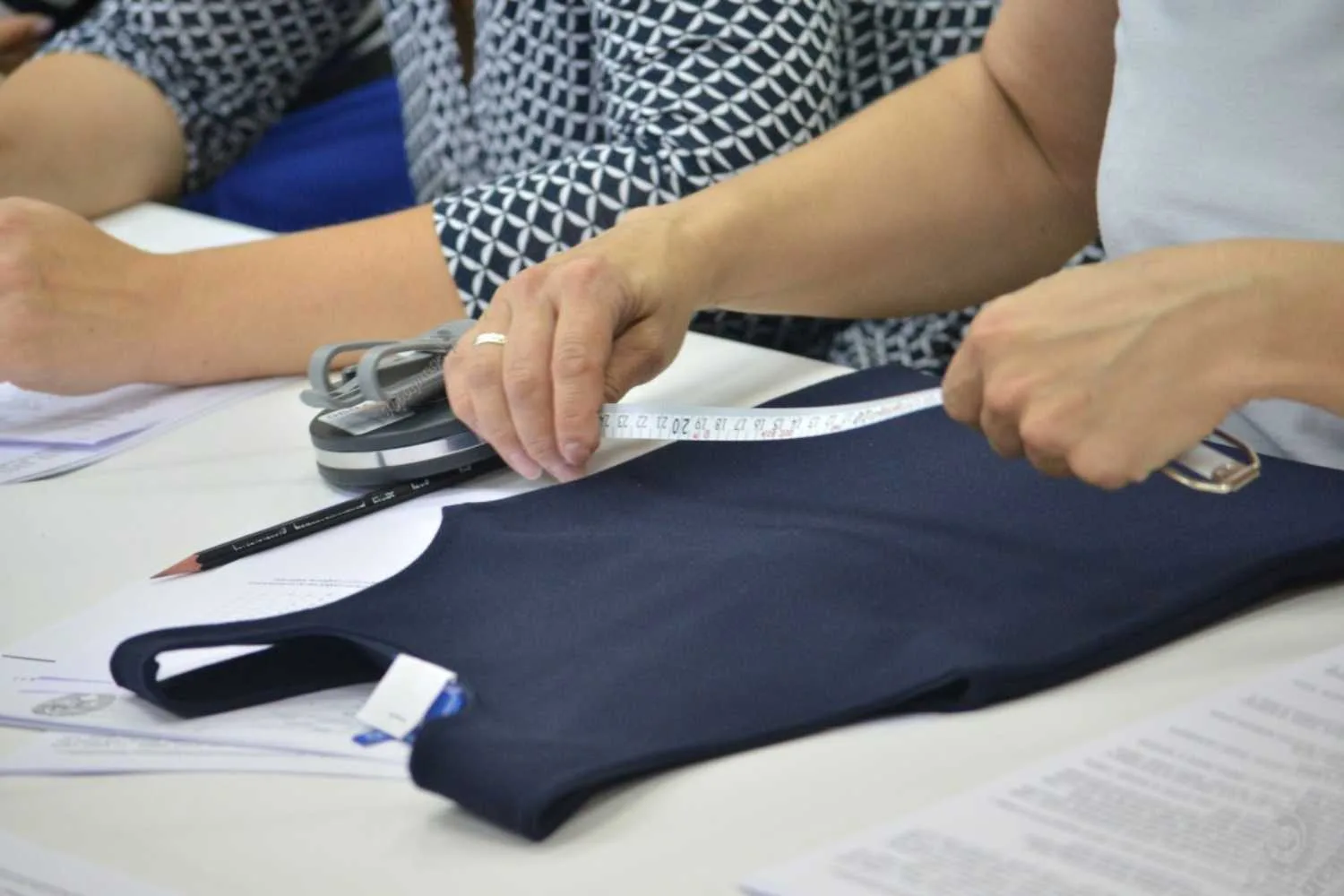
PSI is where buyers underestimate fit and label errors. Workmanship looks clean, but a 1 cm measurement drift or a missing care label triggers returns. Measure against the POM chart at this stage; our product inspection guide covers the full checklist.
Measure on a hard, flat table with the garment laid flat and never stretched. Read chest, body length, sleeve length, waist, inseam, neck opening, and hem width against the tech-pack tolerances, adjusting the list for garment type.
Run the sensory check. A correct garment lies flat without torque, stable elastic recovers fully after stretching, and a zipper runs smoothly without gritty drag.
Check color and wash under D65 light against the approved standard, and flag any shrinkage risk. If floor tests are inconclusive, escalate colorfastness and shrinkage to a lab. Visual checks alone are not enough.
Fold trims and labels into the same pass: care label, fiber content, origin, size label, hangtag, and barcode. Test zipper and snap function, and check pull security. For US market labeling, see the FTC’s Textile and Wool Acts guide and Care Labeling Rule. Confirm product certification where the destination market requires it.
Describe defects precisely. Write “3 cm oil mark at left cuff edge,” not “visible stain.” That helps the factory locate and fix the issue.
For private label programs, coordinate label approval early via our private label China guide.
⚠️ Experience Warning: On a large jeans order, an inseam measurement outside tolerance traced back to the factory working from an outdated size chart. Returns rose enough to show in the category. We now measure at least three garments per size.
Step 6: Run the PSI Decision Gate Before Balance Payment

Do not book PSI on a half-finished line. PSI only works when the order is substantially complete and mostly packed, and the sample reflects the actual shipment. Before you release balance payment, this is the last gate with real leverage.
Run the PSI flow in this order: opening meeting; quantity verification; carton count; random sampling; appearance check; workmanship check; measurement check; function and safety tests; packing review. A clean sample set feels consistent carton to carton: same fold, same shade, same label placement, same finishing standard. Open random boxes; surprise variation is a red flag.
Apply AQL as a count, not a feeling. Lot size and Inspection Level II set the sample size; Critical, Major, and Minor each have Ac/Re thresholds. For a 3,200-piece lot, the sample is 125 pieces: AQL 1.5 major allows 5 defects and fails at 6, AQL 2.5 minor allows 7 and fails at 8, and critical allows zero.
| Lot size | Code letter (Level II) | Sample size | AQL 1.5 major (Ac/Re) | AQL 2.5 minor (Ac/Re) |
|---|---|---|---|---|
| 151–280 | G | 32 | 1/2 | 2/3 |
| 281–500 | H | 50 | 2/3 | 3/4 |
| 501–1,200 | J | 80 | 3/4 | 5/6 |
| 1,201–3,200 | K | 125 | 5/6 | 7/8 |
| 3,201–10,000 | L | 200 | 7/8 | 10/11 |
Single sampling, normal inspection, Inspection Level II. Confirm the Ac/Re values against the current ISO 2859-1 table in your contract, and see our AQL inspection standard guide for worked examples.
In one PSI, we pulled 125 pieces from 40 cartons and found six major open seams, clustered in three cartons. Six hit Re=6, so the lot failed. One critical broken-needle fragment would have failed it alone.
The verdict starts the decision; it does not end it. Check defect clustering, customer risk, and contractual leverage. A failure can be reworkable, and a pass can still need a hold.
Report with lot ID, carton IDs, defect counts, defect codes, defect photos, and measurements. Never write “quality is acceptable.” Use our pre-shipment inspection checklist for the PSI gate and our quality control China guide for gate definitions.
⚠️ Experience Warning: A factory once preselected the top cartons. I rejected the sample and re-pulled from the bottom of the stack, where shade drift showed up in cartons that had looked fine.
Step 7: Verify Needle Control, Packing, and Logistics Release
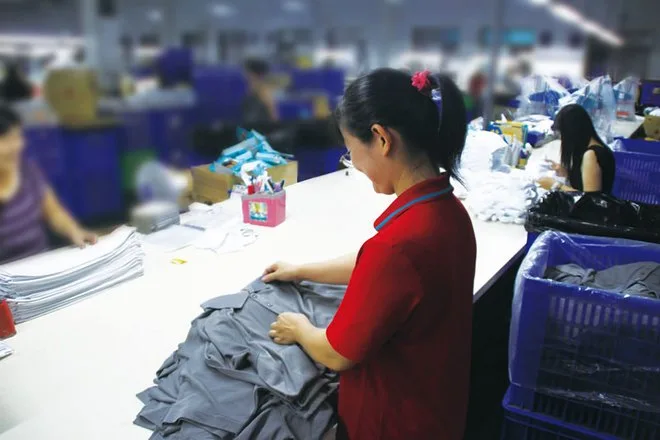
This gate runs after PSI passes and before the container seals. It protects packing and logistics execution.
Needle control belongs in the DUPRO and PSI safety checks, not in a last-minute scramble at the door. At PSI we confirm the broken-needle log is current and watch the detector alarm response. In one audit, a metal tip surfaced inside a baby shirt at the metal-detection check. The factory stopped the line at our request, and the affected units were quarantined before packing.
Move to unit packing. Check the fold standard against the approved sample. Feel the polybag seal: it must be secure with no gaps.
Verify suffocation warnings where applicable. Confirm assort ratios and desiccant use. Scan barcodes: each must read cleanly on the first pass. For carton and polybag specs, see our packaging quality standards.
Then inspect outer cartons. Shipping marks match the PO. Count cartons. Check dimensions, gross/net weight, and carton condition.
Cartons should feel structurally consistent, not crushed, overfilled, or wet-softened. Confirm palletization or loading readiness.
For channel compliance, verify marketplace labels and destination-warehouse formatting. A single unscannable FNSKU label once caused a multi-day FBA hold.
The shipment is release-ready only when unit pack, master carton, and documentation all match the PO and logistics instructions. For the next step, see our Amazon FBA prep services, logistics management, and shipping from China.
⚠️ Experience Warning: On one inspection, the top cartons looked perfectly dry. A box from the bottom row collapsed in my hands. Touch the bottom cartons to find water damage.
Step 8: Choose the Post-Inspection Path and Lock Rework Terms

After PSI, the verdict is only a signal. Isolated defects look random: one cuff, one carton. Systemic failure repeats across size runs, cartons, or one line. Treat repeats as a process failure.
Choose one path: rework and reinspect, supervised sorting of acceptable units, or shipment hold/rejection. Document scope precisely: defect type, quantity, location, responsible process, deadline, and who pays reinspection. Use photos and carton IDs. No vague “fix quality.”
Factory owners sometimes dispute defect levels. The answer is the signed golden sample and the written defect-classification contract, not a negotiation. Point to the sample and the table.
Do not release balance payment until the corrective path is agreed in writing and verified. For leadership, tie each release to brand risk, customer complaints, and landed-cost impact. See our how defects impact margin analysis and supplier price negotiation guide.
⚠️ Experience Warning: A factory called a repeating shade drift “minor.” It ran across several cartons and two sizes. We held balance until the lot was sorted and reinspected at the factory’s cost.
Troubleshooting

Factory Says the Seam Issue Is “Normal”
Problem: Seam puckering or open seams get waved off.
Why it happens: “Normal” is opinion until it meets a written standard.
What to do now: Compare the sealed sample, POM chart, and defect table. Photograph the defect with a ruler. Ask for the written AQL classification. Repeating puckering on one machine line points to tension. If it fails major AQL, hold balance.
PSI Fails but Delivery Is Urgent
Problem: A failed lot blocks a hot shipment.
Why it happens: Urgency tempts verbal promises.
What to do now: Rework and reinspect isolated defects. Sort clean cartons under supervision when a batch mixes clean and defective units. Hold systemic or safety-critical failures. Get corrective action in writing; shipping without it destroys your leverage. See our import guide.
Small Order, Inspection Feels Expensive
Problem: The fee looks huge against a small PO.
Why it happens: Inspectors charge by man-day plus travel, not order value.
What to do now: Use AQL random sampling; it usually suffices. Save 100% inspection for safety or high-return SKUs. Combine SKUs or factories in one trip, and book DUPRO at 30–50% completion, because fixing a line costs less than a finished lot. Third-party QC pays for itself when returns or balance payment outweigh the fee.
Factory Passed Its Own QC, Third-Party Fails
Problem: Self-QC says clean; independent inspection finds majors.
Why it happens: Self-reporting bias: the line wants to ship.
What to do now: Re-pull from the bottom of the stack. Demand line-by-line evidence: carton IDs, defect photos, counts. Check the factory’s own audit records against yours, and read our third-party inspection vs factory QC comparison.
Bulk Does Not Match the Approved Sample
Problem: Bulk feel, shade, or fit differs from the signed sample.
Why it happens: A missing PPS lock, fabric-lot drift, or line change. Shade drift isolated to one dye lot is the clue.
What to do now: Compare under D65 light. Quarantine suspect lots. Reinspect before release.
People Also Ask About Garment Quality Control Inspection China
1. What is the difference between IQC, DUPRO, and PSI in garment quality control?
They are three separate release gates, not one final check. IQC clears fabric and trims before cutting. DUPRO inspects work in progress at 30 to 50 percent completion. PSI validates the finished, packed lot before balance payment.
In factories that run all three gates, repeat defects drop and fewer failures reach PSI. Skipping a gate pushes risk downstream. Steps 2, 3, and 5 above show the full flow.
2. What AQL level should I use for apparel inspection in China?
For garment quality control inspection in China, start with AQL 1.5 for major defects and AQL 2.5 for minor defects. Tighten major defects to 1.0 for premium, kidswear, and high-return SKUs. Keep critical defects at zero tolerance.
Sample size comes from Inspection Level II under ISO 2859-1 / ANSI-ASQ Z1.4. This baseline catches commercial issues without over-rejecting clean lots. The defect table in Step 1 sets the Ac/Re counts.
3. How long does a garment QC inspection take?
Plan one to two man-days for a typical lot. Time scales with sample size, carton count, and how many sizes need measuring. A 3,200-piece lot at Level II needs 125 pieces sampled. Measuring three pieces per size adds hours.
Book PSI windows before production starts so nobody rushes the floor, and travel to Zhejiang or Guangdong adds a day. Book early for Q4.
4. Can I run apparel QC remotely with video?
Use remote video only as a fallback. It misses shade drift, fabric hand feel, and seam tension. A camera cannot show how a zipper glides or how elastic recovers. Remote checks have passed rolls that failed a physical weigh-in.
Use video for paperwork and carton counts. Book on-site inspection for IQC, DUPRO, and PSI. Confidence drops fast without hands-on checks.
5. What is the most common defect in garment manufacturing?
Open seams and skipped stitches top the list. Shade drift across dye lots and measurement variance come next. In one PSI, 125 pieces pulled from 40 cartons turned up six major open seams clustered in three cartons, enough to hit Re=6 and fail the lot.
Broken needles are rare but always critical. Loose trims stay minor unless they create a choke hazard. Log defect location and size so factories can fix fast.
Conclusion
Strong garment quality control inspection in China is a sequence of release gates, not one final check. A controlled shipment looks consistent, measures within tolerance, scans correctly, and ships without a last-minute argument. A risky one shows up as shade drift, open seams, and label errors after the container leaves.
Start with a written standard and put it in the PO. Book inspection dates before the factory cuts fabric, and hold balance payment until the corrective path is agreed in writing and verified.
This article rests on process evidence, floor observations, and operational standards, not factory marketing claims. I take no fees from factories or inspection bodies.
The cleanest shipments I have released shared one trait: every gate was logged, signed, and compared to the sealed sample before the next one opened.
Need hands-on support? Contact LeelineGroup for apparel QC and checklist implementation.

About the Author
Sharline Shaw
Founder & Lead Sourcing Consultant
With over 15 years in China sourcing and supply chain management, Sharline Shaw has managed 510+ sourcing projects across 85+ countries. Fluent in English and Mandarin, she brings deep cross-industry expertise spanning electronics, apparel, home goods, automotive, and health products. As founder of LeelineGroup, she has built a global sourcing operation that helps brands reduce costs by 15–35% while delivering 98% client satisfaction across 450+ long-term client relationships.
Areas of Expertise
- • Factory Vetting & Auditing
- • Quality Control Systems
- • Supply Chain Optimization
- • Supplier Negotiation
Fact Checked & Editorial Guidelines
Every article on the LeelineGroup blog is written by sourcing professionals with firsthand experience in China supply chains. Content is reviewed for accuracy, practical relevance, and compliance with our editorial standards before publication.
Your trust is important. Learn more about our Fact Checking Process and Editorial Policy.