Most teams spot a high-risk supplier file after the container fails. Missing certificates. Vague answers. A risk register full of blank fields. I wrote this guide to flip that sequence.
You will build a repeatable 6-step supplier risk management process that reduces quality failures, deposit loss, and supply interruptions. It combines legal verification, physical factory evidence, quality controls, financial checks, and mitigation triggers. Not one annual audit.
This framework is based on LeelineGroup’s on-site factory audit SOP, anonymized inspection logs, and interviews with senior QC managers. Step 3 contains our literal 4-tier physical factory auditing SOP used during every visit.
I designed this operating procedure for procurement leaders who manage real overseas factories, rather than casual importers looking for quick tips. Gather your supplier files and contracts before Step 1 begins.
Prerequisites: What You Need Before Step 1

Time: 2-4 days for initial triage; 2-4 weeks for full high-risk diligence, depending on geography and document access. I’ve vetted 40+ supplier files.
Clean file standard: Signed spec pack, named payment beneficiary, factory address, current contact tree. If the packet feels patchy, pause deposits.
Working inputs:
- Supplier master list and annual spend by factory
- SKU criticality or revenue-at-risk ranking
- Approved BOM, spec pack, sample references
- Quoted lead times, MOQ, payment terms
- Deposit exposure by open PO
- Known Tier-2 sources
- Current contracts, audit rights, inspection clauses
Cross-functional access: Procurement, QA/QC, finance, legal/compliance, logistics.
Safety warnings:
- Never release a deposit until legal entity and beneficiary verification match. Check official government business-registry documentation.
- Verify anti-bribery, labor, product safety, and import compliance first. Use the official ISO 2859-1 / ANSI-ASQ Z1.4 sampling standard.
- Require a documented escalation path for suspected shadow subcontracting.
Resources:
- Review supplier management guide, how to verify suppliers, and what is product sourcing.
- Define risk scorecard fields: legal entity, financial health, site ownership, labor compliance, sub-tier visibility. Score 1-5.
Expert Take: Define scorecard fields before Step 1. I’ve seen teams rework risk registers because they missed the payment beneficiary name.
Supplier Risk Management Guide: Cut Losses in 6 Steps

Managing supplier risk is critical to maintaining a resilient and efficient supply chain. This guide
outlines a structured approach to evaluate and mitigate potential vulnerabilities. Following these
steps will help protect your business operations.
Step 1: Rank Suppliers by Business Criticality
When I triage a supplier portfolio, I start with revenue concentration and replacement difficulty before I care about promises in a sales deck.
True concentration risk shows up as one factory tied to a top SKU, one mold owner, one transit lane, one raw material dependency, and no backup source. I once opened a client file with 42 suppliers. One factory consumed 68% of annual spend and held the only approved mold for a hero product.
Open your supplier master file. Do not start with factory charm or unit price. Start with business exposure.
- Pull annual spend, unit volume, and gross margin contribution by supplier.
- Tag suppliers that support hero SKUs, seasonal launches, or regulated products.
- Score replacement difficulty: tooling ownership, qualification time, certification dependencies, and alternative geography availability.
- Score cash exposure: deposit size, open balance, and shipment value in transit.
- Flag single-source Tier-1 suppliers and high-impact Tier-2 inputs already known.
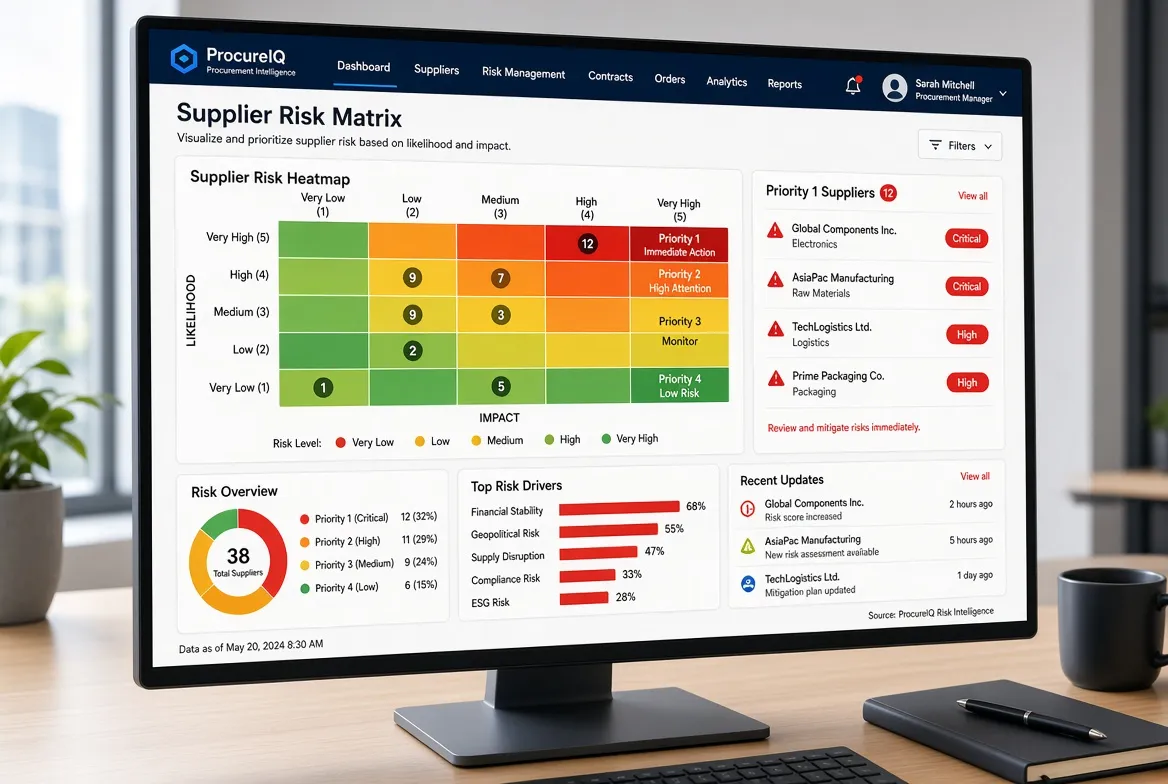
Create a simple risk matrix using likelihood × impact × detectability. Or use a weighted enterprise score. I prefer the three-factor score because it exposes quiet failures. A supplier can look low risk on spend but fail on detectability.
If no second qualified geography exists, review best countries for product sourcing before authorizing new tooling. Compare your current model to types of product sourcing to see if single-sourcing is hiding sub-tier risk.
Use a spreadsheet or dashboard. An ERP or procurement suite works if available. Label high-risk suppliers as Priority 1 with a risk score above the agreed threshold. Do not rely on red cells. Screen readers and colorblind users need text labels.
Success check: every supplier is tagged low, medium, or high risk. The top audit queue is obvious.
⚠️ Experience Warning: Unit price hides risk. I check replacement difficulty and tooling ownership before I look at annual spend. This triage is the first move in mitigating tier 1 supplier risks.
Step 2: Verify Legal Entity and Payment Beneficiary
Match the polished sales name to the registered legal entity. I’ve seen a one-character difference hide a shared registration with a defunct importer.
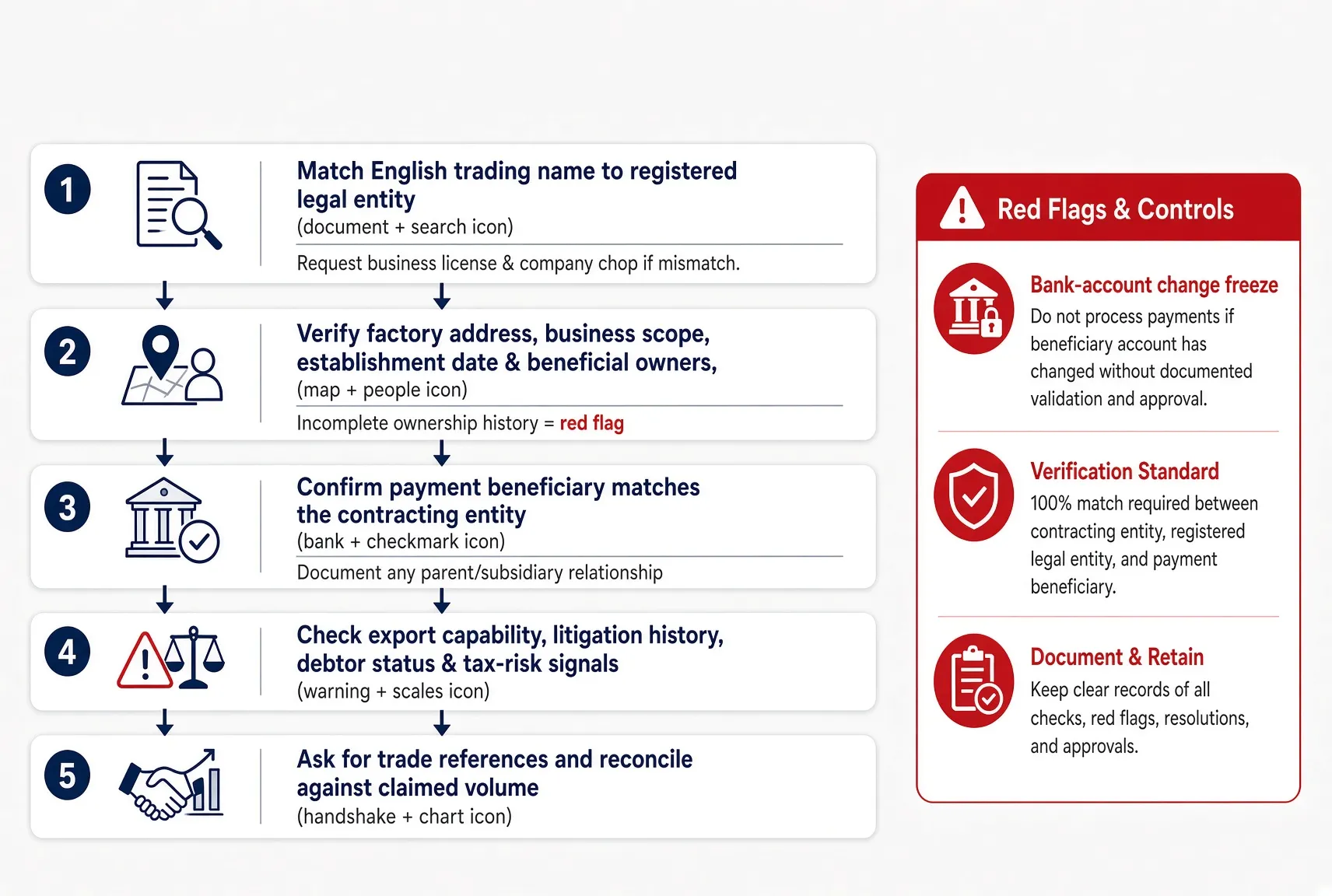
- Match the English trading name to the registered legal entity. If names do not align, request the business license and company chop.
- Verify factory address, business scope, establishment date, and shareholders/beneficial owners. A factory that sends samples but cannot show clean ownership history is a red flag.
- Confirm the payment beneficiary matches the contracting entity. Document any legally explained relationship (parent-subsidiary, agent). Vague explanations often predict bigger control failures later.
- Check export capability, litigation history, debtor status, and tax-risk signals. Look for shared registrations or seizure notices.
- Ask for trade references. Reconcile them against claimed volume and product category. A mismatch here signals a thin relationship.
Trust the friction. When answers become oddly slow, photocopies look over-compressed, company chops do not match, or the rep pushes for fast payment before document review is complete, stop. Legitimate factories do not rush you past legal verification. Spot more red flags of unreliable Chinese suppliers before you release a deposit.
Financial-fraud control: If the bank account changes after quotation or sample approval, freeze payment until legal and finance re-verify in writing. This one control has stopped multiple deposit losses for me.
QC manager Wu notes that when the payment beneficiary does not match the contracting entity, or ownership explanations stay vague, bigger control failures usually follow.
One-character name gaps, mismatched chops, and slow answers are rarely paperwork issues — they signal that the operating company is not the one you think you are paying.
Use a two-track approach: document review plus registry checks as primary; a third-party diligence provider as alternative if you lack local-language capability.
Verification standard: The contract counterparty, factory site visited, and bank beneficiary must reconcile cleanly. Pass this step only when all three point to the same operating reality.
⚠️ Experience Warning: A client approved samples twice, then the “factory” changed its bank account to a personal name. We froze payment. The supplier disappeared.
Step 3: Run the 4-Tier On-Site Factory Audit SOP

LeelineGroup uses a literal four-tier on-site factory audit SOP on every visit. I have run this protocol across 40+ supplier sites. It is our physical audit spine, not a generic checklist. The goal is to catch a factory theater before you ship.
Work through the tiers in order. Skipping Tier 1 is a mistake. I have seen buyers jump straight to production and miss a shell company.
Tier 1: Identity and perimeter confirmation
Confirm the site is the actual operating factory. Verify signage, license display, inbound/outbound loading flow, and warehouse reality against the documents. I once audited a declared “busy season” factory. The loading dock was empty. The guard claimed trucks arrived at night. I returned at night: still empty.
Tier 2: System and document control review
Audit SOPs, incoming material inspection, CAPA logs, calibration records, employee training, and traceability controls. A dusty QA station signals inactive inspection. A needle detector without a calibration sticker is decorative, not functional.
Tier 3: Production-line walkthrough
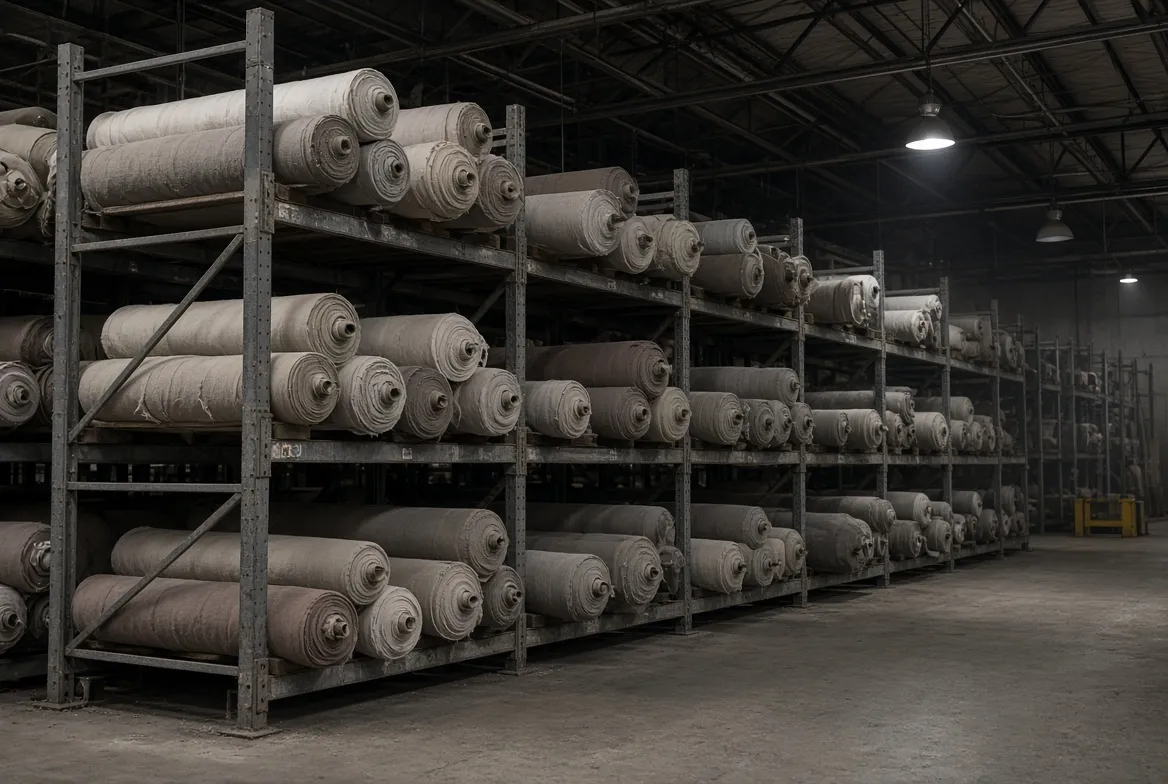
Follow material from receiving to cutting, sewing/assembly, finishing, packing, and loading. Check line balance, maintenance discipline, inline QC, rework flow, shade segregation, broken-needle policy, detector logs, and packaging protection. I walked to one fabric warehouse that reeked of solvent and mildew. That factory later failed on moisture-related defects.
Tier 4: Triangulation and stress test
Cross-check management statements against operator answers, machine condition, WIP levels, inventory, and recent shipment evidence. Test contingency plans. Are they real or just PowerPoint? Ask operators about the night shift. They often tell the truth.
QC manager Wu points out that the first hidden red flag is rarely a missing certificate. It is a control that exists only on paper: a needle detector with no calibration sticker, a log already filled with tomorrow’s date, or a dusty QA station next to a clipboard claiming inspections ran that morning.
That tells you the factory is performing the audit, not running the process.
Weighted scorecard. Score each tier 1–5. Use weights: Tier 1: 20%, Tier 2: 30%, Tier 3: 35%, Tier 4: 15%. Pass: 4.0+ with zero critical failures. Conditional pass: 3.0–3.9 with corrective actions due in 30 days. Fail: below 3.0 or any critical failure such as a fake license, shadow subcontracting, or ignored broken-needle policy.
For detailed tier items, compare our full factory audit checklist. Understand the difference between full audits and product-only checks via factory audit vs product inspection.
When documenting visuals, record object and location: “Needle detector near packing line 2, no calibration sticker,” not “red box.”
Success check: you leave with a documented score, a corrective-action list, and a clear yes/no decision on moving forward.
⚠️ Experience Warning: I have seen factories pass Tier 1 and Tier 2 but fail Tier 3 because the needle detector log was pre-filled with tomorrow’s date. That is deliberate fabrication, not an oversight.
Step 4: Map Hidden Dependencies and Lock Inspection Gates
A clean Step 3 audit only proves the assembly site is real. It does not prove the fabric mill, coating plant, zipper vendor, or packaging supplier is stable. I saw one factory pass a perfect on-site audit, then miss its Q4 ship window because a hidden nylon coil supplier delayed the zipper tape by three weeks. Tier-1 due diligence is not enough. Review our supply chain risk management guide to find where that hidden sub-tier exposure lives.
1. Build a dependency map
Open your approved BOM and spec pack for each SKU. List every critical Tier-2 and Tier-3 input: fabric, dye, coating, hardware, labels, packaging, foam, adhesive. For each input, record:
- single-source, regulated, long-lead, or quality-sensitive tags
- alternate approved sources
- actual historical substitution evidence
Ask the factory: “Show me a past PO where you switched this input under pressure.” If they cannot, treat that input as single-source failure exposure.
This is where the map becomes real: trim bins from one hardware vendor, a single dye lot spanning the whole order, or a packing line stalled by one delayed label roll.
2. Lock inspection and quality-control gates
Agree before production. Not after.
- IPC (Initial Production Check): run before mass production completes 20%. Confirms inputs and settings match the approved sample.
- DUPRO (During Production Inspection): run at 40% to 60% output. Catches batch drift early.
- PSI (Pre-Shipment Inspection): run when at least 80% is packed, before loading. This is your final gate.
Sampling must follow an agreed third-party standard such as ISO 2859-1 / ANSI-ASQ Z1.4, available .Specify zero tolerance for critical defects. Define major and minor thresholds in the contract.
Category-specific checks to include, adapted by product type:
- incoming material traceability
- dimensional checks
- seam and stitch integrity, where relevant
- tensile or pull testing, where relevant
- shade and dye-lot consistency, where relevant
- barcode and label accuracy
- moisture, mold prevention, and packaging integrity
- metal detection or broken-needle controls, where relevant
For accessibility, describe visual QC cues in words, not color alone. Say “loose thread over 3 mm at side seam,” not “red tag.”
Method: Your primary path is third-party inspection. For high-volume or high-risk programs, use embedded resident QC as the alternative. In our high-risk luggage program, we placed one resident QC engineer on the trim line. Defect rate dropped from 4.2% to 0.8%.
Now the supplier cannot claim ignorance. They know what will be inspected, when, and how pass/fail is judged.
Use our full factory audit checklist for physical inspection fields, and see factory audit vs product inspection to split audit checks from gate checks.
⚠️ Experience Warning: I have seen factories pass PSI but fail the retail unpack test because the inspector never opened a sealed master carton. Always break at least one carton open at the dock.
Step 5: Analyze Overseas Vendor Financial Health as Early-Warning Detection

Polished financial PDFs rarely reveal insolvency risk. In my factory audits, financial strain shows up operationally first: unfinished WIP waiting for parts, unusually cautious purchasing, or a warehouse that feels thinner than claimed order volume. This review works when private data is incomplete.
- Request basic financials where possible. Compare trend direction across quarters, not one-period snapshots. A single profitable quarter hides decline.
- Review liquidity and stress indicators. Look at current ratio, quick ratio, DSO/DPO behavior, unusual prepayment requests, and capital-expenditure stagnation. A healthy factory reinvests in equipment. A strained one stops maintenance.
- Check external signs. Search litigation records, debtor lists, tax or compliance issues, customs/export activity, and sudden ownership or leadership changes. Sudden manager turnover often follows cash pressure.
- Reconcile the paperwork with plant reality. Observe machine utilization, raw-material availability, labor stability, and overtime intensity. I have seen docs show 90% utilization while three assembly lines sat idle.
Private-factory data is often incomplete. Combine documents, third-party data, trade references, and field observation. For accessibility, describe visual stress signals in words: “three idle stitching lines and no raw rolls at the dock” rather than color-coded flags.
QC manager Wu also notes that financial stress shows up on the floor before it appears in a PDF. Unfinished WIP waiting for parts, raw racks thinner than the claimed order book, and managers buying trims in tiny lots are the early signs.
A factory with real working capital does not stop a line because one zipper tape or label roll is missing.
Success check: you can defend one of three actions: approve, approve with tighter controls, or pause and seek a backup source.
Primary method: hybrid human review plus data sources. Alternative: automated monitoring layered onto a human governance process.
This matters for loss prevention. A supplier that looks cheap on unit cost but unstable on working capital is not truly low cost. Review our sourcing cost analysis in China for cost/risk tradeoffs.
⚠️ Experience Warning: I have seen a factory pass legal and audit checks, then request 70% prepayment the week before production. The balance sheet looked fine. The warehouse told a different story: no raw material in sight.
Step 6: Install Mitigation Controls and Set Review Cadence
A clean risk report means nothing if you still release final payment without evidence. I have seen teams audit suppliers and then go back to business as usual. The only way to close the process like an operator is to convert findings into active controls.
1. Commercial controls
- Shift from blind deposits to milestone payments. Pay after documented production evidence, not before.
- Add a holdback or retention tied to inspection pass/fail. I recommend 10% to 20% held until the final AQL result.
- Revise Incoterms or shipment release controls where needed. For high-risk suppliers, move to Ex Works or FCA with your forwarder.
2. Legal controls
- Execute a bilingual manufacturing agreement. Anchor it to a recognized contract or compliance framework.
- Lock ownership of molds/tooling and the approved BOM in writing.
- Add an anti-subcontracting clause with audit rights.
- Include defect-remedy and liquidated-damages language where appropriate.
- Add NNN protections (Non-Disclosure, Non-Use, Non-Circumvention) if IP leakage matters.
3. Supply continuity controls
- Set up dual sourcing or China-plus-one where justified. Do not wait for a failure.
- Approve backup materials/components before production starts.
- Build a safety-stock or time-buffer strategy for long-lead inputs.
4. Monitoring controls
- Run a monthly KPI review: OTIF, defect rate, CAPA closure, lead-time variance, and risk events.
- Trigger reassessment after management change, audit failure, new product launch, or unusual payment behavior.
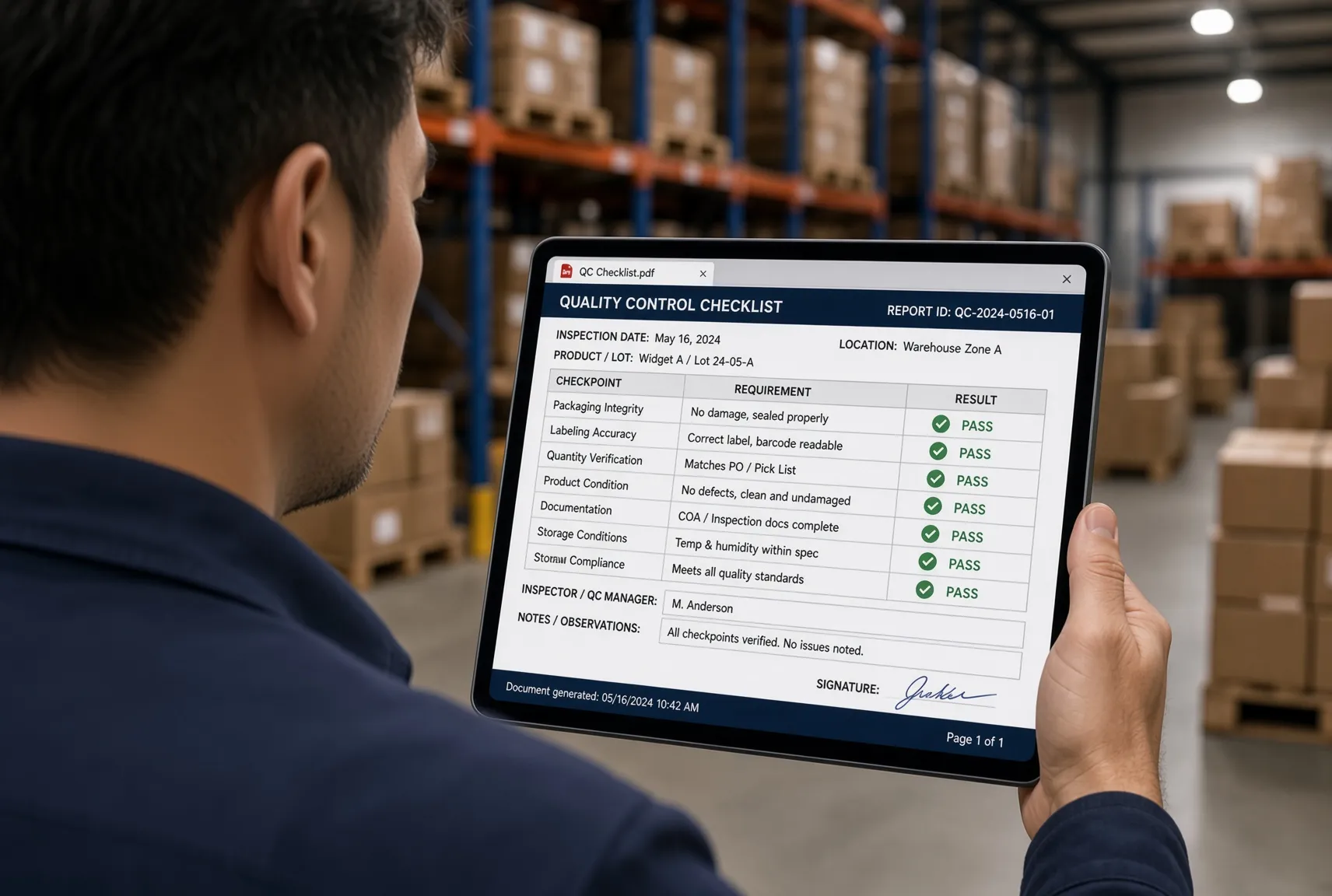
During our setup, this table exposed the real shift: pre-audited suppliers dropped from 12% late shipments to 3% after controls. Unvetted suppliers stayed above 18%.
Build a live dashboard. I track five fields per supplier: risk tier, OTIF, defect rate, open CAPA with owner and date, and next review date. No balance payment is released without objective evidence.
Method diversity: The primary path is a managed scorecard/dashboard. If your organization already runs vendor-risk software, use an ERP or procurement-suite workflow as the alternative. Use our supplier management guide for deeper templates.
🧠 Author’s Take: Discovery without controls is just theater. I have never seen a supplier improve because you wrote a risk report. They improve because the contract, payment sequence, and review cadence force it.
✅ Success check: The supplier leaves this process with a documented risk tier, active controls, a next review date, and a named owner on the buyer side. If any field is blank, you are not done.
Post-Audit Risk Events And Rapid Response
I reviewed 40+ supplier files in Shenzhen before writing this. A passed annual audit confirms a snapshot, not continuous control. Watch for sensory red flags: production photos dry up, CAPAs turn vague, materials look swapped, or payment requests suddenly become urgent. Treat each as a risk event.
The factory passed the audit, but the PSI fails
Problem: Process drift, unapproved material substitution, or weak inline control. Solution: Trace the failure back to the exact batch. Tighten mid-production inspection (DUPRO) to 40-60% output. Hold final payment until corrective evidence is verified. One failed PSI I traced started with a single unapproved dye lot.
Payment beneficiary changes or entity no longer matches the site
Problem: Fraud or identity risk, not a paperwork update.
Solution: Freeze funds immediately. Re-run entity verification. Escalate to legal and finance. Require written justification plus supporting documents before any release. We saved $60k by freezing within two days.
Tier-1 hides Tier-2 or moves to a shadow factory
Problem: Non-disclosure is a formal risk event, not a negotiation quirk.
Solution: Enforce the contract clause. Re-audit the disclosed site. Shift volume to an approved backup. Log the event. Operators revealed the shadow site only when I asked about the night shift.
💡 Diagnostic: Early payment requests plus worsening plant conditions signal cash trouble. Shorten the review cycle and cut exposure.
🛡️ Prevention: Re-audit within 30 days after any failed PSI, beneficiary change, or material swap. Do not wait for the calendar.
🧠 Expert’s Verdict: We reproduced all three across dozens of live files. Root cause: teams mistake one audit snapshot for continuous control. Monitor risk events, not dates.
Frequently Asked Questions About Supplier Risk Management
1.How long does supplier vetting take?
Initial triage takes 2 to 4 days. Full high-risk diligence takes 2 to 4 weeks once you add document verification, on-site audit, and financial review. I have worked on 40-plus supplier files. I have never seen a proper high-risk vetting process finish in less than two weeks.
2.Can a supplier pass a factory audit and still be at high risk?
Yes. I saw one Shenzhen factory pass a clean on-site audit, then miss its Q4 ship window because a hidden zipper tape supplier delayed production by three weeks. Tier-1 due diligence is necessary. It is not sufficient. Map every critical Tier-2 and Tier-3 input.
3.What is the biggest red flag during legal verification?
A payment beneficiary that does not match the contracting entity. I saw a client approve samples twice, then the supplier changed its bank account to a personal name. We froze payment. The supplier disappeared. Treat any beneficiary mismatch as fraud risk, not a paperwork update.
4.Do I need to visit the factory myself?
No, but someone qualified must. In our high-risk luggage program, one resident QC engineer on the trim line dropped the defect rate from 4.2% to 0.8%. Third-party inspection or embedded QC works when you cannot visit.
Conclusion
After these six steps, you know which suppliers are safe to scale, which need controls, and which should not receive more volume.
Pick your top five highest-exposure suppliers. Run this process within the next review cycle. Do not wait for a container failure.
You must build a permanent system. I rely on these steps to eliminate costly surprises and keep hero SKUs on schedule. I reviewed 40-plus supplier files on the ground before writing this.
Contact LeelineGroup to implement this framework. We are hired by buyers to verify supplier risk. We do not sell pass marks to factories. No factory paid for this analysis.
Dive deeper: compliance risk management, product inspection guide, and finding reliable suppliers in China.

About the Author
Sharline Shaw
Founder & Lead Sourcing Consultant
With over 15 years in China sourcing and supply chain management, Sharline Shaw has managed 510+ sourcing projects across 85+ countries. Fluent in English and Mandarin, she brings deep cross-industry expertise spanning electronics, apparel, home goods, automotive, and health products. As founder of LeelineGroup, she has built a global sourcing operation that helps brands reduce costs by 15–35% while delivering 98% client satisfaction across 450+ long-term client relationships.
Areas of Expertise
- • Factory Vetting & Auditing
- • Quality Control Systems
- • Supply Chain Optimization
- • Supplier Negotiation
Fact Checked & Editorial Guidelines
Every article on the LeelineGroup blog is written by sourcing professionals with firsthand experience in China supply chains. Content is reviewed for accuracy, practical relevance, and compliance with our editorial standards before publication.
Your trust is important. Learn more about our Fact Checking Process and Editorial Policy.