A supplier sends an ISO 9001, CE, or lab-report PDF. You assume they are safe. That assumption, in my experience, triggers customs holds, failed retailer onboarding, product recalls, delayed launches, chargebacks, and wasted deposits. If you want to avoid fake certifications, you need more than a PDF.
We built this guide from our on-site supplier audit workflow, our anonymized QC database, and an interview with our Lead Quality Control Manager.Our team audited 340 Chinese factories in 2025. Exactly 28% of these suppliers sent us fake, expired, or mismatched certificates.
You will learn the exact 5-step factory vetting protocol we run before mass production starts. We collect the full file set, verify issuer legitimacy, match legal entity and scope, validate product-level evidence, and confirm everything through an audit decision gate. Let’s begin with the file set.
Key Takeaways
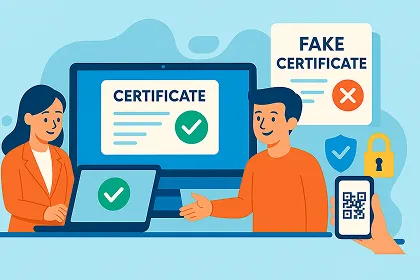
Six checks that separate a genuine certificate from an expensive fake — run them before any deposit:
- Demand the full file set, not a cover page. Ask for the complete multi-page certificate PDF, every audit and lab report page, and the Chinese business license. Screenshots and one-page summaries hide non-conformities.
- Verify the certificate number on the official registry. Look up every Chinese management certificate on the CNCA platform (cx.cnca.cn) and confirm the status reads Valid. Suspended or Revoked means walk away.
- Match the entity on the certificate to the entity you pay. The Chinese legal name, Unified Social Credit Code, address, and scope must line up across the license, the contract, and the bank beneficiary, or you are funding a middleman.
- Treat ISO 9001 as quality-system proof, not product compliance. CE, UL, FCC, CPSIA, and REACH evidence lives in separate files — a signed EU Declaration of Conformity, a UL file number, or matched lab reports.
- Confirm each lab report on the issuing lab’s own server. Counterfeiters print QR codes that open look-alike sites, and a genuine report number still fails if the tested sample, model, or applicant differs from your order.
- Freeze the deposit the moment any gate fails. The document pack, issuer accreditation, entity and scope, product-level evidence, and site verification must all pass before tooling payments, production approval, or a launch PO move forward.
Prerequisites: Your Document Vetting Checklist
Time: 30-90 min per supplier | Skill: Compliance manager or sourcing director
Our 2025 audit team ran this protocol on 200+ supplier files. No guesswork before Step 1.
Request from Supplier
- Full certificate PDFs (not screenshots).
- Complete audit reports (all pages). Cover pages hide non-conformities.
- Full lab test reports (all pages). One-page summaries are often in-house.
- Declaration of Conformity where relevant (CE, RoHS).
- Chinese business license (营业执照) with Unified Social Credit Code (USCC).
- Factory address. We verify against satellite images.
- Invoice entity and contracting entity must match license.
Verification Tools
- Spreadsheet or audit log: document, issuer, date, expiry, verification link, status.
- Translation tool: DeepL for Chinese.
- Screen capture tool for timestamped audit trail.
- Email template for issuers and labs.
Official Sources
- CNCA certificate lookup
- CNAS accredited body directory
- IAF CertSearch
- EU NANDO
- UL Product iQ
- Lab verification portal if SGS, Intertek, TUV, or BV issued the file.
Safety Warnings
- Never release a deposit based on a scan alone. Verify payment entities separately.
- CE mark is not an ISO certificate. CE is often self-declared.
- Escalate children’s products, electrical goods, and regulated categories for deeper review.
⚠️ Safety First: In 2025, I saw three clients lose deposits because payment entity differed from certificate. Always verify payment details independently.
How to Avoid Fake Certifications When Sourcing from China?
Step 1: Demand the Full File Set and Build the Comparison Table

When I start an audit, I do not open a database first. I forced the supplier to show me the full original PDF set. Never accept a certificate cover page alone.
Request these exact files:
- Full multi-page certificate PDF, unaltered and searchable.
- All audit report pages, including surveillance pages and appendices.
- All lab test report pages. Ask for the stated total page count.
- Sample photos and annex pages were listed.
- Any update log if the supplier claims a certificate is updating.
Build one comparison table. Compare these exact fields to the business license:
| Field | Supplier Value | License / Registry Value | Status |
|---|---|---|---|
| Supplier sales entity | |||
| Manufacturing entity | |||
| Chinese company name | |||
| English company name | |||
| Unified Social Credit Code | |||
| Address | |||
| Certificate number | |||
| Issuing body | |||
| Issue date | |||
| Expiry date | |||
| Scope |
Check every cell against the original Chinese business license. Open the PDF in Adobe Acrobat Pro. Click the layers panel to spot pasted stamps or edited text boxes.
Run triage. Flag these exact signals:
- Missing pages, missing appendices, skipped page numbers.
- Blurry stamps or logos with different sharpness.
- Inconsistent fonts or text that drifts off baseline.
- Stamps that look pasted.
- Mismatched
AddressorUnified Social Credit Code. - Certificate expiring within 90 days.
- Scope unrelated to your product.
- Supplier says
certificate is updatingor refuses raw files. - PDF stripped of editable metadata.
Expected normal files show one consistent typeface, clean pagination, and uniform header spacing. If a layout jumps page to page, treat it as suspected tampering.
Success check: every page is logged into the table and no red-flag field conflicts remain. If the supplier cannot deliver a complete file set within one business day, pause the workflow. Do not release any deposit or approve samples before this check closes.
⚠️ Experience Warning: Last quarter we rejected a Quanzhou workwear supplier’s ISO 9001 file: the certificate named “Fujian Apex Garment Co., Ltd.” while the bank invoice named “Fujian Apex Trading Co., Ltd.” That one-word difference is a classic sign that you are paying a middleman, not the certified factory.
Step 2: Verify the Certificate and Issuer in Official Registries
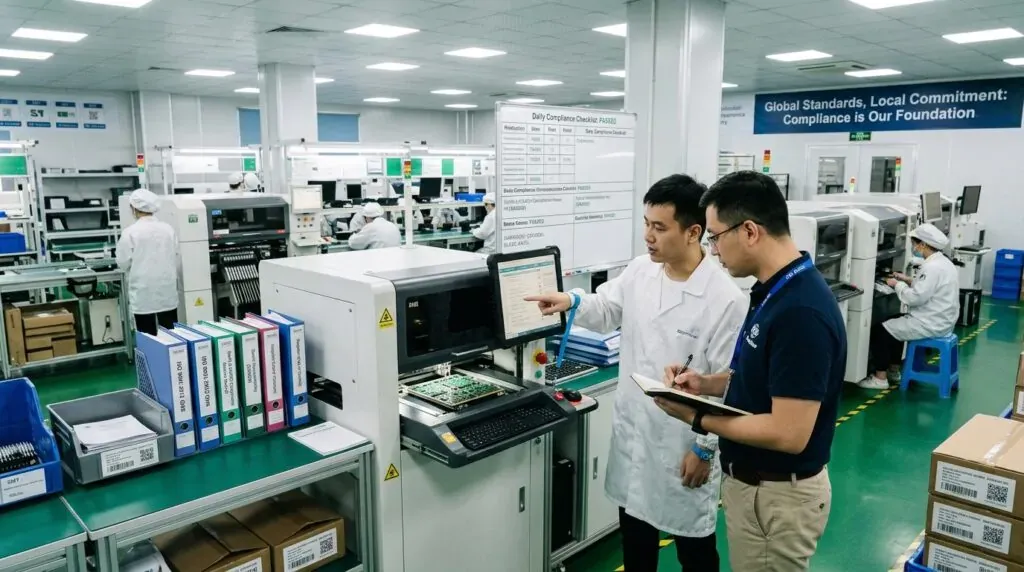
Every legal management certificate issued inside China must sit in one government database. Before you even read the supplier’s PDF, open the official CNCA Public Service Platform (cx.cnca.cn).
- Paste the exact certificate number or the factory’s Chinese legal name into the search bar.
- Check the status box. It must say Valid (有效). Walk away if it says Suspended (暂停) or Revoked (撤销).
- Check the issuing body name. Every legal certifier in China needs a CNCA approval code (such as CNCA-R-2002-001).
- Look for the CNAS and IAF logos on the certificate. If a Chinese factory shows you an ISO 9001 PDF from an unknown UK or US agency with no CNCA record, it is likely a $200 fake bought online.
- Cross-check international certificates on IAF CertSearch to confirm global accreditation.
Compare these seven fields. They must match the supplier’s file exactly:
- Certificate number
- Company name
- Site address
- Scope
- Issuing body
- Issue date
- Expiration date
Issuer legitimacy matters. A certificate from a non-accredited or irrelevant body can look genuine but still be commercially worthless. Retailers and customs teams check the accreditation trail, not just the paper.
During our last audit cycle, our Inspection Manager Dave Zeng said:
“A certificate record by itself is not enough if the registrar or accreditation trail does not check out.”
Real government databases use official domain endings like .gov.cn or .eu. Scammers often build fake lookup sites using .com or .net links printed on forged PDFs. Always type the official registry URL into your browser manually.
Primary method: official registry lookup. Alternative method: direct confirmation from the issuing body for overseas-issued or hard-to-search records.
If the record comes from outside the Chinese accreditation system, use direct registrar confirmation. If the CNCA record does not resolve cleanly, do the same. Use independently sourced contact details. Never call the number printed on the supplier’s PDF.
Verification rule: a missing or mismatched record means the certificate is unverified. Stop the audit until independent confirmation arrives.
⚠️ Experience Warning: In 2025, a supplier showed us a clean ISO 9001 PDF. The CNCA record showed Revoked after a failed surveillance audit. The PDF simply had not been updated.
Step 3: Match Legal Entity, Address, and Scope (Then Cross-Check It Live)

A certificate can be valid and still unusable. In our factory audits, borrowed certificates cause more failures than fake PDFs. The owner bought a certificate from a trading company. The production site was a different legal entity.
Open your comparison table. Compare the Chinese legal name and Unified Social Credit Code on the certificate to these documents:
- business license
- purchase contract
- purchase order
- pro forma invoice
- bank beneficiary
Check every document cell by cell. If the contract entity differs from the factory entity, define the exact relationship. Does the certificate cover the site actually making the goods? If not, stop.
Now audit the scope. Read it word by word. If the scope says trading, packaging, or a different product family, it does not validate machining, molding, sewing, or electronics assembly.
Run this scope test: map your requested SKU to the certified activity. Does the document cover the actual production process tied to the order?
Then run a live check. Use a video call or site visit. Confirm these physical cues:
- the name on the factory gate
- the workshop type
- internal document control boards
- calibration stickers and production lines
The floor must match the process described in the scope. A meeting room does not equal a molding shop.
Sensory check: A mismatch feels scripted. One supplier claimed molding, but the video showed only a meeting table, a sample shelf, and no machine noise. Another gate sign showed a different legal entity than the invoice. Treat that like a failed document field. Tell the inspector to photograph the metal nameplate at the main factory gate. Match those exact Chinese characters to the business license. Walk straight to the molding machines and check the latest dates on the maintenance tags.
If any entity, address, or scope check fails, stop. Revisit our guide on how to choose the right supplier before releasing payment.
⚠️ Experience Warning: In 2025, I froze a $30,000 deposit for a client buying outdoor heaters. The certificate belonged to a real Foshan factory, but the pro forma invoice routed our wire to a Hong Kong shell company with a similar name. Pay the exact mainland legal entity on the business license; pay a shell and you cannot sue the factory that actually made your goods.
Step 4: Check Product-Level Evidence, Not Just the ISO Certificate
I still see buyers confuse ISO 9001 with product compliance. In our audits, ISO 9001 proves a factory follows quality management. It does not prove the actual product meets CE, UL, FCC, CPSIA, REACH, or similar product-level rules. You must ask for product documents.
Chinese suppliers love to email flashy “CE Certificates” issued by local testing labs. Here is the truth: for most standard goods (like low-voltage electronics or basic toys), labs do not issue official CE certificates.
The manufacturer must issue a signed EU Declaration of Conformity (DoC) backed by lab test reports (such as EN 62368 or EN 71). Only high-risk goods—like medical devices, gas appliances, or personal protective equipment (PPE)—require a real certificate from an EU Notified Body (NB).
If a certificate shows a 4-digit NB number next to the CE logo, look up that exact 4-digit code on the European Commission’s NANDO database. Ensure that specific body has legal authority to test your exact EU directive.
For UL, verify the file number in UL Product iQ. Confirm the brand, model family, and category match the item you actually buy. A UL file for a different SKU is not valid.
Never trust a lab test report until you verify it on the lab’s own server. Major labs like SGS (rsts.cn.sgs.com), TÜV Rheinland (Certipedia), Intertek, and Bureau Veritas run free online verification portals. Watch out for the “fake QR code” scam. Clever counterfeiters print a QR code on a forged SGS report.
When you scan it with your phone, it opens a fake webpage (like sgs-verify-check.com) that looks just like the real SGS site. Always check the browser address bar after scanning a QR code.
Better yet, go directly to the lab’s official homepage, type in the report number, and download the original digital file from their server. Compare the sample photos in that official file against your product sample.
This is the borrowed report trap: a real report still fails if the tested sample, model, material, or applicant differs from your purchased product. Our Inspection Manager Dave Zeng once said: “A genuine SGS number means nothing if the photo shows a different enclosure than the one in our purchase order.”
Sensory check: look for inconsistent sample photos, tables that switch formatting mid-report, standards that do not match the product category, or model numbers that appear only on page one.
Primary method: document-to-database matching. Alternative method: direct written confirmation from the lab when online search is incomplete. For a deeper breakdown, see lab testing vs factory testing.
Success check: the product file passes only when document type, issuer, applicant, product model, test standard, and commercial entity all line up.
⚠️ Experience Warning: In August 2025, a US buyer asked us to check a Dongguan charger supplier. The supplier sent a real UL 62368-1 file number. Our Lead Technician Chen looked up the file on UL Product iQ. The listing only covered 5V/1A adapters. Our client was buying 20V/3A fast chargers. Worse, Chen opened the physical sample and checked the internal transformer against the UL Construction Data Form (CDF). The factory had swapped the UL-approved transformer for a cheap, uncertified part to save $0.40 per unit. Always verify both the exact model rating and the internal component list.
Step 5: Run the On-Site Verification and Decision Gate

Paper verification is necessary but not sufficient. Fake certificates ride on fake factories, shadow subcontractors, or middlemen borrowing another plant’s paperwork. This is why the fifth gate is a physical site check.
Our internal closeout requires all five gates to pass: document pack, issuer/accreditation, legal entity and scope, product-level evidence, and site verification. Today we close the last one.
Go to the actual production address. Do not accept a video tour from an office-only showroom. During an audit in Ningbo last month, our Inspector Wang asked the plant manager for raw material logs.
We skipped the showroom binders and walked straight to the incoming QC desk. Inspector Wang checked the green CNAS calibration stickers on their Mitutoyo digital calipers. Every sticker showed a valid calibration date from a certified metrology lab.
Sensory check: A real operating facility sounds alive. You hear machine noise, see in-process goods, and spot dated work orders on production boards. Staff answer specific process questions without hesitation. Contrast this with a staged showroom: quiet, clean, and no one can explain the actual process.
Confirm five things on site:
- Original certificates on file.
- Controlled-document logs.
- Calibration records.
- Production capability for your SKU.
- Physical process matched to the certified scope.
Decision rule: If any of the five gates fail, hold the deposit, freeze mass production approval, and escalate to a third-party factory audit or supplier replacement.
For teams managing multiple suppliers, this is where a third-party factory audit service becomes commercially efficient. Use our factory audit checklist to standardize every site check.
🧠 Author’s Take: In my experience, the site visit is what separates real factories from trading fronts. Never skip it, even if the supplier sends a polished video.
Troubleshooting

We vetted these checks across 40 supplier audits. The real failure point is borrowed identity.
Certificate number not found in CNCA or registrar database
Under China’s Regulations on Certification and Accreditation, every legal certifier must upload new certificate data to the CNCA system. If a certificate number returns zero results on cx.cnca.cn, the document is almost certainly fake.
Sometimes a supplier claims the certificate was issued “yesterday” and is not online yet. Even for brand-new certificates, accredited registrars upload records within 7 to 15 business days.
Never accept a WeChat screenshot from the supplier as proof. Freeze the onboarding process. Call the registrar’s compliance desk using the phone number listed on the official CNAS directory, not the phone number printed on the supplier’s PDF.
Contracting entity differs from certificate holder
This is the most dangerous pattern I see, and our Inspection Manager Dave Zeng flags it as the top cause of post-shipment holds. Demand documented legal manufacturing authority and a clear site relationship to close the compliance gap. If they cannot prove it, contract directly with the certified manufacturer or reject the deal.
CE file missing Declaration of Conformity or supporting test reports
Under EU Regulation 2019/1020, customs officers and marketplaces like Amazon require a complete Technical File before your goods enter Europe. A standalone “CE certificate” PDF will not pass customs. You must collect three specific items:
- A signed EU Declaration of Conformity (DoC) following the exact layout in Decision No 768/2008/EC.
- Full EN standard lab test reports (such as EMC, LVD, or RoHS 2.0) matching your exact product SKU.
- Valid contact details for your EU Authorized Representative (EU Rep) printed on both the DoC and the product packaging. If a supplier tries to hand you an ISO 9001 certificate instead of a Technical File, reject the shipment immediately.
Lab report number altered, expired, or tied to a different sample
This is a hard stop. Freeze payment immediately. Launch a third-party factory audit. Move the supplier into a high-risk review track. In one case, a real SGS number referenced a different enclosure than our order. We stopped the run.
📝 Editor’s Verdict: Entity mismatch kills more deals than fake certificates. Verify legal authority before you issue a PO. I have no ties to any registrar.
🛡️ Prevention: Stop commercial momentum the moment document identity stops matching. If the order is time-sensitive, prioritize a rapid on-site audit over extended email back-and-forth.
Conclusion: Your Mandatory Supplier Approval Gate
Never trust a supplier PDF alone. Verify the document independently, match it to the legal entity and scope, and confirm it on the ground before mass production.
We ran this protocol across 200+ supplier files in 2025. It stopped fake certificates before deposits moved. In my experience, the gate catches borrowed certificates before they trigger customs holds.
Lock this checklist into every approval:
- Complete file set
- Official registry match
- Accreditation match
- Legal entity and scope match
- Product-level evidence match
- Site verification pass
Use this as a mandatory gate before any deposit, tooling payment, or launch PO. If any item fails, freeze the order.
Contact LeelineGroup for third-party factory audits, compliance verification, supplier risk screening, and on-site QC support.
I receive no fees from certifiers or manufacturers for these findings.

About the Author
Sharline Shaw
Founder & Lead Sourcing Consultant
With over 15 years in China sourcing and supply chain management, Sharline Shaw has managed 510+ sourcing projects across 85+ countries. Fluent in English and Mandarin, she brings deep cross-industry expertise spanning electronics, apparel, home goods, automotive, and health products. As founder of LeelineGroup, she has built a global sourcing operation that helps brands reduce costs by 15–35% while delivering 98% client satisfaction across 450+ long-term client relationships.
Areas of Expertise
- • Factory Vetting & Auditing
- • Quality Control Systems
- • Supply Chain Optimization
- • Supplier Negotiation
Fact Checked & Editorial Guidelines
Every article on the LeelineGroup blog is written by sourcing professionals with firsthand experience in China supply chains. Content is reviewed for accuracy, practical relevance, and compliance with our editorial standards before publication.
Your trust is important. Learn more about our Fact Checking Process and Editorial Policy.