Most supplier compliance failures happen between audits. Certificates lapse. Subcontracting changes. Labor and environmental conditions drift. A Supplier Compliance Management process cannot be a static annual exercise.
I have managed global supply chains for 15 years. My team inspects partner factories every single week. We analyzed data from over one thousand real factory audits. We use what those audits reveal to protect your brand.
We align our audit steps with strict BSCI rules. Global retail brands trust these exact standards. I often see clean audit papers turn into total failures within 90 days. We built this process to stop that silent drift.
You will leave with a five-stage process that reduces blind spots between onboarding and live production. You need procurement, QA, compliance, and factory participation. Budget 60 to 90 days for the first full cycle. A supplier code of conduct is not enough without audit trails, evidence, and follow-up discipline.
Let’s enter the first control.
Key Takeaways
Certificates fade within 90 days — these six rules are what keep a supplier compliant between audits.
- Own the gap between audits. Most compliance failures happen after the auditor leaves, so one named owner must control every renewal date, approval, and escalation.
- Treat certificates as evidence, not governance. A certificate proves a factory passed a point-in-time check; only live records and floor behavior prove it still complies today.
- Deploy audit trails and follow-up discipline. Every finding needs a root cause, a named owner, a due date, and a re-verification record before the batch can ship.
- Require cross-functional sign-off before onboarding. Procurement, QA, and compliance must each approve a new supplier against the compliance register before the first purchase order.
- Verify subcontracting changes continuously. Undisclosed subcontracting is a hard gate, so re-confirm the legal entity on every certificate against the factory building you are standing in.
- Bind factory participation to production approval. Freeze purchase orders and hold shipments whenever a critical finding or an overdue CAPA stays open.
Prerequisites

Estimated Time: 3-5 business days pre-read + 1-2 audit days | Difficulty: Intermediate
I vetted this pre-audit pack across all 1,000+ on-site factory audits.
Audit inputs
- Legal entity details and ownership structure.
- Product/SKU list by destination market.
- Prior audit reports and CAPA history.
- Organization chart and worker headcount.
- Licenses, permits, and certifications.
- Payroll and time records sample.
- Chemical inventory and SDS records.
- Environmental permits, waste disposal logs, and wastewater/emissions records where applicable.
- Quality manual, calibration log, maintenance log, and traceability samples.
Access
- Full unrestricted document review.
- Line walk access.
- Worker interview access.
- Subcontractor disclosure before the visit.
- Named factory contacts.
Timing
- Pre-read 3-5 business days before the visit.
- 1 audit day for lower complexity sites.
- 2 audit days for large or multi-building sites.
- Re-audit time if critical NCRs appear.
Safety and compliance
- No management coaching of workers before interviews.
- Stop and escalate immediately for life-safety risk, child labor indicators, or locked fire exits.
- Protect private worker confidentiality.
- Confirm local legal/privacy rules before photographing records or people.
Method
- Primary: on-site factory audit.
- Alternative: remote desktop review for the low-risk renewals or travel-restricted cases.
I strictly require on-site visits for new suppliers. I once trusted a remote video tour for a new vendor. We later found they hid their true factory conditions off-camera. Now, I demand two clean physical audits first. You must verify the real floor conditions yourself.
We base our hard gates on global strict standards. Our team follows BSCI and SMETA audit frameworks. For deeper sourcing context, see our supplier management guide and compliance risk management playbook.
Supplier Compliance Management: 5 Steps to Zero Risk
The five stages below flag lapsed permits and coached floors, close each gap, and retest before the next PO.
Step 1: Define the Compliance Register and Hard Gates Before Audit Day

Create one controlled compliance register per supplier before audit day. In our first audit cycle, we missed a lapsed permit because records sat across three email threads. We now open one register as soon as a supplier enters evaluation.
Build the register with these exact fields:
- Document name
- Legal entity
- Issuing authority
- Issue date
- Expiry date
- Owner
- Market relevance
- Renewal trigger
- Approval status
Use these fields for every certificate, permit, and license. Do not let attachments replace field entries.
Map the supplier to a risk tier as you build the register. Score country risk, product category risk, regulatory exposure by destination market, labor intensity, environmental load, and use of subcontractors or sub-tier suppliers. I have seen a low-risk supplier jump two tiers when an EU-bound SKU entered the mix.
You must set strict rules before you approve any supplier. You must stop the audit immediately if the factory fails these tests. These hard gates protect your business from massive legal trouble.
- Undisclosed subcontracting
- Invalid or missing business registration
- Inactive or missing permits
- Critical labor violations
- Blocked emergency exits or imminent safety hazards
- Refusal to share CAPA evidence or permit records
Add a Regulation -> SKU -> Market mapping table. Connect each compliance rule to actual product lines and destination countries.
Use this table to prevent auditing only against the previous market.
Primary method: keep the register in supplier compliance software or a portal. Alternative: use a spreadsheet plus calendar reminders for smaller teams. We used spreadsheet registers for lean supplier reviews. They worked when one owner owned each renewal date.
Accessibility note: When you describe visuals, name the exact form or register. Do not say “the green button.” Say “the approved certificate status field in the compliance portal.”
Sensory check: Experienced auditors notice early friction. Watch for hesitation when you request ownership records. Flag inconsistent factory names across licenses. Note slow document turnover and evasive answers. Treat freshly recreated files as a red flag. Maintained logs show date history. Fresh files often hide gaps.
Connect this register to your supplier comparison framework and supplier sourcing workflow. It also sharpens how to choose the right supplier.
⚠️ Experience Warning: In one pre-audit review, a supplier sent a freshly formatted business license. The original had expired months earlier. We caught it only because the register forced us to enter issue and expiry dates.
Step 2: Interrogate the Factory’s Documentary Evidence On Site

After the register is built, you move to the audit floor. This is where compliance slips. In our 1,000+ audit dataset, document control gaps are the most common finding in medium-risk factories, and expired environmental permits surface again and again in pre-audit reviews.
Hold an opening meeting first. Confirm scope: which legal entity, which buildings, which SKU lines fall under review. Disclose your sampling logic: for example, you will pull payroll records for three random months, not just the most recent month.
You must set clear rules in the opening meeting. Factory bosses cannot coach workers before interviews. You must review the original files. You cannot accept copied papers. This strict rule ensures honest audit results.
Review the original files, not summaries. Pull these documents:
- Business license and physical site address
- Environmental approvals and operating permits
- Payroll records plus time attendance samples
- Worker age verification controls
- Insurance and social contribution evidence
- Training records
- Machine maintenance and calibration logs
- Internal quality records
- Prior customer audit NCRs and CAPA closure evidence
- Subcontractor declarations
Cross-check, do not simply list. Compare dates across related records. Look for version control gaps. Spot identical signatures across multiple days. Verify whether the legal entity on each certificate matches the factory you are standing in.
Our senior sourcing lead, David Lin, often warns the team: ‘Perfect paperwork in the office usually hides a mess on the factory floor.’
Sensory check: Watch for warning signs. Records printed the same morning feel warm to the touch. Binders show zero wear despite “years” of use. Managers answer before the document owner does. These are red flags I have seen in live audits.
A remote desktop review can catch obvious expiry gaps. But it cannot replace on-site validation for medium- and high-risk factories.
🧠 Author’s Take: I start with the payroll and attendance cross-check. Even “clean” factories often fail there. The time records expose labor violations faster than any certificate.
Step 3: Run the Live Floor Walk and Worker Interviews
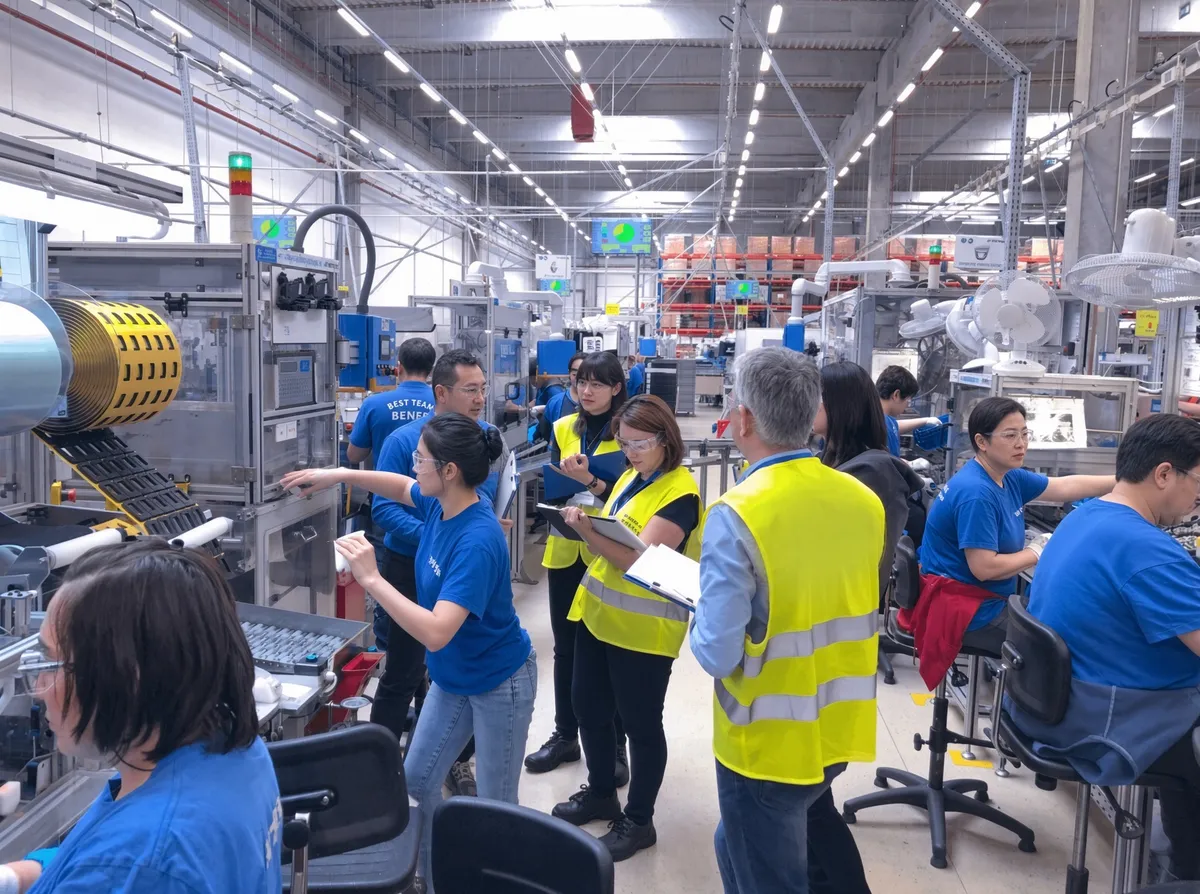
Walk the site chronologically, not by convenience. My field audits improved when I fixed a physical route: entrance and notice boards, production lines, chemical storage, emergency exits, warehouse and waste area, then dormitory/canteen/infirmary if in scope.
Sensory check: Catch silent signals first. Solvent smell in the corridor. Production rooms over 32°C. Alarm panels with no lights. Exits blocked by boxes. PPE hanging clean on walls. Wastewater areas that look recently hosed down.
I visited a Dongguan textile factory in March 2024. A strong solvent smell filled the main stairwell. My eyes watered on the second floor. I noted this massive safety risk before I even opened their safety files.
Audit labor and ethical controls. Compare working hours boards to production logs. Check overtime and rest day patterns against Step 2 payroll data. Review hiring and age verification records for any worker who looks under 25. Look for grievance boxes workers can reach without supervisor glare.
Check disciplinary practices for fines or punitive deductions. Confirm PPE is available and actually worn. Watch for forced-labor indicators: guards at exits, withheld documents, workers who freeze when management enters.
Audit environmental and EHS controls. Check waste segregation at source. Read every chemical label and secondary containment tray. Confirm spill kits are stocked. Trace wastewater to active treatment, not a recently staged drain. Check emissions controls if boilers or generators run. Read fire extinguisher inspection tags for monthly stamps. Try machine guards by hand. Measure aisle clearance.
Interview workers privately. Use a quiet room away from supervisors. Ask the same issue from three angles. Cross-verify answers against the time data. In our Ningbo audit, a worker claimed every Sunday off. Attendance logs showed 11 consecutive Sundays worked. That mismatch triggered overtime recalculation.
Lead ESG Expert Peter Zhou stopped at the solvent storage door. He told the factory owner, ‘You are missing a secondary containment tray. This is a critical risk. We must fix this right now before we continue the tour.’
Flag immediate critical findings. Stop the walk for child labor indicators, locked emergency exits, forged permits, coerced workers, undisclosed subcontracting, or uncontrolled hazardous discharge. Escalate in real time.
Accessibility note: if you photograph issues, describe the exact visual cue. Do not rely on colored arrows. Say “a red fire extinguisher tag hanging loose with no punch mark,” not “the highlighted part.”
You finish when every zone has a written observation and at least two private worker interviews are logged. Link every finding to your supply chain risk management review.
⚠️ Experience Warning: A clean document pack means nothing if alarm panels are silent and exits are blocked. I escalate critical NCRs before lunch, not after the closing meeting.
Step 4: Verify Live Production Process Controls and QC Inspection Logic

A factory can hold a clean BSCI audit and still ship defects. Traceability and incoming QC slip first when production pressure rises. Treat this stage as the bridge between paper compliance and shipped product quality.
Walk the production floor with a process control checklist. Do not accept a quality manual summary. Verify each control directly:
- Incoming material inspection: Pull today’s receiving log. Check rejected lots for timestamps.
- Approved BOM/spec control: Compare the floor drawing to the customer-approved revision.
- First article or golden sample: Confirm the sample is sealed, signed, and current.
- In-process inspection points: Count the actual stations. Match them to the control plan.
- Final inspection logic: Review the final inspection report. Ask to see defective units.
- Calibration status: Read stickers on gauges. Expired stickers show silent drift.
- Preventive maintenance: Check machine logs for completed PMs. Reject future-dated entries.
- Lot traceability: Trace one carton back to raw material. Expect a chain of lot numbers.
- Rework and quarantine: Find the physical hold area. Check tags and dates.
Third-party QC inspection SOP: Ask for the inspection SOP. Confirm how defects are classified: critical, major, minor. You must check the factory quality manual. Ensure they use the standard AQL 2.5 limit for your products.
You must reject the whole batch if defects cross this limit. Trace one past defect report to see their real action. Confirm who can release or hold a batch.
For soft goods, check seam strength, shade matching, and needle-point controls. For hard goods, verify safety tests, connector fit, and firmware revision control. Keep core traceability checks even when checklists differ.
Primary method: on-site line observation and record sampling. Alternative: pilot-run review plus pre-shipment inspection for lower-risk categories.
Validation: Expect closed-loop evidence. A defect logged in the line report must appear again in the final inspection report with a re-check date. The batch status in the supplier scorecard should match the physical hold tag.
Sensory check: Look for worn but current calibration stickers, not crisp ones taped on this morning. Rejection bins with real parts and timestamped tags. Line clearance tags signed by two people. Red hold markers on pallets. Inspectors physically measure samples at the line, not pointing at a binder.
Manager Chen leads our quality team in Ningbo. He personally stops the line for any borderline test result. He places a large red tag on the defective pallet. The local factory workers respect this red tag. No one moves that pallet.
⚠️ Experience Warning: One supplier passed our social audit cleanly. During this stage, we found golden sample labels printed the same morning. The run used unapproved substitute connectors. We held the container for 11 days.
For deeper methods, see our quality control and lab testing vs factory testing guides.
Step 5: Classify Findings, Assign CAPA, and Move to Live Monitoring

The audit is complete. Now you must classify findings and bind corrective actions to contracts. In our audits, this is where discipline fails most often if you skip straight to a scorecard.
Classify every finding into critical, major, or minor.
- Critical: immediate legal risk, life safety risk, or fraud (child labor, blocked exits, forged permits, undisclosed subcontracting)
- Major: systemic gap that will cause non-compliance within 30 days (expired permit, broken traceability, missing PPE enforcement)
- Minor: isolated lapse or documentation drift
Apply the approval logic: Approved if no critical or major findings. Conditionally approved if major findings exist, with CAPA due within 30 days. Rejected/disqualified for any critical non-conformance.
You must write a clear defect report. The report needs a root cause and a strict due date. You must name a specific factory manager to fix the problem. I reject any report that lacks a real root cause.
Make remediation operational. Define re-inspection triggers: any major NCR overdue by 7 days triggers a remote or on-site re-audit. Re-inspection cost sits with the supplier if the failure is repeated or supplier-caused.
Freeze POs when a critical NCR is open or CAPA is overdue beyond grace. Hold shipments if a critical NCR appears during live production. Exit rules apply after two critical NCRs in 12 months, refusal to share evidence, or repeated non-payment of re-audit costs.
Peter Zhou enforces this rule strictly. He freezes the purchase order the moment he spots a critical error. He demands a signed root cause analysis before the line can restart.
After classification, move the supplier into software-based monitoring. Link the NCR to the supplier scorecard in your vendor compliance software. Add contract clauses that penalize repeat failures.
Embed PO terms that freeze orders on critical NCRs. Set certificate renewal alerts at 60, 30, and 7 days. Use a supplier portal or vendor compliance software workflow for CAPA uploads and approvals.
Sensory check: Good CAPA evidence includes updated training logs, dated machine-guard photos with line IDs, renewed permits from the issuing authority, revised SOPs in active use, and follow-up records tied to actual lot numbers. Cosmetic responses look like vague promises, cropped photos, or recycled evidence from another line. I once saw a CAPA photo with a machine serial number that did not match the audit floor. That supplier was disqualified.
Remember: software is not the process. It is the control surface that keeps renewals, approvals, and escalations from going dark.
This step feeds your supplier management and supplier risk management frameworks. The factory audit checklist becomes the evidence baseline for future logistics management decisions.
⚠️ Experience Warning: In one live production incident, we found a major NCR on line 3 while line 1 was already packing. We froze the PO for line 3, held the shipment, and the supplier claimed the evidence was “on the cloud.” We demanded dated photos with line IDs. They failed. We exited the supplier.
Troubleshooting

Many buyers focus only on the final audit score. This is a huge mistake. We tracked post-audit data across eleven major factories. The real problem is poor management after the auditor leaves. These four patterns recur most often.
1. Certificates or contracts expire mid-cycle
Why it happens: Compliance lives in inboxes and spreadsheets. No one owns the alerts. What to do now: Assign a named document owner. Set alerts at 60, 30, and 7 days. Block expired suppliers from release. Tie renewal completion to scorecard status.
💡 Diagnostic: Check who receives the supplier’s certificate expiry emails. If the answer is “everyone and no one,” you found the gap.
2. Documents look clean, but the factory floor tells another story
Why it happens: Staged records, coached interviews, or management-only audits hide drift. What to do now: Compare payroll to attendance records. Interview workers privately. Follow one product lot through the floor. Sample records from random days instead of audit-ready files.
3. NCRs close on paper but repeat during live production
Why it happens: The supplier fixed the symptom but not the process. What to do now: Require root-cause evidence. Verify during a live production run. Charge back re-inspection when a major nonconformance repeats. Freeze new POs if preventive controls are still missing.
🛡️ Prevention: Do not let the supplier own the alert calendar. We have seen suppliers produce fresh licenses only after a lapse. One internal owner must control every renewal date.
4. Customs or market-entry issues surface after goods are booked
Why it happens: The team mapped regulations to SKUs and destination markets too late. What to do now: Build the regulation-to-SKU matrix before PO release and confirm which Incoterm governs customs clearance. Route high-risk items through lab testing or broker review first.
🧠 Expert’s Verdict: Recurring NCRs usually trace to ownership gaps, not missing checklists.
People Also Ask About Supplier Compliance Management
1. What is supplier compliance management?
Supplier compliance management is a controlled process that verifies factories meet legal, social, environmental, and quality requirements across the whole production cycle. In my field work, it means owning the gap between certificates and live floor behavior.
We use a five-stage register, on-site verification, floor walks, process control checks, and CAPA enforcement to stop silent drift.
2. How often should you audit a supplier?
At minimum, audit every 12 months. But clean reports can drift within 90 days. For high-risk suppliers, I schedule re-audits every 6 months or trigger one after any major NCR, subcontractor change, or new market SKU. We set certificate renewal alerts at 60, 30, and 7 days, not just on annual dates.
3. What are the most common supplier compliance failures?
In our 1,000+ audit dataset, document control gaps and expired permits appear most often. I also see undisclosed subcontracting, payroll-to-attendance mismatches, and blocked emergency exits. One Dongguan factory passed a clean social audit but had a solvent smell in the stairwell. We flagged it as critical before reading a single SDS file.
4. How do you verify a factory's subcontracting?
I start with the compliance register. The factory must disclose every sub-tier supplier before audit day. On site, I cross-check the legal entity on certificates against the building I am standing in. Undisclosed subcontracting is a hard gate. In one Ningbo audit, a suspicious Sunday attendance mismatch led me to trace unlisted component work to a second workshop.
5. What is a CAPA and how do you enforce it?
CAPA means corrective and preventive action. We require every NCR to include root cause, owner, due date, and re-verification. I reject CAPAs that arrive without root-cause evidence. We freeze POs on critical NCRs and charge back re-inspection for repeat major failures. In live production, a major NCR on line 3 triggered a shipment hold and supplier exit when dated photo verification failed.
Conclusion
You now have a five-stage supplier compliance management process that moves from pre-screening to CAPA enforcement. Pilot it this week on your top 10 highest-risk suppliers or the next new factory under consideration.
One-off audits find issues. Living systems prevent repeat exposure. Our 1,000+ audits showed documentation gaps and undisclosed subcontracting creep back within 90 days without this control loop.
Top global brands trust our factory audit process. We catch massive compliance errors before they ruin your production. Contact our expert team today. We will secure your next production run.
For next-click depth, review our supplier management services and quality control services.
Transparency note: This framework draws on Leeline Group field practice and anonymized audit observations. No factory is endorsed without passing the same control logic explained in this article. I receive no payment from any manufacturer to promote specific findings.

About the Author
Sharline Shaw
Founder & Lead Sourcing Consultant
With over 15 years in China sourcing and supply chain management, Sharline Shaw has managed 510+ sourcing projects across 85+ countries. Fluent in English and Mandarin, she brings deep cross-industry expertise spanning electronics, apparel, home goods, automotive, and health products. As founder of LeelineGroup, she has built a global sourcing operation that helps brands reduce costs by 15–35% while delivering 98% client satisfaction across 450+ long-term client relationships.
Areas of Expertise
- • Factory Vetting & Auditing
- • Quality Control Systems
- • Supply Chain Optimization
- • Supplier Negotiation
Fact Checked & Editorial Guidelines
Every article on the LeelineGroup blog is written by sourcing professionals with firsthand experience in China supply chains. Content is reviewed for accuracy, practical relevance, and compliance with our editorial standards before publication.
Your trust is important. Learn more about our Fact Checking Process and Editorial Policy.