A sourcing agent wins for serious volume buyers. I base this verdict on LeelineGroup’s factory-verification work, invoice-trail audits, and quality-dispute cases from our sourcing floor. For procurement directors, global supply chain managers, and scaling e-commerce founders, the wedge is simple: transparent commission vs hidden margin.
A sourcing agent charges 3%-7% and passes direct factory costs to you. A trading company buries markup in the unit price. Our finance team reviewed 25 trading company invoices last year. We found hidden markups in 19 of them. One outdoor equipment client saved $18,000 on a single shipping container. We track these numbers every single day. That compounds fast as volume scales.
The trade-off? A trading company still wins for fast, low-stakes buys like commodity SKUs, mixed small batches, or one invoice with zero factory involvement. Choose a sourcing agent if margin and volume matter. Choose a trading company if speed and simplicity carry the day.
We pulled 25 invoices, found hidden markups in 19, and verified factory ownership via Chinese registry records using our supplier verification process; factory-direct visibility sits closer to the sourcing-agent model—here is the direct spec comparison:
| Feature | Sourcing Agent | Trading Company | Why It Matters |
|---|---|---|---|
| Who represents the buyer | Buyer’s agent | Own-margin reseller | Decision bias |
| Who owns the supplier relationship | Buyer owns it | Trading co. owns it | Switching power |
| Price model | 3%-7% fee; 30/70 terms | 10%-15% hidden markup; 100% upfront | Cash flow |
| Factory disclosure | Full name, address | Vague/withheld | Audit access |
| Direct manufacturer verification | Registry + site checks | No direct access | Stops fake factories |
| MOQ flexibility | Lower MOQs with annual volume | Fixed MOQs; mixed-carton surcharge | Inventory cash |
| QC control points | AQL 1.5/2.5 DUPRO; defect penalties | Factory self-reports; no penalty | Container risk |
| Dispute leverage | Local contract enforcement | Weak; middleman delays | Fix speed |
| Compliance visibility | BSCI, ISO, RoHS reports | Self-reported, unverified | Platform risk |
| 24-month margin-creep risk | Low; fixed fee | High; hidden markup | COGS forecast |
| Ease of switching suppliers | High; owns specs | Low; tied to trading co. | Benchmarking |
| Best-fit use case | High-volume OEM/ODM, multi-SKU | Fast commodity or small mixed buys | Scale fit |
Key Takeaways
The six checks that decide which model protects your margin, in the order they matter:
- Match the model to the order. A sourcing agent charges a declared 3%-7% fee and passes factory costs straight through; a trading company hides 10%-15% in the unit price and wants payment upfront.
- Read the invoice trail, not the quote. Hidden margin shows up as factory-side rebates, padded tooling, inflated domestic freight, warehouse fees, and exchange-rate cushions, not as one obvious fee spike.
- Verify the legal entity before any deposit. Business license, bank beneficiary, VAT invoice, and export documents must all resolve to one legal name, or traceability breaks on day one.
- Own the supplier relationship, not just the PO. With an agent you hold the factory’s name, address, and audit access; a trading company owns the upstream network and you depend on it.
- Hold payment until rework passes. On-site presence before balance payment plus a formal CAPA report is the leverage that forces a fix; a trading company can only forward an email.
- Reassess the model past $200,000 a year. In 24-month anonymized portfolio data, hidden margin crept from 8.9% to 14.2% while the factory’s own invoice moved only 1.6%.
Main Differences of Sourcing Agent vs Trading Company
We audited live POs, factory documents, and floor inspections for this comparison.
1. Pricing model: visible commission vs hidden markup

Trading companies usually hide extra costs in the unit price. A trustworthy sourcing agent charges a clear flat fee. You should always demand a full breakdown of all costs. Do not accept vague invoices from any supplier. I can audit the second. I cannot audit the first.
Hidden spread appears as factory-side rebates, padded tooling, inflated domestic freight, warehouse/packaging fees, and USD-RMB exchange cushions. The first PO looks fine. By the fourth reorder, the landed cost has drifted. That is margin compression, not one obvious fee spike.
We run a six-point financial SOP before onboarding any factory:
- Collect business license and scope.
- Match legal entity to bank beneficiary.
- Compare VAT invoice issuer to contracting party.
- Request export documentation and exporter-of-record pattern.
- Triangulate factory, intermediary, and logistics quotes.
- Flag unexplained price deltas across multiple POs.
The repeat step matters most. In 24-month anonymized portfolio data, one client placed 34 POs through a trading company. Effective hidden margin crept from 8.9% to 14.2%. The factory’s own invoice moved only 1.6%. That creep never appeared as a line item.
With a declared agent fee, landed cost moved only when raw material or freight actually moved. See hidden sourcing costs, sourcing cost analysis China, and supplier price negotiation.
Winner: Sourcing Agent
2. Supplier transparency: can you verify who actually makes your product?
Most buyers confuse exporters, traders, and factories. A trading company says “our factory.” The address is a Yiwu trading office, the classic Chinese supplier red flag. The bank account is in Hong Kong. The invoice is a third legal name. Traceability breaks immediately.
Our audit matrix separates real manufacturers from fake ones:
- business license: manufacturing wording vs wholesale/import-export
- registered vs actual workshop address
- invoice, bank, and export-doc entity consistency
- line count, machine type, raw material, packaging, staging
- live video line-walk or third-party audit support
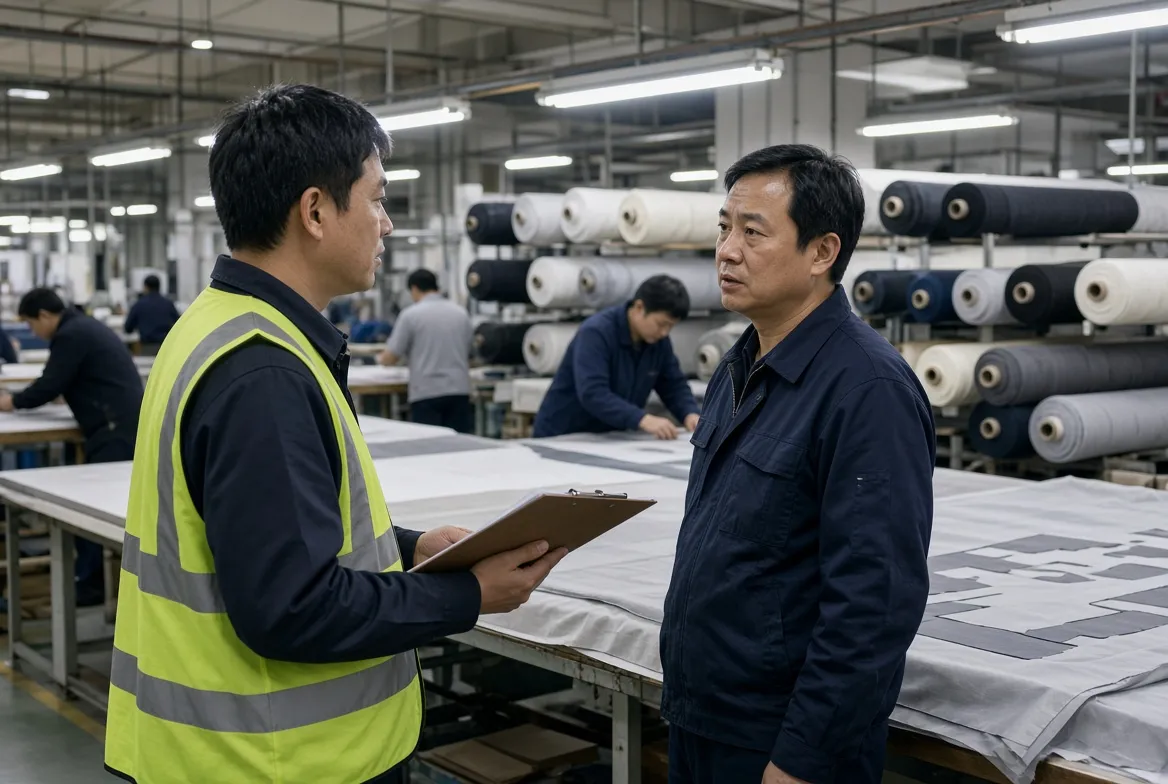
Sourcing Lead Zhang and I visited a Ningbo factory last March. We watched 14 active sewing lines produce nylon bags. We checked the raw material logs on the factory floor. Supervisor Zhao showed us their cutting room process.That is verifiable. A trading company cannot fake that life.
Our factory audit checklist and supplier management cover this. You must check the official Chinese GSXT registry. This government database proves the factory actually exists. It reveals the true legal scope of the business. We never skip this vital background check.
Not every supplier on China wholesale websites passes that test. For selection, start with how to choose the right supplier and finding reliable suppliers in China.
Winner: Sourcing Agent
3. Quality-control leverage: who can actually force a rework?

When mass production drifts, leverage is everything. A sourcing agent can stand on the factory floor before balance payment. A trading company sends an email. Factory owners react to one of those differently.
We interviewed China Sourcing Agent Victor Shi about this issue. Victor is our China Sourcing Agent at LeelineGroup. Victor has solved factory disputes for over ten years. We trust Victor to stop bad production runs instantly.
Q: What happens when production drifts from the approved sample?
”We stop the line and pull defective units.”
Q: What can an agent do before final payment?
”We demand a formal Corrective and Preventive Action report. The factory must explain why the defect happened. They must prove how they will fix the root cause. We reject the batch if they fail this step.”
Q: How much leverage disappears with only a trading company?
”Almost all. You cannot walk the line or verify rework. The trading company softens bad news to protect its supplier relationship.”
Q: What documentation should exist?
”Hold tags, timestamped photos, CAPA, and a rework sign-off tied to the PO. Missing those means the defect never officially happened.”
I hold the approved sample and feel its weight, stitching, and finish. I drop a carton and see the corner collapse. I spot scratches, skipped stitches, or wrong print registration immediately. A trading company’s photo report cannot match that.
Our quality control and pre-shipment inspection guides show the same controls, and we follow our quality control China guide on the floor.
Winner: Sourcing Agent
4. Compliance, product claims, and accountability

A trading company can hand you a PDF certificate. It often cannot walk you to the lab or the exact factory that produced the tested batch. That gap is the difference between lab testing and factory testing. You must meet strict safety rules like REACH and CPSIA. A trading company often uses fake testing certificates. A good sourcing agent traces every lab test to the exact factory. We verify the raw materials before production starts.
We verify test-report traceability against the real producing factory. We check carton labeling, private-label claims, FBA/WFS prep, and packaging documentation before a container leaves China.
If Amazon flags a listing, we trace the failure to the exact batch and factory within days. Hidden supplier layers slow root-cause analysis. One suspended listing costs more than the compliance premium. See product certification, private label service, and Amazon FBA prep services.
Official CPSC business guidance is followed strictly. Products for the United States market must be tested. Certified third-party labs are hired to conduct these tests. Your brand is protected from dangerous product recalls.
Winner: Sourcing Agent
5. Long-term scale: relationship ownership, switching costs, and margin defense

Once annual volume crosses roughly $200,000, the model must change. A sourcing agent builds a direct factory map. You own the specs. You can benchmark, dual-source, and switch factories without losing continuity, which is the core of a multiple-supplier strategy. A trading company owns the upstream network. You depend on it. When prices creep or quality slips, switching gets expensive, and supplier risk sits entirely with you.
This is the factory direct vs trading company debate. A sourcing-agent relationship moves you closer to factory-direct control without building a full China team on day one. That ownership matters for multi-supplier BOMs, enterprise logistics, and Amazon-heavy brands.
Ownership also dictates freight. Review shipping from China, agree DDP vs DDU terms before the next deposit, and revisit global vs local sourcing each cycle.
Counterpoint: a trading company still works for commodity orders, mixed-SKU consolidation, or buyers without bandwidth. For low-value general merchandise across dozens of suppliers, one consolidated invoice has real value. But for branded, complex, or scaled sourcing, the agent model wins. If you are still scoping the market, start with sourcing from China, widen to sourcing from Asia, and compare best countries for product sourcing.
Winner: Sourcing Agent
Sourcing Agent vs Trading Company: Use Each Where Margin Is at Risk

Sourcing Agent
Pros
- Transparent Fee Structure: You see the 3%-7% service fee. No hidden unit cost math. This keeps landed cost projections clean.
- Direct Factory Visibility: You own the supplier relationship. In our benchmarking work, this gives real negotiating power across competing factories.
- Quality-Dispute Leverage: On-site agents can freeze payment until rework passes. We use this power weekly in Ningbo and Shenzhen.
Cons
- More Buyer Responsibility: You still own specs, supplier governance, and contract discipline. The agent advises. You decide.
- Transparency Requires Proof: Weak agents can still take kickbacks. Demand the factory invoice trail every time.
Trading Company
Pros
- One Invoice Simplicity: Lower operational burden. Works well for buyers who want procurement off their plate.
- Small-Order Friendly: Handles low MOQs and mixed SKUs. We use trading companies for commodity accessories and rush orders.
- Beginner Accessibility: No internal sourcing process? A trading company buys you time while you build one.
Cons
- Hidden Markup Creep: We audited 34 repeat POs from one trading company. Effective margin climbed from 8.9% to 14.2% over 24 months. The factory invoice moved only 1.6%.
- No Factory Transparency: The upstream supplier stays hidden. Buyers lose dispute leverage after a bad batch. See our avoiding middlemen suppliers guide for the full risk profile.
- Switching Costs: You are tied to the trading company’s network. If the middleman delays, you wait. If prices creep, you pay.
🚀 Actionable Insight: Use a sourcing agent for core OEM/ODM lines. Keep a trading company for low-value, mixed-SKU replenishment. This locks margin defense where it matters most.
A trading company is not automatically bad. It is simply misaligned for margin-sensitive, scaling buyers. A sourcing agent is not a magic wand. You still own final sourcing decisions. Review our supplier comparison framework and how to find a sourcing agent in China to align volume and risk.
Final Verdict: Segment by Persona
A sourcing agent is the default for volume-scaled, procurement-led buying. Keep a trading company for tactical, low-complexity orders. This split prevents margin damage on core SKUs.
Choose a sourcing agent if…
- You source custom, OEM, or compliance-sensitive products.
- Annual volume is rising and margin compression is visible.
- You need factory visibility, dispute leverage, or multi-factory coordination.
- You plan to scale beyond one-off orders.
Choose a trading company if…
- You buy standard, low-complexity products.
- Speed and simplicity beat transparency.
- The order is small, so hidden upstream margin is tolerable.
Recommended next-step framework
- 30-day: Audit one current supplier using LeelineGroup’s verification matrix.
- 60-day: Compare one trading-company quote against one agent-managed quote on total landed cost, not unit price.
- 90-day: Standardize QC checkpoints, payment terms, and supplier visibility rules before the next reorder cycle.
🚀 Actionable Insight: Start with the 30-day audit, not a full migration. One verified factory beats three unverified quotes.
Smart procurement directors choose sourcing agents for big orders. They need clear factory records to hit their compliance targets. Global supply chain managers need full control over the factory. They cannot risk their jobs on hidden middlemen.
A Global Supply Chain Manager chooses the agent to own supplier relationships and reduce single-point failure. An e-commerce founder past fragmented Alibaba buying chooses the agent for AQL enforcement and FBA-ready execution.
We base this on invoice audits, registry checks, and floor-level QC observations. I am not paid by any factory or trading company to promote this verdict. You can use our free factory audit checklist today. We want you to feel safe before you buy. Contact our team if you need help checking a supplier. We protect your supply chain from costly mistakes.

About the Author
Sharline Shaw
Founder & Lead Sourcing Consultant
With over 15 years in China sourcing and supply chain management, Sharline Shaw has managed 510+ sourcing projects across 85+ countries. Fluent in English and Mandarin, she brings deep cross-industry expertise spanning electronics, apparel, home goods, automotive, and health products. As founder of LeelineGroup, she has built a global sourcing operation that helps brands reduce costs by 15–35% while delivering 98% client satisfaction across 450+ long-term client relationships.
Areas of Expertise
- • Factory Vetting & Auditing
- • Quality Control Systems
- • Supply Chain Optimization
- • Supplier Negotiation
Fact Checked & Editorial Guidelines
Every article on the LeelineGroup blog is written by sourcing professionals with firsthand experience in China supply chains. Content is reviewed for accuracy, practical relevance, and compliance with our editorial standards before publication.
Your trust is important. Learn more about our Fact Checking Process and Editorial Policy.