Customs clearance stalls when one field disagrees across documents. A container can sit at port because the invoice HS code or description does not match the packing list. This guide shows how to build one clean shipment file for China export and U.S. destination entry, from the invoice to the ISF and the entry summary.
Four rules anchor the work: keep every field consistent across documents, assign filing ownership in writing, set document timing before you book, and send the broker the packet for early review. We assemble this file before cargo loads.
Key Takeaways
The essentials before you build a China shipment file:
- Build one master line list first. Every document copies its descriptions, quantities and values from that single source, so no field can disagree.
- Treat six records as core and the rest conditional. Invoice, packing list, PO, transport document, China export declaration and power of attorney apply to nearly every shipment; ISF, origin certificates, product reports and insurance are added only when the lane or goods call for them.
- Match five fields 72 hours before filing. Description, HS code, quantity, value and exporter details must agree across the invoice, packing list and export declaration.
- File the China export declaration before the port cut-off. The deadline is the terminal’s closing time for the vessel, not a fixed 24 hours before loading.
- Transmit ISF 24 hours before loading. That is CBP’s legal deadline; a 72-hour internal send only adds buffer and does not change the rule.
- Recount cartons and reconcile values before seal-up. A physical count and one signed, dated reconciliation sheet catch the errors that hold a container.
Quick Reference: The Documents That Make One Shipment File
Every shipment needs six core records, plus a short list of documents some shipments add. Group them this way and the invoice, the packing list and the entry filing stop contradicting each other.
The six core records:
- Commercial invoice
- Packing list
- Sales contract or purchase order
- Bill of lading or air waybill
- China export declaration
- Customs power of attorney
Documents some shipments add (conditional):
- ISF 10+2 — U.S. ocean cargo only
- Certificate of origin — only when you claim a trade preference
- Product test reports or compliance certificates — regulated goods
- Insurance certificate — CIF/CIP terms or a letter of credit
- ISPM 15 marking — solid-wood packaging (a stamp on the wood, not a separate certificate)
The table maps who files each record and which other document it must match.
| Document | Issuer / Filer | When Needed | Side | Must Match |
|---|---|---|---|---|
| Commercial invoice | Exporter | Before booking | Both | Packing list and PO |
| Packing list | Exporter | Before booking | Both | Invoice line items |
| Sales contract or PO | Buyer and exporter | With the order | Both | Invoice and Incoterm |
| Bill of lading / air waybill | Carrier | After loading | Both | Invoice and ISF |
| China export declaration | Exporter or its broker | After goods enter customs area, before port cut-off | China export | Invoice and packing list |
| Customs power of attorney | Importer’s broker, or exporter’s agent | Before the relevant filing | Both | Invoice legal name |
| ISF 10+2 (conditional) | U.S. importer or broker | 24h before loading (legal deadline) | U.S. import | B/L and invoice |
| Entry summary, CBP 7501 (conditional) | U.S. customs broker | Within 10 working days of release | U.S. import | Invoice and entry data |
| Certificate of origin (conditional) | CCPIT or exporter | Before export declaration | China export | Invoice and B/L |
| Insurance certificate (conditional) | Insurer | CIF/CIP or LC terms | Both | Invoice and B/L |
One mismatch is what triggers a manual review. The sections below cover each core record, the fields that must agree, who files the conditional documents, and the destination-side timing.
⚡ Power Move: Read the “Must Match” column before you send anything — it tells you which document each one has to agree with.
1. Commercial Invoice
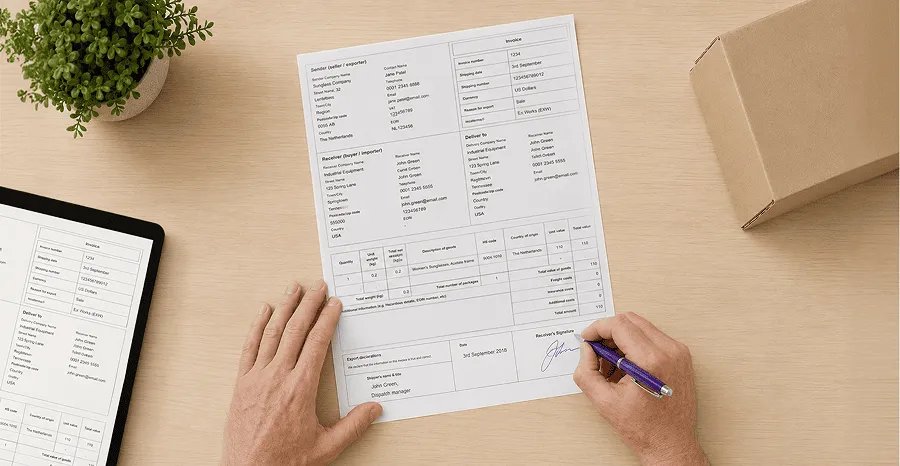
The commercial invoice is the master value record and the document customs compares everything else against.
U.S. rules in 19 CFR 141.86 list what an invoice must show: seller and buyer, a detailed goods description, quantity, unit price and total value, currency, country of origin, and itemized charges such as freight and insurance. Write the Incoterm on it too, so the broker can check those charges.
A proper invoice should show:
- Seller and buyer legal names
- Plain-language goods description
- Quantity, unit price and total value
- Currency
- Country of origin
- Incoterm and named place
Two failure modes cause the costliest holds. First, vague descriptions like “parts” or “apparel” force customs to guess what the goods are. Second, any value or origin detail that does not match the packing list triggers a review.
When the invoice and packing list describe the same goods differently, the file goes to manual review. The fix is mechanical: keep one master line list and copy each description word for word into every document.
Author’s Take: We check every invoice against the packing list and the purchase order before the broker sees it. One field that disagrees can trigger a manual review, so the line list is the single source both documents copy from.
2. Packing List
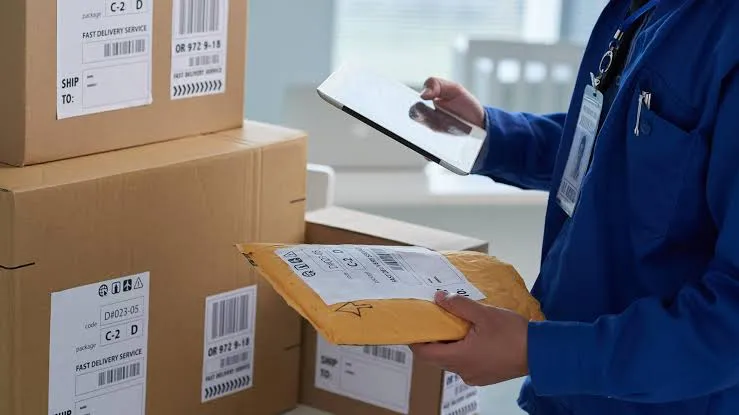
A packing list is not a copy of your order. It proves what is physically inside each carton, which is why customs compares it to the invoice line by line.
Six fields must reconcile with the invoice and the packed cargo, not just the purchase order: carton count, package marks, SKU or line-item quantity, dimensions, net weight, and gross weight. These are the core shipment data the WCO Data Model defines.
Three failures recur:
- A carton count that misses the physical load.
- A gross weight that drifts from the invoice.
- Missing package marks that trigger a manual search.
Count cartons against the master list at the loading door before sealing, which is the same count a pre-shipment inspection starts with. Our quality-control lead signs off only after the carton count, weights and marks match the invoice and the actual pallets. No matching count, no release.
🚀 Actionable Insight: The packing list is the only document that proves what is physically in each carton, so treat the carton count as a physical audit, not a paperwork step.
3. Bill of Lading or Air Waybill

Sea freight moves on a bill of lading (B/L); air freight moves on an air waybill (AWB). They are separate records, not interchangeable labels.
The B/L releases cargo in one of three ways: original B/L, telex release, or sea waybill. Original B/L requires the consignee to present the paper at destination. Telex release means the shipper surrenders the originals at origin and the carrier releases by message. A sea waybill skips the title document.
Choose one and write it into the shipping instructions; do not let the freight forwarder decide.
Five fields must match the invoice and the entry filing: consignee, notify party, route, marks, and cargo description. A single wrong letter in the consignee name forces a B/L amendment, the carrier charges for it, and release slips while it is corrected. Compare the draft B/L with your invoice and ISF field by field before departure.
4. Sales Contract or Purchase Order
The invoice shows what you paid. The sales contract or purchase order (PO) proves why: what was bought, by whom, at what price, and under which Incoterm.
Brokers ask for the PO when the invoice alone does not establish the transaction basis. A conflict between documents triggers a manual review. If the invoice says one Incoterm and the PO says another, customs questions every number on the file. Keep quantity, product description, pricing logic and Incoterm aligned across the PO, the invoice and the customs declaration.
Write the full term on every document, such as “FOB Shanghai, Incoterms® 2020,” using the ICC Incoterms 2020 rules. Note that FOB suits general sea freight; for container cargo many traders now use FCA instead, because it better matches how containers are handed over. Ask your forwarder which term fits your shipment.
Author’s Take: Attach the signed PO to every broker packet. It answers the broker’s first question before they ask it.
5. China Export Customs Declaration
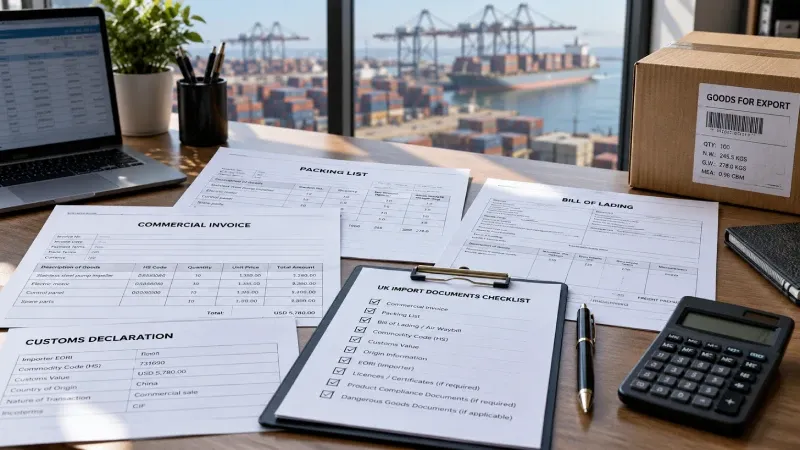
Who files the China export declaration? Settle that before booking, or cargo can stall while each side assumes the other will file.
The exporter or its appointed customs broker/declarant files it, not the buyer. Put “exporter files” in the PO or the booking approval and name the party.
The declaration is filed after the goods enter the customs supervision area and before the port cut-off — the closing time the terminal sets for that vessel. This is not a fixed 24 hours before loading.
The 24-hour rule you may have read about applies to the vessel manifest and to U.S. ISF, not to this declaration. Follow the cut-off your terminal and China Customs (GACC) set for the vessel.
⚠️ Safety First: Do not apply the 24-hour rule to the China export declaration. That clock belongs to the vessel manifest and to U.S. ISF; the China declaration follows the port cut-off.
Five fields must match your master line list before filing: product description, HS code, quantity, value, and exporter details. One mismatch triggers manual review. Run the five-field match check 72 hours before filing. Review factory-supplied HS codes against the WCO HS nomenclature; never copy them blindly. Require the exporter’s draft declaration 72 hours out.
6. Customs Power of Attorney
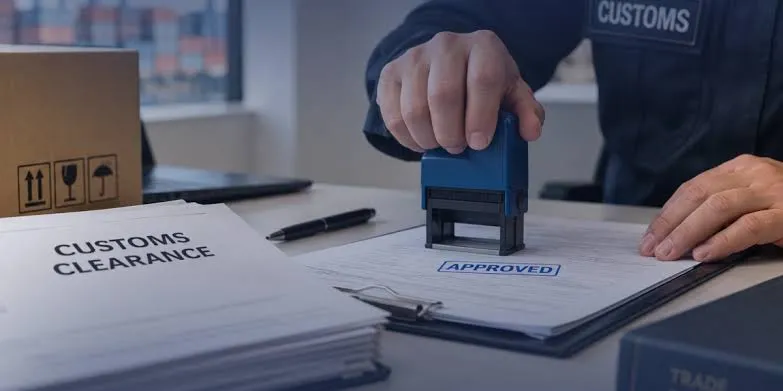
A missing customs power of attorney (POA) stalls release, and it is two different documents on the two sides of the shipment.
On the import side, the importer’s broker files entry under a POA from the importer — in the U.S. that is CBP Form 5291 or the broker’s own POA form. On the China export side, the exporter signs a customs agency agreement with its declarant. Do not treat one as covering the other.
Check three things before cargo moves:
- Signature authority: an authorized officer must sign.
- Exact legal names: the POA must match the invoice and the importer-of-record records.
- Timing: the broker needs it before the first entry, not after cargo lands.
A name that differs across the POA, the invoice and the ISF raises a red flag. It can trigger a manual review or an ISF penalty, so match legal names letter for letter.
7. Certificate of Origin and Product-Specific Certificates

Most shipments do not need a certificate of origin. A few need it urgently, and the reason matters.
Test 1: Origin claims, only where a trade agreement exists. The U.S. has no free trade agreement with China, so a China-origin certificate does not lower U.S. duty. Origin still matters for a different reason: it decides whether Section 301 tariffs apply, which you check in the HTSUS Chapter 99 list.
China-issued origin certificates matter for markets that do have an agreement with China — RCEP and ASEAN members, for example — where they can lower the duty rate. CCPIT or your exporter issues the certificate. Request it before the export declaration; a certificate requested after the goods have sailed cannot support the claim.
Test 2: Market access and product compliance. Regulated goods need product certificates or test reports before entry. Match each certificate to its market: CE and RoHS for the EU, FCC for the U.S., and the relevant conformity mark for the destination. A missing product certificate blocks entry faster than a wrong weight.
See our guide to product certification for the checks per market.
If a document is required, the certificate is shipment-critical. If it is not required, do not invent one. Map every SKU and origin claim to “required” or “not required” before cargo is packed.
8. Import Entry Documents for U.S., UK, and EU Shipments

A DDP quote does not name the filer, and that gap causes holds. Treat these as destination-side records, not China export papers.
U.S. Your broker files entry papers within 15 calendar days of arrival. The entry summary (CBP 7501) follows within 10 working days of release, filed with the estimated duty. You also need a customs bond: a single-entry bond for one shipment, or a continuous bond if you import often.
The bond is a destination-side contract; it is not a China export document. Name the importer of record and the duty payer in writing. If the cargo is going to Amazon, the FBA prep stage adds its own label and pallet checks before the truck leaves.
UK. Get a GB EORI and match the declaration data to the invoice, packing list and B/L. Your broker files the UK entry under your GB EORI. For the full UK border file, see importing from China to the UK.
EU. Get an EU EORI and map the entry workflow, including ENS filing where it applies. On EU sea freight the carrier files ENS, but you own the data accuracy.
Author’s Take: Name the legal filer, the importer of record and the duty payer in writing before booking. A DDP quote is not proof. Send the broker one sheet listing filer, IOR, duty payer, EORI and bond before the first entry.
9. ISF 10+2 Documents for U.S. Ocean Shipments

The ISF can kill a shipment before the container reaches the dock. File late and U.S. Customs and Border Protection can assess liquidated damages of up to $5,000 per violation, under 19 CFR Part 149.
ISF 10+2 applies to ocean cargo entering the United States. The importer or broker files it; air freight needs no U.S. ISF.
Two deadlines, and they are not the same thing. The law requires the core ISF data at least 24 hours before the vessel loads at the foreign port; two flexible items (stuffing location and consolidator) may follow up to 24 hours before U.S. arrival.
Your own buffer is different: we transmit everything 72 hours before loading. The 24 hours is CBP’s rule; the 72 hours is our internal margin.
The data comes from records you already own: commercial invoice, packing list, booking details, manufacturer or supplier identity, and the U.S. destination party. Pull all five before you confirm a sailing date. If supplier identity or the HTS code is missing, the clock runs out and the booking slips.
🛡️ Our Verdict: Transmit ISF 72 hours before loading. That keeps the 24-hour legal deadline safe without mistaking our internal buffer for the rule.
Common Document Mistakes That Delay Clearance

These are the errors that show up most in a pre-seal file review. Each one is preventable with one master line list and a final count.
- Inconsistent product descriptions. The invoice and packing list describe the same goods differently. Fix: one master line list, copied word for word.
- Carton-count mismatch. Paperwork and the physical load disagree. Fix: a physical recount at the loading door.
- Weight or value discrepancies. Gross weight drifts from the invoice. Fix: a final cross-document reconciliation on one signed, dated sheet.
- Outdated HS code. A tariff revision changes a code and the old one gets filed. Fix: a broker-reviewed code, rechecked before the export filing.
- Wrong consignee or importer details. A misspelled legal name forces amendments. Fix: written importer-of-record details, spelling confirmed.
- Late ISF or ENS data. The filing clock starts without you. Fix: transmit 72 hours before loading.
Run the pre-seal checklist before every seal-up. It takes under an hour; a port hold takes days.
How to Run a China Export and Import Document Checklist Before Release

We run this seven-step checklist on every shipment we handle. It catches document errors before the container seals, because it compares the documents against each other and against the physical load, not against memory.
Step 1: Freeze Destination, Mode, and Incoterm
Lock destination, port, mode and Incoterm before booking.
- Write the Incoterm on the booking note and the PO, using the ICC Incoterms 2020 rules.
- Match the invoice Incoterm to the PO. A conflict triggers a manual review.
- Output: one booking note with destination, mode and Incoterm.
Step 2: Name the Filers for Both Sides
Settle filing ownership in writing before you book.
- China export declaration: the exporter or its appointed broker files it.
- Destination entry: the importer’s broker files it.
- Put “exporter files” in the PO or booking approval.
- Output: a filer sheet naming both parties.
Step 3: Build the Master Line List
Create one line list and copy it word for word into every document. For each SKU, include:
- SKU and plain description
- Material and use
- Quantity
- Net and gross weight
- Dimensions and marks
- Unit value and currency
- Country of origin
- Broker-reviewed tariff code
Run the five-field match check 72 hours before filing. Output: one signed master line list.
Step 4: Assemble Both Document Packs
Build two labeled folders.
- China export pack: commercial invoice, packing list, export declaration, certificate of origin if needed, and ISPM 15 marking on wood packaging if used.
- Destination import pack: invoice, packing list, B/L or AWB, ISF or ENS data, POA, entry data.
- Output: two folders with matching file names.
Step 5: Reconcile and Count Before Seal
Reconcile invoice, packing list, transport record and declarations field by field.
- Count cartons against the master list. Check marks on every pallet.
- Our quality-control lead signs off only after count, weights and marks match.
- Output: one signed, dated reconciliation sheet.
Step 6: File ISF or ENS on Time
File destination security data on time, using the CBP ISF guide.
- U.S. ocean cargo: CBP requires the core ISF 24 hours before loading; we transmit 72 hours before.
- EU sea cargo: file ENS where it applies.
- Air freight needs no U.S. ISF.
- Output: a filing receipt in the destination pack.
Step 7: Confirm Release Authority and Keep Records
Get release authority in writing before the warehouse releases cargo.
- Confirm the importer of record, duty payer, broker authority and licence readiness. A DDP quote is not proof.
- Retain post-entry records and the UK C79 where applicable; check HMRC’s C79 guidance on GOV.UK.
- Output: a release authorization email and a records retention log.
People Also Ask About Customs Clearance Documents from China
1. What documents are required for customs clearance from China?
Every shipment needs six core records: commercial invoice, packing list, sales contract or purchase order, bill of lading or air waybill, China export declaration, and customs power of attorney. Some shipments add conditional documents: ISF 10+2 for U.S. ocean cargo, a certificate of origin when you claim a trade preference, product test reports for regulated goods, and an insurance certificate under CIF/CIP terms. Each document must match the others.
2. Who prepares the export customs declaration in China?
The exporter or its appointed customs broker/declarant files it, not the buyer. Confirm this in writing before you book a shipment, and put "exporter files" in the PO or booking approval. Unclear filing ownership is a common cause of delay because each side assumes the other will file.
3. Do I need a certificate of origin for goods from China?
Only when you claim a trade preference under an agreement China has signed, such as RCEP or an ASEAN agreement. The U.S. has no free trade agreement with China, so a China-origin certificate does not lower U.S. duty; origin still determines whether Section 301 tariffs apply. Request the certificate before the export declaration, not after the goods sail.
4. What happens if the commercial invoice and packing list do not match?
Customs sends the file to manual review, which holds the cargo until the discrepancy is resolved. Fix the error at the source rather than patching one document to match another. Keep one master line list and copy each field word for word into both documents, so a single field never disagrees.
5. Is ISF required for air shipments from China?
No. ISF 10+2 applies only to ocean cargo entering the U.S. Air freight needs no U.S. ISF. For ocean cargo, CBP requires the core ISF data at least 24 hours before loading; we transmit 72 hours ahead as a buffer.
For a shipment-file review, contact LeelineGroup. We assemble this file before cargo loads, so one field never disagrees.
Related reading: how to import from China, shipping from China, and logistics management.
Last updated November 25, 2026. This guide is checked against the regulations cited above; see our fact-checking process and editorial policy. Customs rules change, so confirm current deadlines with your broker before every shipment.

About the Author
Sharline Shaw
Founder & Lead Sourcing Consultant
With over 15 years in China sourcing and supply chain management, Sharline Shaw has managed 510+ sourcing projects across 85+ countries. Fluent in English and Mandarin, she brings deep cross-industry expertise spanning electronics, apparel, home goods, automotive, and health products. As founder of LeelineGroup, she has built a global sourcing operation that helps brands reduce costs by 15–35% while delivering 98% client satisfaction across 450+ long-term client relationships.
Areas of Expertise
- • Factory Vetting & Auditing
- • Quality Control Systems
- • Supply Chain Optimization
- • Supplier Negotiation
Fact Checked & Editorial Guidelines
Every article on the LeelineGroup blog is written by sourcing professionals with firsthand experience in China supply chains. Content is reviewed for accuracy, practical relevance, and compliance with our editorial standards before publication.
Your trust is important. Learn more about our Fact Checking Process and Editorial Policy.