This page is written for US small importers buying from Asia for the first time. Licensing depends on your product’s HS code, not on any single “import license”. This is practical operations guidance from a China-side sourcing team — not legal or customs advice, and it does not replace a licensed customs broker or an attorney. Last verified: August 2026.
I lead factory vetting, inspection, and freight coordination every working day at LeelineGroup. The seven steps below are the ones our clients follow to land one first shipment at a US port without a customs hold.
In short — each point is a standalone answer:
- The US does not issue a single import-export license for most consumer goods.
- Licensing follows the product’s HS/HTS code and the agency that regulates it.
- Unit price is not profit. Profit is landed cost after freight, duty, brokerage, inspection, and returns.
- Do not pay 100% up front to a new factory. A common safe structure is 30% deposit, balance after inspection.
- A vague commercial-invoice description is a frequent reason cargo is held at customs.
- EXW looks cheap at the factory gate and often becomes the most expensive term for first-time importers.
- A $2,000–$5,000 pilot shipment can work for simple goods. Certified products — electronics, toys, cosmetics — cost more.
- Importing and exporting are different jobs. Most beginners should start with one inbound product, not both directions.
Who This Guide Is For
This page assumes you are a small US buyer, an Amazon or DTC seller, or a wholesale buyer placing a first purchase order with an overseas factory. It is built around a single product, a single destination country, and a single first shipment.
What this page intentionally does not try to do:
- It does not cover export controls, defense articles, or dual-use goods.
- It does not replace a customs broker or an attorney for your specific product.
- It does not give legal, tax, or duty-rate advice.
If your product sits in a regulated category — food, cosmetics, supplements, medical devices, toys, or anything electrical — stop and check the regulating agency before you spend money. The steps below assume a straightforward consumer good.
What You Need Before the First Order
Before you contact any factory, set the foundation. Most first-time importers lose time chasing a “universal import license”; it does not exist. You are licensing the product, and the product is classified by its six-digit HS code.
| What you need | Why it matters | Typical first-shipment note |
|---|---|---|
| Legal entity + EIN | Banking, ISF filing, customs bond | A personal name on the invoice is a red flag |
| Product + 6-digit HS code draft | Duty rate, agency permits, FDA/CPSC rules | Confirm with your broker before you pay the deposit |
| Cash for sample + deposit + freight + duty + 20% buffer | Avoids stranded cargo | See the budget tiers below |
| Written inspection plan | Stops quality drift from sample to bulk | Book it before production ends |
| Freight forwarder + customs broker | Documents, entry, and ISF | Do not leave this to the factory alone |
The compliance and budget work lives in two places. Read the product certification guide to understand what your category needs, and study hidden sourcing costs before you write a quote down on a cost sheet.
Do this next:
- Register an LLC or corporation and open a dedicated business bank account.
- Draft a one-line product description and a 6-digit HS code.
- Allocate sample, deposit, freight, duty, and a 20% cash buffer.
Step 1: Choose a Business Model and a First Product

Keep the first move narrow. In first-time US import programs we handle, the usual failure is trying to sell everything at once. Pick one lane and one product.
Three realistic starting models:
- Reseller / distributor — you buy finished goods and resell. Lowest friction, lowest margin.
- Private-label seller — you put your brand on a standard product. Higher margin, needs packaging and labeling rules.
- Export later — sell domestically first, treat exporting as a phase, not a Day-1 job.
Choose a product that fits a shoebox and can survive a short drop. Small size, low breakage risk, and simple compliance reduce both freight cost and the chance of a customs hold. Avoid heavily regulated categories — supplements, cosmetics, toys, food contact, and electronics — for a first shipment.
Test demand with real data, not vibes. Open a B2B marketplace, search your product concept, filter to Verified Suppliers with High Demand, and read the pricing range. A viable niche feels specific. “Ergonomic left-handed scissors” is a niche; “office supplies” is not. You need a wide enough spread between the supplier quote and your retail price to absorb freight, duty, and fees and still leave margin. If you are still weighing markets, see the best countries for product sourcing to narrow the list.
Do this next:
- Write one product, one target country, one buyer profile.
- Check the USITC Harmonized Tariff Schedule for your category’s duty range.
- Reject fragile, oversized, or heavily regulated products for the first run.
Step 2: Set Up the Legal and Compliance Folder

A single missing permit can strand a container for weeks. Build a folder you can open in ten seconds.
Classify the product first and find its HS/HTS code — never guess it. An incorrect code triggers audits and holds. Most consumer goods need no general import license, but specific categories require an agency permit, so confirm with the CBP Product Classification guidance and the Trade.gov export solutions portal.
Folder contents:
- Business registration, EIN, and customs bond
- HTS / HS code memo for the product
- Supplier business license and factory-audit report
- Product certification and test reports
- Packing list and commercial-invoice templates
- Restricted-party screening (if you export sensitive items)
Importing and exporting carry different risk. Importing triggers customs-entry reviews, labeling rules, and consumer-safety issues. Exporting adds destination restrictions, export controls, and extra filings. You will likely need a Commercial Invoice, Packing List, Bill of Lading, Customs Bond, an ISF for ocean imports, and an EEI for qualifying exports.
Hire a licensed customs broker to verify the folder. Most beginners should rely on a licensed professional to get through importing from China without friction.
Do this next:
- Classify the product, then confirm the regulating agency, then the permit.
- List the four core documents you will need.
- Confirm the invoice description matches the packing list line by line.
Step 3: Find and Vet a Supplier

Do not buy from the first quote. Treat supplier selection as a six-stage funnel, not a search.
Vetting pipeline: catalog search → live-video factory tour → business-license check → physical sample → small trial order → scaled order.
Broad searching alone is not enough. Run the process through finding reliable suppliers in China and compare against the classic red flags of Chinese suppliers. Use a mix of trade shows, B2B platforms, referrals, and an audited supplier sourcing agency.
Before money moves, pin down commercial detail in writing: who signs the contract, who owns the tooling, what happens to defective units, who pays for reinspection after a failed check, and what the MOQ actually is. Read MOQ explained and supplier price negotiation before you negotiate. Do not negotiate only the unit price — a better payment split (30% deposit) protects your cash flow more than a few cents per unit.
Do this next:
- Shortlist three suppliers with comparable quotes and a sample plan.
- Demand a live video call from the factory floor.
- Confirm tooling ownership and defect handling in the written spec.
Step 4: Build a Landed-Cost Sheet Before You Order

This is the section that usually decides whether a first shipment survives. Landed cost is the full cost to get one unit from the factory into the customer’s hands. Most beginners underestimate it.
Build a spreadsheet with these buckets:
- FOB / EXW unit price
- Tooling and sampling (amortized)
- Testing and certification
- Inland trucking + ocean or air freight
- Duty + MPF + HMF (look up the real rate in the HTS, never guess a percentage)
- Customs brokerage, ISF, and warehouse storage
- Inspection, defects, and returns allowance
For the duty number, use the current Harmonized Tariff Schedule and confirm with your broker. Missing even two buckets — brokerage and returns allowance — can erase the entire margin.
Budget tiers (2026 common starting ranges, in USD):
| Launch type | Ballpark cash | Fits | Does not fit |
|---|---|---|---|
| Sample + micro lot | $2,000–$5,000 | Simple home or soft goods, no major certs | Electronics, toys, cosmetics, food contact |
| First sellable PO | $8,000–$25,000 | Private-label basics with inspection | Mold-heavy or regulated goods |
| Certified product | $20,000+ | Toys, electrical, kids’ products | Anyone quoting only factory price |
These figures are common starting ranges in 2026, not promises. They move with order volume, port, and certification scope. For a fuller cost picture, work from sourcing cost analysis in China.
Do this next:
- Fill in all eleven-cost buckets, not just unit price.
- Calculate break-even point and required working capital.
- Confirm your target gross margin survives real freight and duty.
Step 5: Set Up Logistics, Incoterms, and Documents

Logistics is a multi-vendor system, not a shipping company. Assign every stage a named owner: pickup, export clearance, main carriage, import entry, delivery, and documents.
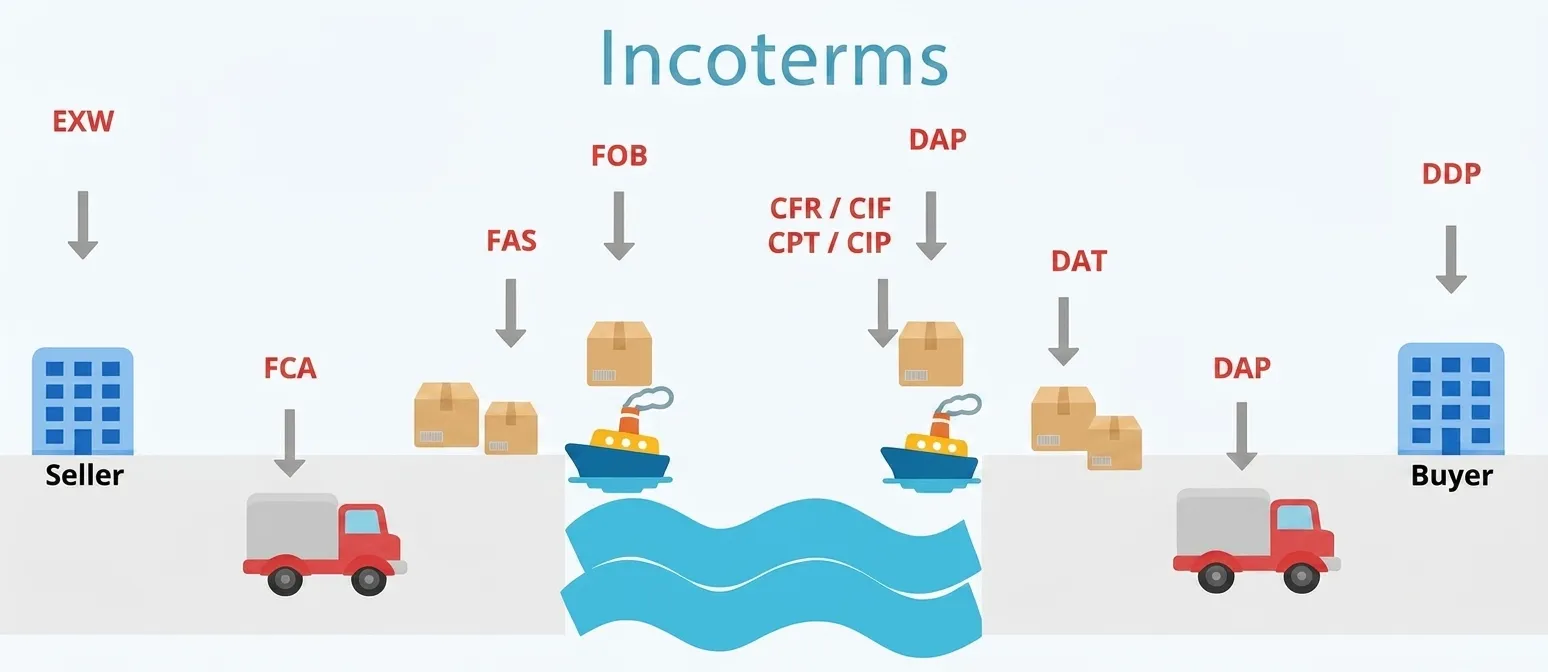
Incoterms — who carries the risk in a first shipment:
| Incoterm | What the seller covers | Good for a first import? | Main pitfall |
|---|---|---|---|
| EXW | Goods loaded at the factory door | No — you handle everything | Looks cheapest, is usually the most expensive |
| FOB | Export clearance and loading onto the ship | Yes — a common default | You pay the main voyage |
| CIF | Freight and insurance to your port | Maybe | Only covers to the port, not inland |
| DDP | Everything, including duty | Only with a trusted supplier | High cost back to you if it goes wrong |
A first-time importer usually starts with FOB or DDP. DDP removes customs complexity but pushes duty liability onto the supplier, which few will price honestly; get a written confirmation on who files the entry. Read Incoterms explained and compare DDP vs DDU before you sign.
Document stack:
| Document | What it does |
|---|---|
| Commercial Invoice | Describes the goods, value, and HS code |
| Packing List | Quantities, weights, and dimensions |
| Bill of Lading / Air Waybill | The contract of carriage |
| Certificate of Origin | Origin for duty and preference |
| Test / certification report | Proves compliance for regulated goods |
| ISF (ocean) | Importer Security Filing before sailing |
Write the English invoice description specifically — material, use, piece count. “Apparel” or “parts” is too vague and is a common reason customs holds cargo. Confirm whether your forwarder files the customs entry; most do not.
Do this next:
- Request quotes on the same Incoterm so they compare fairly.
- Write invoice descriptions to material + use + count.
- Confirm in writing who files the customs entry.
Step 6: Run Quality Control Before the Balance Payment

Scaling from quote confidence alone hides defects. Use a sample and a pilot shipment to reveal poor warning text, bad finishing, and packaging failure before you pay the balance.
QC sequence: golden-sample approval → during-production check → pre-shipment inspection → retained sample.
Set an acceptable-defect threshold before production starts. Use a standard AQL inspection so pass/fail is agreed in advance, and read the quality control guide for what the report should cover. Keep your final invoice, packing list, carton counts, and product specs aligned — small paperwork mismatches trigger holds and rework.
Do this next:
- Approve a physical golden sample and lock specs.
- Book a pre-shipment inspection before the balance is due.
- Never release the final payment without a timestamped, photo-rich report.
Step 7: Review Results After the First Container Clears

The first delivery is a starting line, not a finish line. Turn it into a controlled rhythm.
Compare the actual numbers against the plan: transit lead time, defect rate, and real landed cost against the quote. Build a scorecard for the supplier from that data. Consolidate backup stock in a China warehouse to protect against a stockout, and use a private label service or Amazon FBA prep only once product-market fit is confirmed.
Scale means reordering a known SKU with a known supplier and a proven landed cost — not launching a giant catalog. When volume grows, hand off end-to-end logistics management so it stops sitting on your desk.
Do this next:
- Compare actual landed cost to the original estimate.
- Record transit time, defect rate, and supplier response time.
- Secure one backup supplier before a peak-season stockout.
Troubleshooting the First Shipment
The problems below are the five most common reasons a first import goes sideways, written as the questions buyers actually search.
Why customs held my shipment
An invoice description that is too broad — “apparel”, “parts”, “gifts” — triggers holds daily. Fix it: match the invoice, packing list, and country of origin exactly, and write the six-digit HS code on every document before departure.
I booked freight but cannot clear customs
Founders assume the forwarder files the customs entry. Most do not. Fix it: draw up an agreement assigning the broker responsibility, and confirm who files the entry before the ship sails.
My margin disappeared after duty
The quote looked profitable, but hidden fees erased it. Beginners ignore last-mile delivery, brokerage, and port storage. Fix it: rebuild the cost model with duty, brokerage, storage, inspection, packaging, and domestic freight included.
Bulk quality does not match the sample
The supplier looked good online but shipped defective goods. This happens when you scale too fast. Fix it: lock specs to an approved sample, enforce an AQL 2.5 pre-shipment inspection, and pause mass production until a pilot passes.
I needed a permit I didn’t know about
Many people assume one general license covers everything. Agencies have seized containers over that assumption. Fix it: classify the product and verify the regulating agency’s rules before you authorize production.
Frequently Asked Questions
Do I need a license to start an import-export business in the US?
No. The US does not issue a single general import-export license for most commercial goods. Licensing follows the product’s HS code and the agency that regulates it. Find your 6-digit code and check the CBP importing guidance to see whether the FDA, EPA, or CPSC regulates your item. Confirm the specific permit with a licensed customs broker.
How much money do I need for the first import from China?
A safe pilot for simple, non-certified goods runs roughly $2,000–$5,000, covering registration, samples, a micro-MOQ order, and DDP shipping. Regulated products — electronics, toys, cosmetics, food contact — start well above that. Keep 20% of the budget as liquid cash for storage fees or a hold. These are 2026 starting ranges, not fixed prices.
How do I find a reliable overseas supplier?
Search B2B directories to find candidates, but secure them through vetting. A live video call from the factory floor, a business-license check, a physical sample, and a small trial order separate a real factory from a trading shell. Learn the red flags of Chinese suppliers before you wire a deposit.
What is the difference between importing and exporting?
Importing brings goods into the US and triggers customs-entry review, labeling, and consumer-safety rules. Exporting sends goods abroad and adds destination restrictions, export controls, and filing obligations such as the EEI. The licensing, documents, and risks differ. Most beginners should start with one inbound product before considering both directions.
Which Incoterm should a first-time importer use?
Most first-time importers use FOB or DDP. FOB gives you control of the main voyage; DDP removes customs paperwork but puts duty liability on the supplier. EXW looks cheap but pushes every step onto you. Quote on one Incoterm so prices compare fairly.
What documents does US customs need?
Commonly a commercial invoice, packing list, bill of lading or air waybill, and certificate of origin. Ocean imports also need an Importer Security Filing (ISF). Regulated or specialty goods add test reports and certifications. A customs broker should confirm your exact list before you ship.
Can I start an import business from home?
Yes. A home office is fine for the coordination work, but name the business entity and bank account on the paperwork — never a personal name — and buy a professional email domain. Factories take a Gmail inquiry far less seriously. The real constraint is capital and compliance, not the office.
When should I hire a sourcing agent instead of buying on Alibaba myself?
Do it yourself if you have product clarity, volume, and time to vet. Hire a sourcing agent when you need audited factories, third-party inspection, or origin-side export documents, or when one poor shipment would hurt. The comparison below shows the split.
What We Handle vs What You Must Own
The honest division of labor — the columns are different jobs, not a sales pitch.
| You and your broker | A China sourcing partner |
|---|---|
| Legal entity, EIN, customs bond | Factory shortlist, audit, and sample follow-up |
| Product legality and HTS confirmation | Production follow-up and origin export docs |
| Duty payment and customs entry | Pre-shipment inspection and quality hold |
| Brand, marketplace, and customer service | Consolidation, origin warehouse, and loading photos |
Most first-time importers can handle the left column with a broker and use a sourcing partner for the right column. If you want someone to run the China side — sourcing, inspection, consolidation, and export documents — talk to the LeelineGroup team about your first shipment.
Not legal, tax, or customs advice. Rules change by product and country, so confirm your exact HS code, permit, and duty rate with a licensed customs broker or attorney before you commit funds.

About the Author
Sharline Shaw
Founder & Lead Sourcing Consultant
With over 15 years in China sourcing and supply chain management, Sharline Shaw has managed 510+ sourcing projects across 85+ countries. Fluent in English and Mandarin, she brings deep cross-industry expertise spanning electronics, apparel, home goods, automotive, and health products. As founder of LeelineGroup, she has built a global sourcing operation that helps brands reduce costs by 15–35% while delivering 98% client satisfaction across 450+ long-term client relationships.
Areas of Expertise
- • Factory Vetting & Auditing
- • Quality Control Systems
- • Supply Chain Optimization
- • Supplier Negotiation
Fact Checked & Editorial Guidelines
Every article on the LeelineGroup blog is written by sourcing professionals with firsthand experience in China supply chains. Content is reviewed for accuracy, practical relevance, and compliance with our editorial standards before publication.
Your trust is important. Learn more about our Fact Checking Process and Editorial Policy.