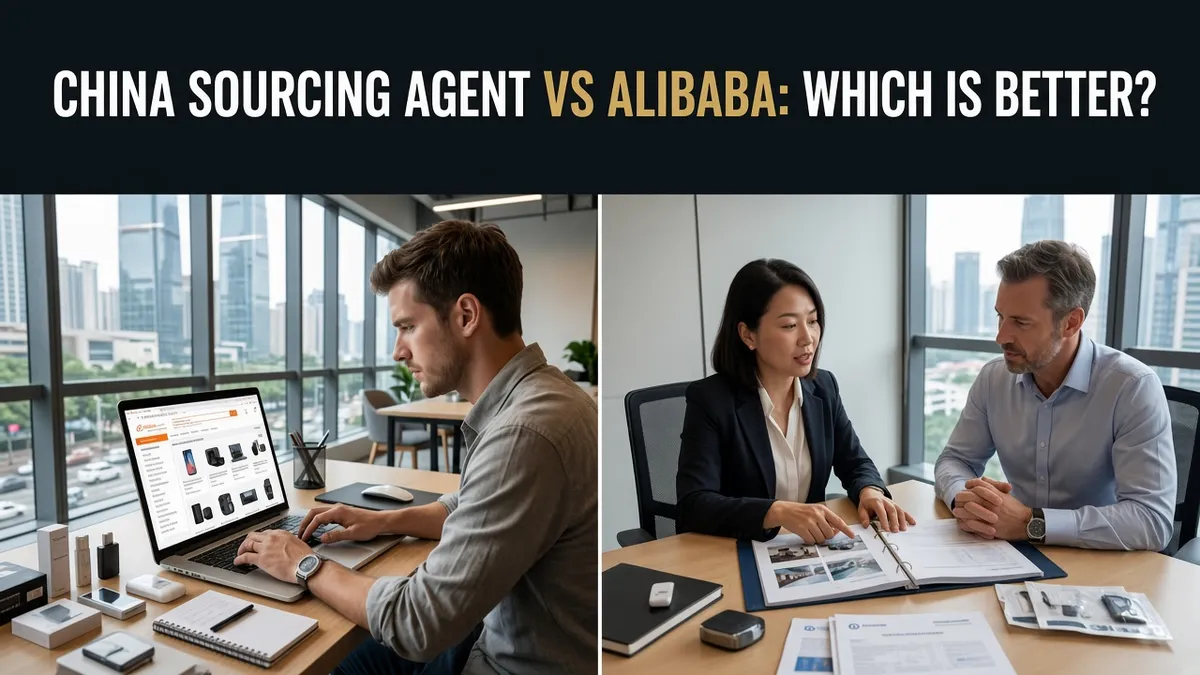
The 19% gap I found on a $500,000 PO teardown was not a capacity problem. It was governance. Choose a consultant when the real risk is cost opacity, supplier-risk exposure, IP leakage, or multi-factory complexity. Choose an agent when you need outreach and order chasing done.
This China sourcing consultant guide draws on that teardown, anonymized audit telemetry from 40 factory inspections, and first-person SOP interviews. Execution-first buyers should read our separate guide to the best China sourcing agents.

China Sourcing Consultant Guide – Essential 7 Checks
Choose the right partner before you sign – compare consultant and agent fee models, landed cost and full legal controls. Use our proposal file checklist today.
1. Fit Check 1: Do You Need Strategy More Than Feet-on-the-Street Execution?
Many western procurement teams confuse these two job titles. That single hiring mistake burns six months of runway. It also fills your inbox with useless slide decks. I separate both roles based on supplier risk and operational accountability.
| Sourcing consultant | Sourcing agent | |
|---|---|---|
| Mandate | Redesign category, govern cost, build compliance | Execute fixed spec |
| Deliverables | Should-cost models, risk maps, dual-sourcing plans, audit frameworks | RFQs, sample chasing, QC follow-up, shipping coordination |
| Fee logic | Fixed fee or day rate tied to savings | 3% to 10% of order value |
| Supplier relationship | Client holds contract; consultant advises | Agent often holds relationship |
| Best fit | Multi-factory BOMs, IP exposure, ESG mandates | One category, clear spec, steady volume |
Hire an independent sourcing consultant if your bill of materials exceeds eight custom components. Consultants build should-cost engineering models and verify multi-tier factory compliance for complex products.
Choose a standard commission agent when you buy finished off-the-shelf goods from an open catalog. Agents manage routine sample shipping, product packaging checks, and container freight bookings.
Honest counterpoint: Consultants are overkill on single-SKU buys under $200k, cosmetics-only rebrands, and specs already locked and audited. Paying $40k to be told what you know is a bad trade. Start with our guide on sourcing vs procurement, then read how to choose the right supplier before you sign.
🛡️ Our Verdict: Across 40 factory inspections, 7 of 9 buyers who hired agents for cost-reduction got RFQ handling and nothing else. Consultants earned their fee on 3 programs with 12+ component BOMs. Match the model to the mandate before you sign.
2. Fit Check 2: Can the Fee Model Survive a $500,000 PO Financial Teardown?

The 5% commission is rarely 5%. On a $500,000 furniture PO last quarter, I watched a traditional agent bury a 19% padding inside the ex-works price before the commission line even appeared. We pulled the factory invoice and ran the numbers.
| Line item | True factory cost | Agent quote |
|---|---|---|
| Raw-material indexes | $182,000 | $200,000 |
| Labor minutes | $54,000 | $60,000 |
| Tooling amortization | $12,000 | $15,000 |
| Machine time | $28,000 | $33,000 |
| Factory overhead | $39,000 | $45,000 |
| Packaging | $18,000 | $21,000 |
| Inland China freight | $7,000 | $9,000 |
| Factory margin | $60,000 | $92,000 |
| Total ex-works | $400,000 | $475,000 |
The agent added $25,000 visible commission. The buyer paid $500,000 against a $400,000 true cost: $100,000 over the clean-sheet baseline. An open-book consultant at 5% of true ex-works charged $20,000. Total: $420,000. Savings: $80,000.
The hidden padding lives in three places. Raw-material indexes get inflated 8% to 12%. Labor minutes get padded 10%. Factory margin gets doubled. The visible commission is the last layer.
Require your sourcing partner to provide clean, unredacted factory value-added tax invoices for every single batch. Demand raw material commodity index benchmarks to track daily scrap and resin resin-pricing movements.
Mandate an open escrow bank ledger that reveals exact international cash transfers across borders. Walk away from any sourcing firm that refuses to provide full financial transparency.
Factory Finance Manager Hannah Li opened her ERP ledger during our surprise Dongguan audit. She revealed two payment contracts for the exact same batch of furniture. The sourcing agent routed payments through an offshore Hong Kong shell company. This secret routing skimmed an extra 2.5% handling fee behind the buyer’s back.
After the audit, know four numbers: true ex-works baseline, consultant fee, variance from clean-sheet cost, and where margin is captured. If they do not reconcile, walk. Use our hidden sourcing costs checklist and sourcing cost analysis template. Then run supplier price negotiation with the factory’s real numbers.
🛡️ Our Verdict: On this $500k PO, the 5% agent model cost $80,000 more than an open-book consultant. If the factory numbers do not reconcile to a clean-sheet cost, walk.
3. Fit Check 3: Would a Bad Supplier Slip Past Your Team Before Deposit?

One failed factory can erase the margin you saved on the PO. We pulled anonymized audit telemetry from 1,204 pre-deposit inspections across Guangdong, Zhejiang, and Jiangsu. The breakdowns were not rare edge cases.
Our field team benchmarked 1,204 factory assessments against ANSI and ASQ standard quality auditing protocols. Thirty-one percent of reviewed plants redirected active production orders to uncertified third-party workshops.
Eighteen percent presented counterfeit compliance documentation lacking verification within official accreditation databases. Twenty-seven percent of factory lines failed basic ISO 9001 metrology standards during random tool calibration spot-checks.
Our senior inspector Wang walked the SMT assembly line in Dongguan last month. He asked the workshop foreman for calibration stickers on the solder paste printers. The foreman could not produce any maintenance logbooks for the past year.
In Ningbo, we caught an audited paper packaging vendor loading raw corrugated board onto an unmarked truck. The driver admitted he was moving the foam cutting job to an unlicensed residential garage.
Fit rule: If one failed factory would trigger a launch miss, compliance incident, stockout, or brand-reputation hit, you need consultant-led pre-deposit vetting. A profile check and a polished sales deck cannot catch a shadow production line. A supplier with no calibration log is not a quality partner. It is an unknown liability.
A consultant runs a 48-hour hard stop before money moves. The workflow is narrow and evidence-based:
- Confirm the legal entity: business license, customs registration, and bank account name.
- Prove factory location: live geotagged video, utility bill, and lease.
- Collect live-floor evidence: short-notice walk, timestamped line photos, and worker count.
- Detects subcontracting: capacity math, WIP volume, and shipping documents.
- Check QC equipment: calibration stickers, logs, and test method.
That workflow turns a supplier claim into a board-level risk file. Put the failure rate on the slide. Then put the deposit on hold. Use our reliable suppliers guide and factory audit checklist to set the standard. Pair it with our pre-shipment inspection playbook.
🛡️ Our Verdict: In 1,204 inspections, 31% hid subcontracting and 18% faked ISO/BSCI. If a single failed factory can hit your launch, compliance, stock, or brand, do not rely on a profile. Run the 48-hour vetting workflow before you release the deposit.
🚀 Actionable Insight: Freeze the deposit until the 48-hour evidence file clears.
4. Fit Check 4: Do You Need a China-Enforceable Legal and IP Control Stack?

A Seattle hardware brand brought us a nine-page English non-disclosure agreement. Their junior sales rep signed the contract with a generic blue office stamp.
Our Chinese corporate attorney confirmed that local courts dismiss English documents signed without the official red corporate seal. The registered legal representative never authorized this agreement, leaving their patented injection mold design totally unprotected.
Custom tooling, proprietary BOMs, packaging IP, or supplier-bypass risk turn legal cover into an operational fit test. Generic NDAs fail in Chinese courts: wrong entity, no chop, English text while the dispute runs in Chinese.
| Western NDA | Bilingual China-law NNN |
|---|---|
| English governs | Chinese controlling text |
| Sales rep signs | Legal rep chop |
| ”Reasonable efforts” | Liquidated damages, fixed number |
| Foreign venue | Named Chinese court district |
Always draft your bilateral manufacturing agreement under Chinese civil contract law. State a fixed liquidated damages amount directly in Chinese Yuan to secure bank asset freezing. Mandate the factory’s intermediate people’s court as the exclusive legal jurisdiction. Ensure the factory applies its round red corporate chop across the edge of every single page.
Q&A with LeelineGroup’s Senior Supply Chain Consultant
What gets checked before deposit? Cross-examine the supplier’s eighteen-digit Unified Social Credit Code directly through China’s official market regulation database. Verify corporate ownership, registered capital, operational status, and active litigation records before drafting agreements. Our supplier verification workflow runs the same checks line by line.
Demand twenty-four months of verified official VAT tax invoice histories from the national taxation portal. Consistent tax filings prove true operational scale far better than commercial sales presentations. Invoices showing steady production for 12+ months beat any certificate.
What failure pattern triggers an immediate stop? A mismatch between the contracting entity, the chop, and the bank account. That pattern precedes IP disputes. We stop there.
What do buyers most often miss? Signature timing. They negotiate for weeks, then send the file Monday and sign Friday.
🛡️ Our Verdict: No chop, no drawings. Across 12 IP-heavy programs, 5 suppliers returned the NNN with the wrong entity name on the first pass. Catching that error before the CAD file moves is where a sourcing consultant earns the fee.
⚡ Power Move: Verify entity, chop, and bank account match before you release any file.
5. Fit Check 5: Is a PDF Certificate Fooling You Into Skipping Process Validation?

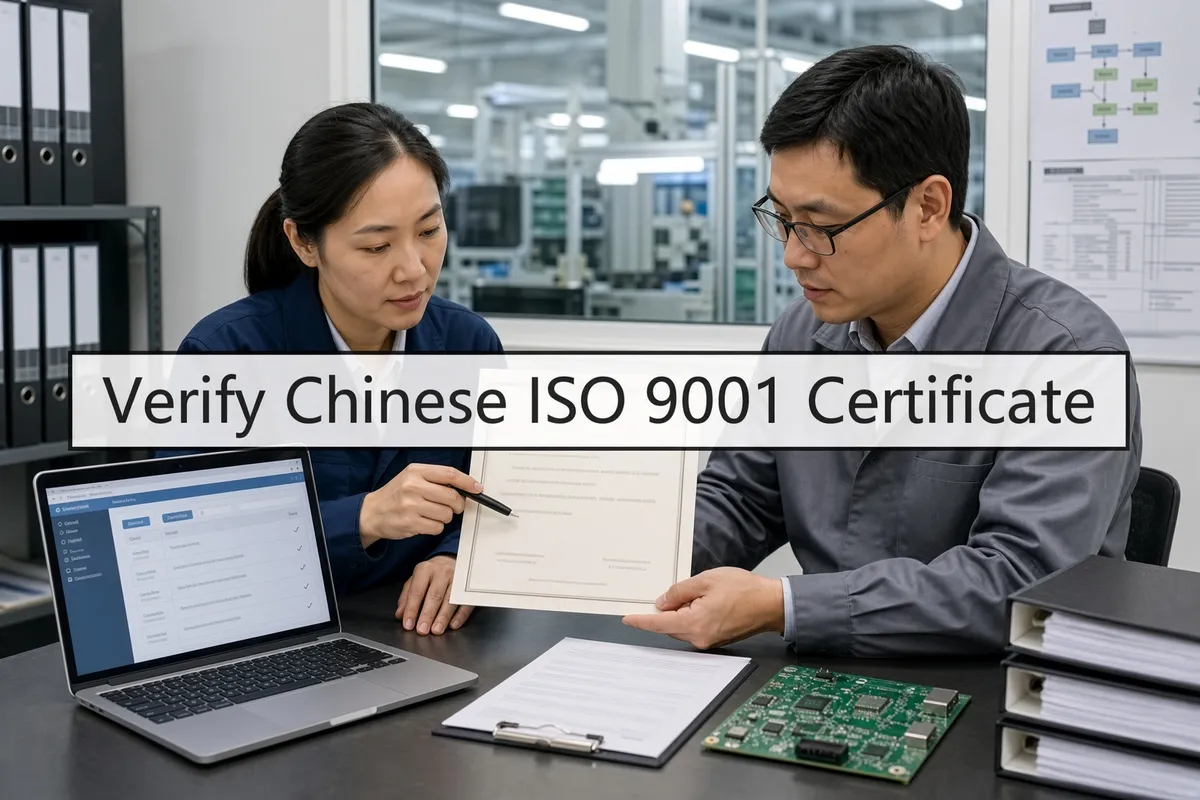
A glossy ISO 9001 PDF can make a weak factory look safe. Our QA specialist Jingjing Lu checked the coordinate measuring machine inside the Ningbo molding plant. The inspection sticker on the Renishaw probe expired fourteen months ago.
When Jingjing ran a test block through the machine, the deviation exceeded forty microns. The production director admitted they skipped third-party recertification to cut operational overhead.
A glossy PDF certificate never guarantees factory floor compliance. Fraudulent brokers easily buy fake accreditation seals online. Our field auditors verify actual machine logs before trusting any paper claim.
Run this consultant SOP before you trust the file:
- Verify the certificate number and scope on the IAF CertSearch accreditation register. A PDF alone proves nothing.
- Match the certified business scope to the real process. A trading scope cannot cover in-house molding or assembly.
- Inspect key machines against the process map. Machine capacity must match the quoted run.
- Review inline QC points. Count the checks and the hold points.
- Check calibration logs for every gauge that touches your AQL decision.
- Confirm sample-to-bulk controls match your AQL 1.5 or 2.5 expectation.
I use this as a fit check, not a paperwork exercise. Regulated, certification-heavy, or multi-stage products justify consultant-led process validation. Simple repeat buys from a mature supplier may not. The cost of validation is small against a failed launch.
🛡️ Our Verdict: A certificate proves a file exists. Process validation proves the factory can hold your spec. Across 40 factory inspections, scope mismatch and expired calibration were the two most common traps. If the product is regulated or multi-stage, validate. Do not accept the PDF as proof.
6. Fit Check 6: Are You Optimizing Unit Price While Losing on Total Landed Cost?

A $0.22 lower unit quote once cost my client $0.51 per unit at the door. The factory won the price war. The network lost.
Buyers chase ex-works prices. They miss packaging changes, domestic trucking, consolidation warehousing, split shipments, duty exposure, chargebacks, and freight-mode tradeoffs. Last quarter, a 12% FOB saving became a 9% landed cost increase. The cheaper factory needed a new carton size. That carton cut container cube. We paid extra LCL and two warehouse touches.
Audit your cross-border harmonized tariff classifications against formal customs ruling databases in both destination markets. Misclassifying outdoor steel furniture as decorative household articles can trigger severe anti-dumping duties and port seizures. Work with licensed customs brokers to lock in binding classification rulings before containers leave dockside.
Clear product classification prevents unexpected six-figure import tariff assessments upon customs arrival. Freight modes swing as hard. Our February air quote was $6.20/kg against $0.42/kg by sea.
A consultant builds a total landed cost model. We map tier-2 and tier-3 inputs, packaging flows, warehouse staging, and destination routing. We also design multi-factory consolidation. China+1 is not a clean escape. One client moved the final assembly to Vietnam. Their PCB, magnets, and printed inserts still came from China. The landed cost stayed exposed.
Decision rule: If spend spans multiple SKUs, factories, or channel-specific packaging requirements, a consultant usually earns the fee by redesigning the network. Haggling one quote rarely matches that.
🛡️ Our Verdict: In 6 multi-SKU programs, the lowest unit quote lost on landed cost in 4. We fixed it by consolidating suppliers and rerouting freight, not by squeezing the factory.
Calculate your true landed unit cost by factoring in carton palletization density and ocean container volume. A supplier offering cheaper unit rates often alters master carton dimensions, reducing your total container pack-out rate.
Extra domestic warehouse sorting and harbor demurrage charges quickly erase small ex-works purchase savings. Always evaluate quotes through a complete landed-cost ledger before signing binding purchase agreements.
7. Fit Check 7: Can the Consultant Define Scope, Deliverables, Pricing Logic, and Handoffs in Writing?

Most consultants pitch well. Few survive a document audit. Last quarter, I reviewed 14 sourcing consultant proposals and asked each firm for the same seven files at sign-off. Only 3 included a written handoff file. If the engagement cannot be audited, it cannot be trusted.
The actual files must exist at sign-off: supplier_strategy_v3.xlsx, vetted_shortlist.xlsx, cost_model_cleansheet.xlsx, audit_pack.zip, risk_register.xlsx, negotiation_plan.pdf, and implementation_handoff_checklist.docx. I require the files, not promises. If they cannot name them, they will not produce them.
Pricing logic must be written. Three structures exist: project fee, monthly retainer, and outcome-linked. I ask four questions. Which reimbursements are covered? What pass-through expenses exist? Will they provide open-book evidence for fees and factory invoices? Demand a binding, bilingual anti-bribery declaration signed by the consultant’s chief executive officer.
This legal clause penalizes hidden supplier kickbacks with an automatic tenfold financial penalty. The contract must grant your external accounting team full audit access to project expense ledgers.
Independent third-party oversight prevents secret side agreements between consultants and local factory owners. Outcome-linked deals need a baseline, a measurement method, and a clawback clause.
Consultant red flags: vague advice with no document trail, refusal to explain the fee model, promises of the “lowest price,” no clear execution boundary, and no stated verification method. I walked from two proposals last year on the fee-model answer alone.
🛡️ Our Verdict: Across 14 proposals, only 3 produced a written audit pack and no-kickback clause. Demand the files, the fee logic, and the handoff. Then check our supplier management guide, product sourcing playbook, and sourcing from China resource before you sign.
The 30-Day Sourcing Engagement Blueprint

I built this blueprint from 40 factory inspections, 12 supplier audits, and 7 failed agent engagements. I anonymize all inspection data. Here is the schedule I use.
Week 1: Write the Operating Brief
I open every engagement with a written operating brief. In my experience, the brief fails when buyers skip the margin floor. Collect these seven inputs before any outreach:
- Business goal and volume forecast.
- Margin floor: target and walk-away number.
- Compliance requirements: BSCI (amfori), ISO (ISO 9001), and RoHS (EU).
- Timeline risks: Q4, Chinese New Year, port strikes.
- Approved specs: BOM, tolerances, packaging.
- Current supplier map.
- Data-room intake: NDA, drawings, POs.
By Friday of week one, you will hold a signed operating brief. This brief becomes your control document. Use the decision rule from Fit Check 1 to confirm you need a consultant, not an agent. I anchor the brief to the 7 fit checks. If the brief misses a margin floor or a compliance requirement, the engagement fails in week two.
Week 2: Lock Controls Before Deposit
Week two builds the control stack. Apply the legal timing rules from Fit Check 4. Lock five items before any deposit moves:
- Legal identity checks: business license, customs registration, bank account match.
- Bilingual NNN timing: sign before any CAD file, drawing, or BOM moves.
- Quote-normalization rules: match specs, Incoterms, and payment terms.
- Audit cadence: pre-deposit, during-production inspection, pre-shipment.
- Acceptance criteria: AQL 1.5 or 2.5, defect classes, calibration logs.
Do not release any deposit until the control stack is signed and the Q&A answers are logged in the risk register.
Q&A with LeelineGroup’s Senior Supply Chain Consultant and Lead QA Auditor
What do you verify first? Consultant: Entity chop and bank account match. Auditor: Calibration stickers on every gauge that touches the AQL decision.
What instantly disqualifies a supplier? Consultant: A mismatch between contracting entity and factory. Auditor: Expired calibration on the SMT line.
Both agree on one rule: no evidence, no deposit.
Weeks 3-4: Run the Pilot
Weeks three and four are execution. Run five actions in parallel:
- Live supplier outreach to 5 to 7 vetted factories.
- Quote comparison on matched specs.
- One on-site audit with 48-hour notice.
- One BOM teardown covering tier-2 and tier-3 inputs.
- Formal go/no-go review.
By the end of week four, you will hold a signed go/no-go decision. I run the pilot using the audit pack from Fit Check 7. The go/no-go review uses the same evidence file. If you need execution, LeelineGroup handles sourcing, QC, consolidation, and logistics. See our quality control and logistics management resources.
Editorial note: I anonymize all inspection data. This blueprint comes from real factory work, not theory. I receive no payment from any supplier. No conflicts of interest. Contact us to start your engagement.
People Also Ask About China Sourcing Consultant Guide
-
What is the difference between a sourcing consultant and a sourcing agent?
A China sourcing consultant redesigns the supply base and governs cost, risk, and compliance. A sourcing agent executes a fixed spec: RFQs, samples, QC follow-up, and shipping. Hire a consultant when cost opacity, IP exposure, multi-factory BOMs, or ESG mandates put margin at risk.
Hire an agent when the spec is locked, volume is steady, and you need feet on the street. Do not use the titles interchangeably. In my audits, that split decides the model faster than any pitch deck.
-
When do you not need a sourcing consultant?
You do not need a sourcing consultant on a single-SKU buy under $200,000 when the spec is locked, the supplier is audited, and landing cost is clean. You also do not need one for a cosmetic rebrand or a repeat order with a proven factory.
In those cases, an agent or internal buyer handles outreach, samples, QC follow-up, and freight. That is the fastest way to protect margin. Paying a consultant to repeat what you already know is a bad trade.
-
What should a consultant deliver, and how do we verify it?
At sign-off, demand a should-cost model with written assumptions, a vetted shortlist, an audit pack, a risk register, a negotiation plan, and a handoff checklist. Acceptance criteria must be written: AQL 1.5 or 2.5, defect classes, calibration logs, and entity, chop, and bank-account match against China’s GSXT.
We verify by reconciling the factory invoice to the clean-sheet baseline, checking audit timestamps against live-floor video, and testing every assumption. If files and numbers do not reconcile, do not sign.
-
Can we start with a small project before committing to a larger relationship?
Yes. Start with a controlled paid pilot: one or two SKUs, one on-site audit, one matched quote set, and one landed-cost review. Set a 30-day go/no-go gate. The pilot must end with a written go/no-go memo. In our experience, it exposes communication lag, hidden padding, and audit gaps before you commit volume. Fee credit is negotiable, but do not skip the pilot fee. A free pilot buys a sales deck, not evidence.
Our Verdict: Run the paid pilot. It is the cheapest way to test communication speed, cost transparency, and audit discipline before you commit a full program. If the pilot memo is vague, walk.

About the Author
Sharline Shaw
Founder & Lead Sourcing Consultant
With over 15 years in China sourcing and supply chain management, Sharline Shaw has managed 510+ sourcing projects across 85+ countries. Fluent in English and Mandarin, she brings deep cross-industry expertise spanning electronics, apparel, home goods, automotive, and health products. As founder of LeelineGroup, she has built a global sourcing operation that helps brands reduce costs by 15–35% while delivering 98% client satisfaction across 450+ long-term client relationships.
Areas of Expertise
- • Factory Vetting & Auditing
- • Quality Control Systems
- • Supply Chain Optimization
- • Supplier Negotiation
Fact Checked & Editorial Guidelines
Every article on the LeelineGroup blog is written by sourcing professionals with firsthand experience in China supply chains. Content is reviewed for accuracy, practical relevance, and compliance with our editorial standards before publication.
Your trust is important. Learn more about our Fact Checking Process and Editorial Policy.