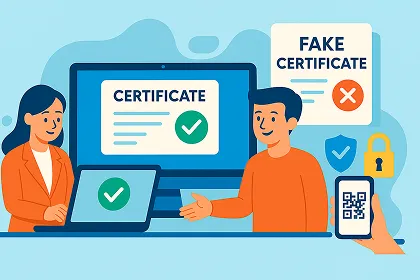
Last month, a polished ISO 9001 PDF looked perfect until the scope line said “trading,” not “manufacturing.” The address fell off. A fake certificate can ruin your entire supply chain. You might lose your initial deposit completely.
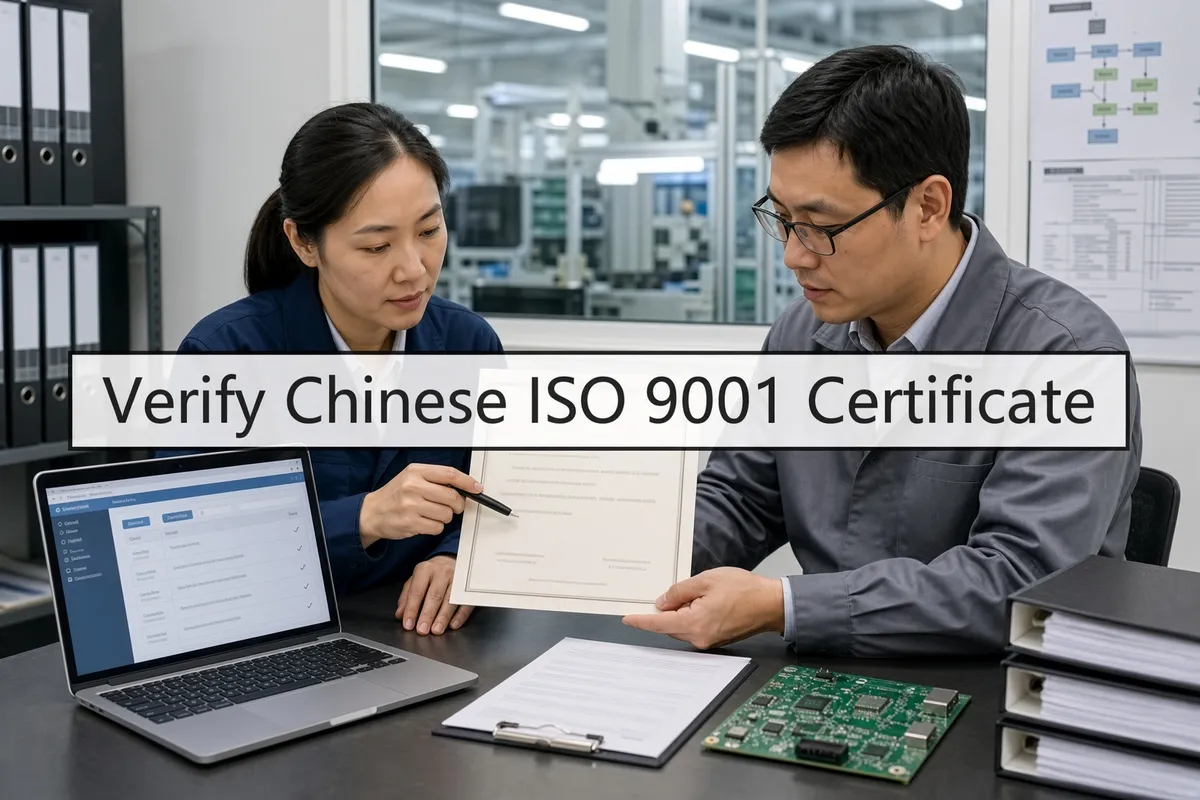
A strict verification process separates a real Chinese ISO 9001 certificate from a fake one — the first filter in our supplier risk management workflow. The checklist below is the exact one we use to protect clients, and every step happens before any money leaves your account. It slots into the wider job of finding reliable suppliers in China.
I do not trust the PDF. I check the certificate, China-side national path, certification body, and international record. CNCA’s official hub lists the national platform (cnca.gov.cn). IAF CertSearch is the global accredited-certificate check (iafcertsearch.org).
Our sourcing team audits factories across China every year. We developed this rapid verification system for procurement directors. You can run the same supplier verification in about fifteen minutes. We teach you how to check the national database. Our method exposes fake documents before you book audits.
Key Takeaways
Six checks decide whether a Chinese ISO 9001 certificate is real, correctly scoped, and safe to pay against.
- Verify the paper before you search any database. Check nine fields: certificate number, legal organization name, standard and edition, registered address, scope, issue date, expiry date, issuing body, and accreditation mark.
- Reject a scope that names no production verb. “Manufacture”, “process”, or “assemble” supports your purchase order; “trading”, “sales”, “warehousing”, or “office administration” does not, even on an active certificate.
- Match the three legal names before any deposit. The certificate holder, the business license holder, and the entity receiving your payment must be the same company.
- Confirm the record on the CNCA national platform. Search by certificate number first, then by the exact Chinese legal name. Translate the status words, never the scope.
- Check the issuer and the international record. The certification body must appear in the CNAS directory with management-system accreditation, and the same certificate must resolve as active in IAF CertSearch.
- Treat a clean record as one gate, not a quality guarantee. A valid ISO 9001 certificate still requires a factory audit, in-line QC, and a pre-shipment inspection before the balance payment.
Prerequisites

I pulled this checklist from our recent Shenzhen supplier files. Missing paperwork delayed more deposits than bad certificates.
Time needed: 10 minutes to collect, 15 minutes to check.
Pull these before Step 1:
- Full certificate PDF or scan, plus Chinese and English versions if both exist
- Supplier legal name in Chinese, and unified social credit code if available
- Covered factory address exactly as printed
- Issuing certification body, certificate number, issue date, expiry date, and QR code if present
- Any supplier audit report on file
You must verify nine specific fields on every certificate. Start with the certificate number and the legal organization name. Then check the standard designation and edition (for example, ISO 9001:2015), the registered address, and the exact operational scope. Confirm the issue date and the expiry date. Finally, authenticate the certification body and the accreditation mark.
Sensory check: Compare English and Chinese fonts. Soft-edged logos mean redrawn art. Read the scope aloud. “Trading,” “sales,” or “office administration” means stop.
⚠️ Warning: Do not accept an ISO logo, Alibaba badge, or translated sales deck as proof. We see these weekly. None is a certificate. The patterns are catalogued in our guide to spotting fake certifications.
This verifies management-system certification status only. It never confirms product conformity, lab testing, or actual batch quality. Treat it as a gate before PO approval, deposit release, or supplier onboarding.
Step 1: Freeze the Legal Entity, Then Request the Full Certificate Pack

Do not start with a search. Start with the paper. In our last 12 supplier files, three sent cropped screenshots. Two sent 72-dpi scans. One sent an English-only copy when I asked for the Chinese original. That friction is normal.
Ask for the full certificate pack. Request the complete PDF or scan, both Chinese and English versions, and the supplier’s business license. Reject any thumbnail in chat. Then capture the legal Chinese company name exactly as printed on the certificate. Compare it with the business license name and the entity receiving payment. All three must match.
⚠️ Experience Warning: A certificate can belong to a related entity, a trading arm, or another site. Only the address printed on the certificate is covered by the audit; any other site is unverified. That is a stop signal.
If the supplier resists: Request a live screen-share of the certificate record from the issuer portal. Do not accept another screenshot.
🧠 Author’s Take: I treat the name match as a deposit gate. If the payment entity differs from the certificate holder, I pause and ask for a written legal explanation.
Step 2: Split the Certificate and Copy the Fields
Split the certificate into two data halves. Supplier identity: legal name, factory address, scope. Certification-body data: certificate number, standard, dates, issuing body, accreditation mark. Copy every field exactly. Do not paraphrase.
In those files, altered PDFs looked too clean. No scan grain. Perfect logo edges. The risky details hid in the scope line, address block, and accreditation mark.
| Field | What to copy | Why it matters |
|---|---|---|
| Legal name | Chinese name as printed | Must match license and payment entity |
| Address | Full covered site | Flags trading offices |
| Scope line | Full wording and verbs | Highest-value procurement field |
| Certificate number and dates | Number, issue date, expiry date | Used in official checks; stale dates fail |
| Accreditation mark | Mark and body name | Cloned marks are common |
The scope line decides the certificate’s value. “Manufacture of bags” differs from “trading of bags” or “sales of consumer goods.” If the verb is not production, stop.
- Date logic: A beautiful PDF is not current proof. Copy both dates. Compare them to today. Expired or future-dated certificates fail.
Check your work: You have two matching data sets. The scope says manufacture or production. The dates are current. The accreditation mark and issuing body are copied exactly. If a field is missing, request the full certificate again.
Next: Once the fields are extracted, move to the official China-side search path.
Step 3: Run the National CNCA Status Check (认e云)

The Chinese public portal is part of our daily routine. Its interface looks very basic. Search using the exact Chinese legal company name; English names return zero results. That lesson came from a real factory audit.
Start on the official CNCA 互联网+服务 page. In our session, the entry sat under business systems, not the main menu. Click the 全国认证认可信息公共服务平台(认e云) entry. Do not hunt by screen position.
Paste the certificate number into the certificate-number field. If the number fails, switch to organization-name search. Paste the legal Chinese name from Step 1. Do not use the English name.
Read status in Chinese. Translate in-line: 有效 = active/valid. 暂停 = suspended. 注销 = cancelled/terminated. 撤销 = revoked/withdrawn.
⚠️ Experience Warning: “No record” is not proof of a fake. Move to the issuer portal, CNAS, and IAF CertSearch first.
If the platform will not load, do not bypass it. Ask a China-based teammate, the supplier on live-share, or the certification body portal to confirm the same record. Document that fallback.
🧠 Author’s Take: I treat a plain 有效 result as one green flag, not a pass. The scope still decides.
Step 4: Verify the Issuing Certification Body Through CNAS

A logo on the PDF proves nothing. In our last audit batch, one supplier showed a clean ISO mark. The issuer did not appear in CNAS. That failed the check in under two minutes.
Follow the hierarchy: supplier certificate → issuing certification body → accreditation body. First, copy the issuer name from the certificate. Next, open the CNAS Find an Accredited Body directory. Search for that exact name. Then confirm the issuer holds accreditation for the certificate category.
Use this micro-checklist:
- The issuer name matches the certificate exactly.
- Accreditation scope/category covers management-system certification.
- Issuer’s own free public certificate-validity query exists and returns the record. CNCA guidance now expects this public-facing capability (cnca.gov.cn).
Never trust a supplier who makes excuses; that is one of the supplier red flags we see most often. Scammers often claim you can only check the CNCA platform. Official rules require certification bodies to provide independent search tools. You must find a live record on the issuer website. A simple PDF logo proves absolutely nothing. A live issuer record resolves to a recognized body. A PDF logo does not.
Validation: The issuer appears in CNAS. The scope matches. The issuer portal returns the certificate.
🧠 Author’s Take: I treat a missing issuer portal as a yellow flag. I ask for a live screen-share before I release any deposit.
Step 5: Cross-Check the Certificate in IAF CertSearch

After the China-side check, add the international layer. In our tests, IAF CertSearch turned a dead-end PDF into a live record. This global database reassures overseas procurement teams.
Open the global IAF CertSearch database. Type the exact certificate number into the search bar. The number format sometimes causes a search error, so switch to a company name search if nothing returns. Use the registered Chinese legal company name, never the English translation.
On the result page, confirm status, scope, issuing certification body, accreditation body, and last update/live data. You will see a live record. The certificate resolves to a real entry, not a static file.
Read the status field. IAF results can show active, suspended, withdrawn, or expired. A match is not a pass. Suspended or withdrawn stops the process.
⚠️ Experience Warning: One supplier’s certificate number resolved to a withdrawn record in IAF CertSearch. The PDF looked current. That mismatch killed the deal.
Not every legitimate certificate surfaces cleanly. Use this as a cross-check, not the only test, alongside our sourcing from China playbook and the product sourcing checks we run before a PO.
🧠 Author’s Take: I treat a clean IAF record as the international green light. But I still read the scope line. A live record with “sales” in scope still fails.
Step 6: Match Scope, Address, and Production Reality
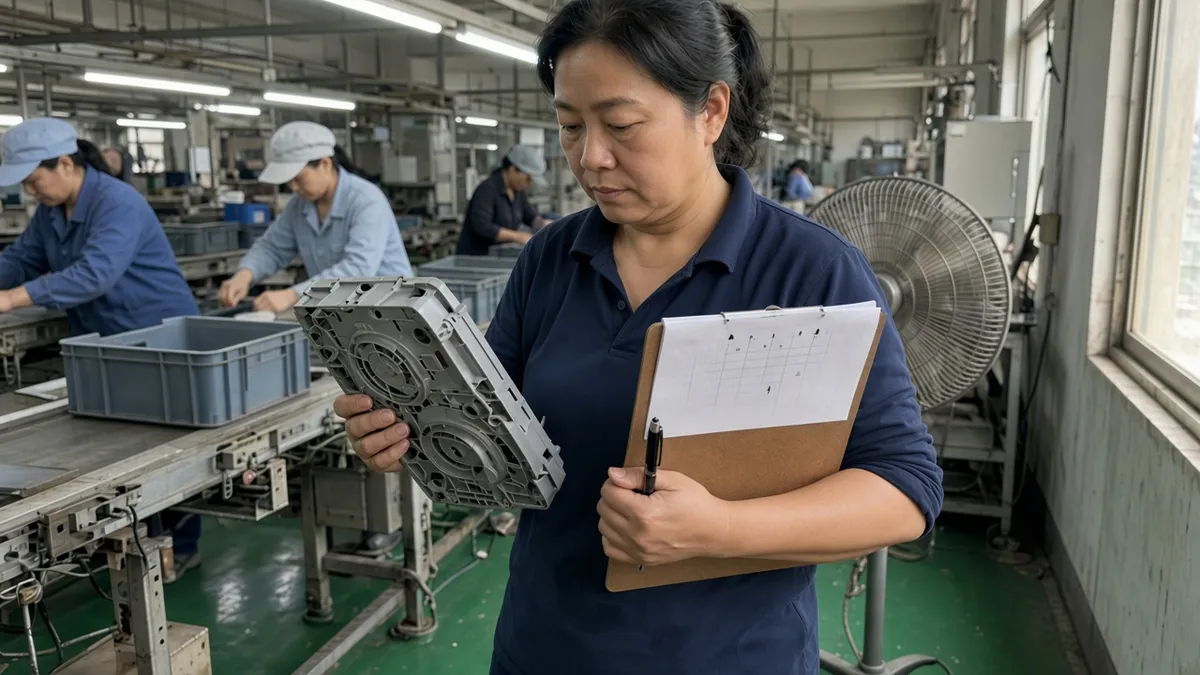
Lay three documents side by side: the certificate scope, the covered address, and the PO production activity. In our last 12 supplier files, this comparison caught two certificates that passed every database check. Both listed “sales and service.” Both suppliers quoted custom manufacturing.
Compare the certificate scope directly with your purchase order. The scope text must include a specific production verb. Look for words like manufacture, assemble, or process. You must reject certificates that only list sales or warehousing. The document must prove active manufacturing controls. The address must look like a plant, not a sales office.
Sensory check: On a live video call, ask the supplier to walk from reception to the line. I watch for an incoming inspection bench, in-line check sheets, and calibration stickers. If the camera stays in a showroom, stop.
Supplier Quality Manager Steven Wang told me the most advanced forgery is a cloned CNAS mark with one edited scope word.
Bridge from certificate to audit evidence. Request the latest ISO audit report or surveillance summary. Ask for incoming QC records, in-line checks, CAPA logs, calibration logs, and process-traceability records. Match the dates and product family to your PO. Then tighten the quality control methods on the line, work through the factory audit checklist before deposit, and book a pre-shipment inspection before the balance payment.
Escalation trigger: Check scope, address, legal entity, and production reality. If they do not line up, move from desk verification to an on-site factory audit. Do this before releasing the deposit.
⚠️ Experience Warning: A clean certificate database record still fails when the scope and floor activity do not match your order.
Troubleshooting

No CNCA result
A blank CNCA result usually means a search mismatch, not a fake. I see this most when buyers search for the English invoice name. Retry with the Chinese legal company name from the business license. Then check the issuer portal and IAF CertSearch. In my experience, “no record” is a pause signal, not a verdict.
Suspended, cancelled, or revoked status
The record appears, and your stomach drops. Stop treating that certificate as valid supplier evidence. Read the Chinese status: 暂停 = suspended, 注销 = cancelled, 撤销 = revoked. Ask for the current replacement certificate plus a written explanation. If the supplier cannot produce both, hold the PO and deposit.
Name or address mismatch
The translated name does not match the Chinese legal name. Or the address is one floor off. A translation can differ; a legal entity shift is different. Request the business license, a related-entity explanation, and proof the certified site is the manufacturing site tied to your PO. Match the payment entity too.
A supplier sent us a valid ISO certificate. We checked the address block carefully. The certificate listed a downtown sales office. The actual factory operated 40 kilometers away. We rejected the supplier instantly. Never accept a certificate for a trading office.
Active certificate, non-manufacturing scope
The record is active, but the scope says “trading of goods” or “office administration.” This is the biggest failure point. Scope manipulation is more dangerous than a crude fake because it often survives a casual desk check. Do not treat an ISO certificate as manufacturing risk control. Escalate to a factory audit before deposit.
🛡️ Prevention: Save the Chinese legal name, scope wording, and status result in your supplier file. Re-check at every PO; certificates lapse quietly.
Buyer reality: A good sample or polished PDF does not prove batch-level execution. If the order matters, verify the system and inspect the factory before balance payment.
Escalate through supplier management and the factory audit checklist before your next PO.
People Also Ask About Verify Chinese ISO 9001 Certificate
-
Does an ISO 9001 certificate prove my product is good?
No. An ISO certificate never guarantees product quality. The document only proves the factory has a management system. We treat the certificate as a basic entry requirement. You must still inspect every batch before the final payment.
On one 12,000-unit order, the factory held an active, correctly scoped certificate and still shipped a 2.8% defect rate. Our pre-shipment inspection caught it. Plan the inspection to the AQL 1.5 or 2.5 standard alongside the paperwork.
-
Can I trust the ISO 9001 badge on Alibaba or a PDF sent in chat?
No. Badges and chat thumbnails are marketing files, not evidence. Ask for the full certificate pack: the complete PDF, the Chinese original, the English version, and the business license.
Then confirm three names match: the certificate holder, the license holder, and the entity receiving your payment. Suppliers routinely send cropped screenshots in chat. I reject those and ask for the source file.
-
How do I check a Chinese ISO 9001 certificate if I don’t read Chinese?
Copy the certificate number and paste it into the national CNCA platform (cnca.gov.cn). Translate the labels only, never the scope line. Read the status characters: 有效 is valid, 暂停 is suspended, 注销 is cancelled, 撤销 is revoked. If the number fails, search for the legal Chinese name instead. Then confirm the same record in IAF CertSearch. Most “no record” results are typing errors, not fakes.
-
The certificate is active, but the scope says “sales” or “trading.” Is that a fail?
Yes. Stop there. The scope line must name your product family and a production verb such as manufacture, process, or assemble. Active status only proves a record exists. A trading scope on a manufacturing PO usually means the real production controls sit at a different site. Escalate to a factory audit before you release any deposit.
Author’s Take: Status answers whether a record exists. It does not answer whether the record covers your product.
-
Do I still need a factory audit if every desk check passes?
Yes, unless your order is small and repeatable. A desk check confirms a record exists. It does not confirm the line follows it. I still book an on-site audit, request the latest ISO audit report, and review calibration and CAPA logs. For live orders, I add a video walk from receiving to packing. If the camera stays in the showroom, book the audit.
Final Thoughts
A Chinese ISO 9001 certificate becomes procurement-usable only when the paper, the CNCA record, the issuer path, the IAF record, the scope, the address, and the factory floor all agree. We built this process from real supplier files and the mismatches we found inside them.
Your next step is not another PDF. Move the supplier into the full qualification flow: business-license verification, a factory audit, quality-control planning, and shipment inspection. Read our guide to how to import from China and the difference between sourcing vs procurement before you book, and plan shipping from China once production clears.
Want a second pair of eyes before you release the deposit? Contact our team and we will run the same nine-field check on your supplier file.
Disclosure: we are not paid by certification bodies or manufacturers to validate these findings.

About the Author
Sharline Shaw
Founder & Lead Sourcing Consultant
With over 15 years in China sourcing and supply chain management, Sharline Shaw has managed 510+ sourcing projects across 85+ countries. Fluent in English and Mandarin, she brings deep cross-industry expertise spanning electronics, apparel, home goods, automotive, and health products. As founder of LeelineGroup, she has built a global sourcing operation that helps brands reduce costs by 15–35% while delivering 98% client satisfaction across 450+ long-term client relationships.
Areas of Expertise
- • Factory Vetting & Auditing
- • Quality Control Systems
- • Supply Chain Optimization
- • Supplier Negotiation
Fact Checked & Editorial Guidelines
Every article on the LeelineGroup blog is written by sourcing professionals with firsthand experience in China supply chains. Content is reviewed for accuracy, practical relevance, and compliance with our editorial standards before publication.
Your trust is important. Learn more about our Fact Checking Process and Editorial Policy.